When GRAMMY.com first interviewed pianist, composer, arranger, educator, and bandleader Steven Feifke in 2021, he stressed the cruciality of creating open spaces for his accompanists to blossom.
"I hope my music has an intimate feel, allowing the members of the band's individual personalities to shine and fitting that into the large-ensemble textural plane," Feifke said back then.
Upon receiving a golden gramophone for Best Large Jazz Ensemble Album at the 2023 GRAMMYs — for his co-led big-band album with trumpeter Bijon Watson, Generation Gap Jazz Orchestra — Feifke hasn't let a wisp of egotism cloud his creative vision. Even despite the fact that, at 31, he's the youngest-ever bandleader to win a GRAMMY in that storied category.
"I always just want to make sure that I'm elevating someone else's thing and adding to it in such a way that it doesn't take away from that person's craft," he tells GRAMMY.com in 2023. "There are times to allow the music to be what it's going to be, and there are times to understand the vision and then allow the music to be what it's going to be."
This applies whether he's arranging and orchestrating for another artist — like acclaimed vocalist Veronica Swift, on This Bitter Earth — or for his own small, yet rapidly expanding, discography. Feifke's willingness to foster a capacious environment for those around him remains his personal stamp.
"He is a student of big-band composers and writers, and big-band leaders, and bands of the past. But he puts his own fresh spin on things," Watson, who also won his first-ever GRAMMY for Generation Gap Jazz Orchestra, tells GRAMMY.com.
As per Feifke's egolessness on the bandstand? "That's definitely a great way to describe it," Watson adds. "Almost to a fault. Because he is an amazing piano player… I think his playing is definitely underrated."
To mark Feifke's big win and GRAMMY landmark in the Best Large Jazz Ensemble category, he has shared "This Promised Land," the debut single from his upcoming big-band album, Catalyst, out June 16 via La Reserve and Bandstand Presents.
"'The Promised Land' is a reference to the land of Israel," Feifke shared in a statement. "Israel is the meeting place for so many intersecting faiths, cultures, and ideas. It’s seen millennia of conflict, but also millennia of progress, innovation, and change.
"This piece acknowledges the many perspectives around Israel through angular rhythms," he continued, "and a simple melodic mode that transforms in as many different ways as possible."
Concurrently, GRAMMY.com asked Feifke to hand-pick 11 past tracks — whether his compositions, arrangements, or both — that he feels sums up his still-young career. (And for the tunes on Generation Gap Jazz Orchestra, Watson spoke his piece as well.)
These quotes have been edited for clarity.
"Evidence"
From 2015's Peace in Time, composed by Thelonious Monk, arranged by Steven Feifke
Feifke: I love the tune, and I love Monk and his music. I was introduced to Monk in high school by my teacher there, Jeffrey Leonard. He did this really cool thing where there was a four-year cycle in the jazz program.
Every year that I was there, I was in one of the ensembles at Lexington High School. The first year I got to school, it was Duke Ellington, and then we did Miles Davis, and then we did John Coltrane, and then we did Thelonious Monk. That's a four-year cycle, basically, where you study and play the music of those people throughout the year in the jazz classes.
Where I went to high school, it's a public school, but the jazz program is pretty solid. All of this stuff is for credit and all that. He took it seriously as a professor, so I took it seriously as a student. I think that's how I hope I teach now as a professor at Berklee.
That's when I first got into Monk's music. I wrote this arrangement, however, as part of my audition to the Thelonious Monk competition in 2011. I was 19 at the time, and I was shocked to get into it, but very grateful nonetheless.
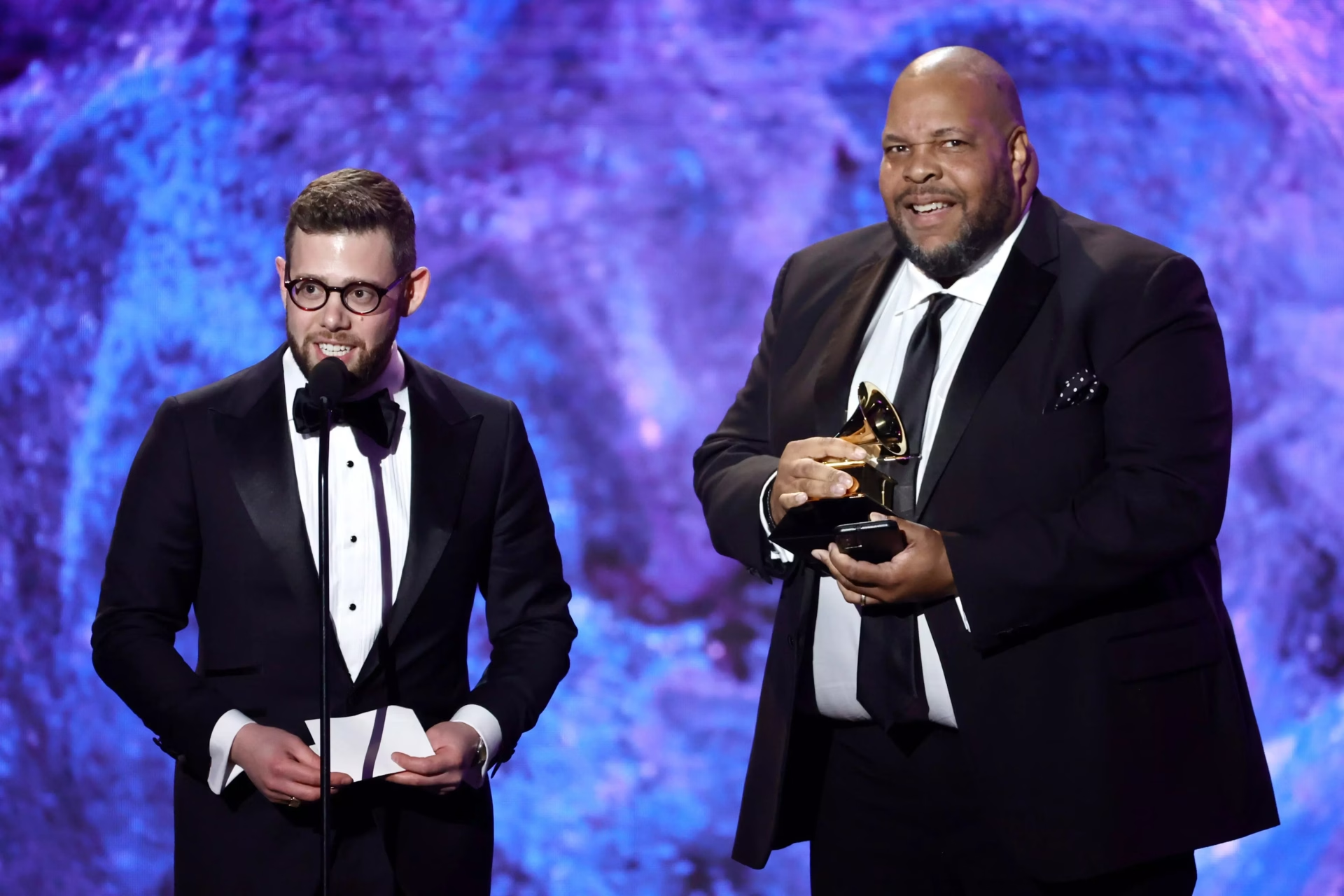
*Steven Feifke and Bijon Watson accepting their GRAMMY for Best Large Jazz Ensemble Album. Photo: Frazer Harrison/Getty Images*
I remember meeting Herbie [Hancock]. I have this extremely derpy picture of me and Herbie where I'm just smiling ear to ear, just being like: This is Herbie Hancock! Herbie is just one of my absolute favorite artists of all time. Not just piano composition or arranging. Dude, come on. It's freaking Herbie. It was awesome. Also, I was so young — so much younger than a lot of the other guys who were there.
[Composer and pianist] Kris Bowers won that year. This is back in the days of MySpace Music, and I used to go to Kris's MySpace page and he had a song up there called "Hope." It was a beautiful piano trio plus string orchestra composition that he had written. He played it at the competition.
I was basically meeting so many of the people who I looked up to artistically. That's what role the arrangement played in my life. I liked what I'd written, I guess, and I expanded it for the septet. It's just my take on Monk's piece.
When I recorded my first album, Peace in Time, I featured this as the opening track to feature two of my best friends, [saxophonist] Andrew Gould and [trumpeter and vocalist] Benny Benack III, who are both still members of my big band today.
"Caravan"
From 2019's Prologue, comp. Juan Tizol, arr. Feifke
Feifke: [This standard] was recorded shortly after our Peace in Time recording session. I wrote it to feature Chad [LB]. He's ridiculously killing, and this [arrangement] is written around his virtuosity as a tenor saxophonist.
I was always really inspired by the Dave Grusin arrangement of "Something's Coming" that featured [saxophonist] Michael Brecker — while this is a totally different song and arrangement. I was really deep into Duke's music at the time. I think I spent an entire year — almost a year and a half — only listening to Duke Ellington.
Ironically, this song was composed by [trombonist and composer] Juan Tizol, but with that said, this is such a staple of the Duke Ellington songbook. I just wanted to do my own arrangement of it with Jimmy Macbride on drums, Nick Dunston on bass, and Chad on tenor saxophone.
Chad just takes this whole arrangement and runs with it. When I first sat down to write this, I immediately heard Chad's voice on it. But when we got into the studio, he just lit it up and took it to a whole other level that I couldn't possibly have imagined.
He truly is one of the great saxophonists of our generation, and it was an honor to feature him on this.
"This Bitter Earth"
From Veronica Swift's This Bitter Earth, 2021, comp. Dinah Washington, arr. Feifke
Feifke: I don't think my approach changed more for [working with Veronica] than it does for anything. My hope is just that when I'm arranging or orchestrating music for someone — even if it's for my record featuring somebody — whether it's [vocalist] Kurt [Elling] on "Until" or whomever on whatever.
I always just want to make sure that I'm elevating someone else's thing and adding to it in such a way that it doesn't take away from that person's craft. Whether that's the macro version of the craft — the vision for the overall album — or the micro version of the craft, which would be, in my opinion, being able to express themselves musically on top of whatever I've written.
I'm trying to stay out of Veronica's way, but also nudge here and pull there — support over here, surround there. Veronica had such a clear vision for this album before she even went into the studio. We were hanging out quite a bit before that record came out, and she shared some of her vision with me, and shared that this was going to be the opening track.
I immediately knew: Oh, wow, this is the direction of the record, because most opening tracks are a little more loud, and this is loud in a quiet way. I don't know if that makes sense. She's like, "Come here, step into my world for a second, and my world is 'This Bitter Earth.'"
Orchestrationally, that helped. But the approach is not different, I think. There are times to allow the music to be what it's going to be, and there are times to understand the vision and then allow the music to be what it's going to be. This was the latter.
"Singing In The Rain"
comp. Freed / Brown, arr. Feifke for "The Masked Singer" on FOX feat. Katherine McFee and David Foster, 2021
Feifke: While not strictly on an album, some of the works I arrange, orchestrate and compose happen to be for television and film media.
I used to intern for a company called JinglePunks in my senior year at NYU. I got to write some music for some pretty cool shows like Jerry Seinfeld's "Comedians in Cars Getting Coffee."
This arrangement though is pretty cool. I was also able to highlight some of the sounds of the studio orchestra that reminded me of Nelson Riddle and Johnny Mandel — two of my absolute favorite arrangers/orchestrators of all time.
And speaking of composer/arranger/orchestrators, I am a huge David Foster fan. He has worked with literally everybody, and all of the music he has created and shared throughout his career is absolutely killing. And Katherine McFee? Come on. She is one of the greatest vocalists of all time, in my opinion. Getting to write for her was really special.
"Kinetic"
From 2021's Kinetic, comp. Steven Feifke
Feifke: This track is special to me, because it's the title track off of what I like to call my "second first record." In 2015, I released Peace in Time. I had a septet. That used to be my thing; I didn't have a big band or a trio yet. When I released [my first big-band album] Kinetic, I just had a better picture of my career and where I wanted to be going.
I've released simultaneously in a very spontaneous and focused way since Kinetic, because I feel like I'm more in touch with myself as a person — as a human being first, and then second, as an artist.
With Peace in Time, I look back on it and realize how much I still had to learn. How much I still have to learn now and always. Even with things like the mix, for example. I was super happy with the recording process, but I feel like on Kinetic, I got a second first chance.
[On the title track] I featured [drummer] Ulysses Owens, Jr., who has been something of a mentor figure to me over the years. He has had me arrange music for several of his albums, and featured me as the pianist on his record "Falling Forward" alongside [bassist] Reuben Rogers, [vibraphonist] Joel Ross and [vocalist] Vuyo Sotashe.
[Ulysses] really brought it on this track. It wouldn't have been the same without him. Not to mention — he is the drummer on Generation Gap!
"The Sphinx"
From 2021's Kinetic, comp. Steven Feifke
Feifke: I wrote this song during my second year of my masters program at Manhattan School of Music under the tutelage of the great Jim McNeely and Mike Holober.
While I was in school, I was juggling a lot of outside writing and touring projects, and I wound up only having about 36 hours to write this entire piece. Originally it was written for a studio orchestra, but when I recorded Kinetic, I reorchestrated it for a big band. It features Lucas Pino on the tenor saxophone.
Part of the reason I chose to go to Manhattan School of Music was that at the end of every semester, you got to have one of your pieces performed by a studio orchestra.
That's extremely rare: a full-sized orchestra complete with everything that you could possibly imagine — a full brass section, a full string section, full percussion. There's no other program that really does that, anywhere in the world, to my understanding.

*Steven Feifke. Photo: Anna Yatskevich*
During this semester, I was swamped with commissions and traveling as well. I got back, and I basically had 36 hours at the piano, and I stayed up for 36 hours. I wrote this piece from start to finish, from zero notes written down to all the notes written down.
We played it, and it was pretty stream-of-consciousness. I approached the composition in a pretty specific way as a result, because I wanted a major leaning — almost an Arabian Nights mode to start in D major.
Then, to talk about the theory a little bit, I tonicized the key of D major for the first almost two thirds of the piece, and then it uses the relative minor of D major — B minor — to exude a little bit of a darker texture and flavor and ultimately use a plagal cadence to modulate into F# major to the end. Hence the name "The Sphinx." Compositionally, very little of the song changed from the studio-orchestra version to the big band.
Whatever your tool or color palette is, I think it's important to bring it out in the best light possible as an orchestrator. I think that's the orchestrator's job. In the process of shifting the orchestration, a big band is still a huge band. It's a lot of people. I didn't feel like I lost anything when I moved over. I just had to work to find some of the color combinations a little bit.
"Wollongong"
from 2021's Kinetic, comp. Steven Feifke
Feifke: Two of the most important roles in a big band are the drums and the lead alto saxophone, and I'm lucky that these two guys — [drummer] Bryan Carter and [saxophonist] Andrew Gould — have such an incredible hookup.
This song is inspired by the ocean — Wollongong Beach in Australia — and the two of them really demonstrate the power of the ocean on this track.
Those two guys are such powerhouses of music and human spirit that they often play supporting roles to bring my music to life. This song was a chance to just let them loose and let them be water in one way, shape or form.
They are also featured heavily on the title track of my forthcoming big-band album, Catalyst. Stay tuned.
"Sunrise in Harlem"
From 2022's The Role Of The Rhythm Section, comp. Feifke
Feifke: I began writing this in 2018, and I continue to work on it always. The version on The Role of the Rhythm Section is just where it is for now.
This track speaks to a few things: In NYC, you can go out, hear your first show at 8 pm, then go out for a late dinner, falafel, taco truck — whatever it is. Then, go out and hear a second show, go out for a drink with a friend before you wind up at the Dizzy's or Smalls jam session, and then by the time you come home, the sun is rising.
Some of my best memories are of nights like that, filled with music the whole night through, and coming back to my apartment in Harlem and being the only one awake as the sun is rising.
The other sense is that the title is an allusion to the Harlem Renaissance. "Sunrise in Harlem" speaks to all of my heroes who at one point or another lived in New York. Bud Powell and Thelonious Monk being two of the grandfathers of bebop. Benny Golson, Herbie Hancock… the list goes on and on. And it's my small way of paying tribute to them.
"I've Got Algorithm"
From 2022's Generation Gap Jazz Orchestra, comp. Steven Feifke
Feifke: This is my play on Gershwin's "I've Got Rhythm." A little on the nose, but… [Laughs]
Bijon Watson: As collaborators, we were putting together what the album would look like, and we wanted to cover a lot of ground in terms of styles of music we wanted to play. We knew we wanted to do blues, do rhythm changes, do something contemporary, do something that featured the strength of the players and the band [as well as] these different styles.
Feifke: Bijon and I talked a lot about who else to feature on this track, seeing as it opens our Generation Gap Jazz Orchestra album.
Without Chad LB on this track, it just isn't the same. Chad has been one of my closest musical collaborators since we met as students at the Stanford Summer Jazz Institute in 2009.
We chose to feature Mike Rodriguez on the trumpet. Mike is one of my favorite trumpet players of all time. The first time I ever got to play with Mike was on a concert with the NYU Jazz Orchestra. I was a student; he was a professor.
I remember sitting behind the piano just saying to myself: Wow, wow, wow, after every single line. Having him on the Generation Gap Jazz Orchestra album was something special.
Watson: We wanted to do a traditional Ellington- or Basie-style tenor-battle type of thing.
Feifke: That's a rhythm-changes chart without a good old-fashioned tenor battle? We were lucky enough to have [saxophonists] Roxy Coss and Tom Luer in our section, and they both brought the fire here for real.
Bijon and I have often spoken about our mutual respect for the incredible John Clayton. When I was growing up and checking out big band music for the first time, I was listening to a lot of Clayton and Hamilton — of course, featuring Bijon on lead trumpet — and I certainly borrowed a lot of techniques and colors from Maestro Clayton on this one.
"Until (Matter Of Moments)"
From 2022's Generation Gap Jazz Orchestra, comp. Sting, arr. Feifke, feat. Kurt Elling
Feifke: [Vocalist] Kurt Elling is featured on this track. In fact, he requested we do it on the album.
Watson: Steven and I are both huge fans of Kurt Elling.
Feifke: I'd be lying if I said I wasn't a little starstruck during our first "collab call."
Watson: The way he approaches albums when he [appears on them], he doesn't hold back. It's whatever he's feeling, whether it's the SuperBlue project he has now, or the way he takes pop tunes and makes them his own from a jazz standpoint. Or the American Songbook — the way he can put his own stamp on it.
Feifke: The arrangement is customized to fit Kurt's voice. Because of the timbre of his sound, I was able to access higher frequencies in the ensemble such as flutes and trumpets in mutes, and flutes and flugels as countermelodies to Kurt's singing.
The ending of this track is probably my favorite part. The way Kurt built the stacked vocals — that wasn't arranged. He just did it. So incredibly special. It truly speaks to the kind of artist Kurt is that he heard that and just went for it.
"Remember Me"
From 2022's Generation Gap Jazz Orchestra, comp. Robert Lopez and Kristen Anderson-Lopez for Coco, 2017
Feifke: Bijon is known for his incredible lead trumpet playing on records with the Clayton-Hamilton Jazz Orchestra, Diana Krall, Natalie Cole, Michael Bublé, and many others. Chances are, if you've listened to any of those artists, you've heard the incredible trumpet stylings of Mr. Watson.
When we set out to start Generation Gap Jazz Orchestra, Bijon told me, "Don't shy away from the pyrotechnics, brother!" Which I didn't. I took full advantage of Bijon's seemingly limitless lead-trumpet capabilities. But the time came for a ballad on the record, and I asked Bijon if he liked the song "Remember Me" from Coco so we could show off the sensitive side of Bijon Watson.
Will Brahm is also featured prominently on guitar, providing beautiful accompaniment on the duo intro and an incredible solo later on in the track. While Bijon is filling the solo-chair role, Tanya Darby effortlessly steps in on lead trumpet for this track.
The resulting track is one of my favorites on the Generation Gap Jazz Orchestra record. It truly shows off Bijon in a light that, as a fan of his, I humbly hope he takes more readily in the years to come.
The History Of Yellowjackets In 10 Songs: A Gateway To The Jazz Fusion Greats