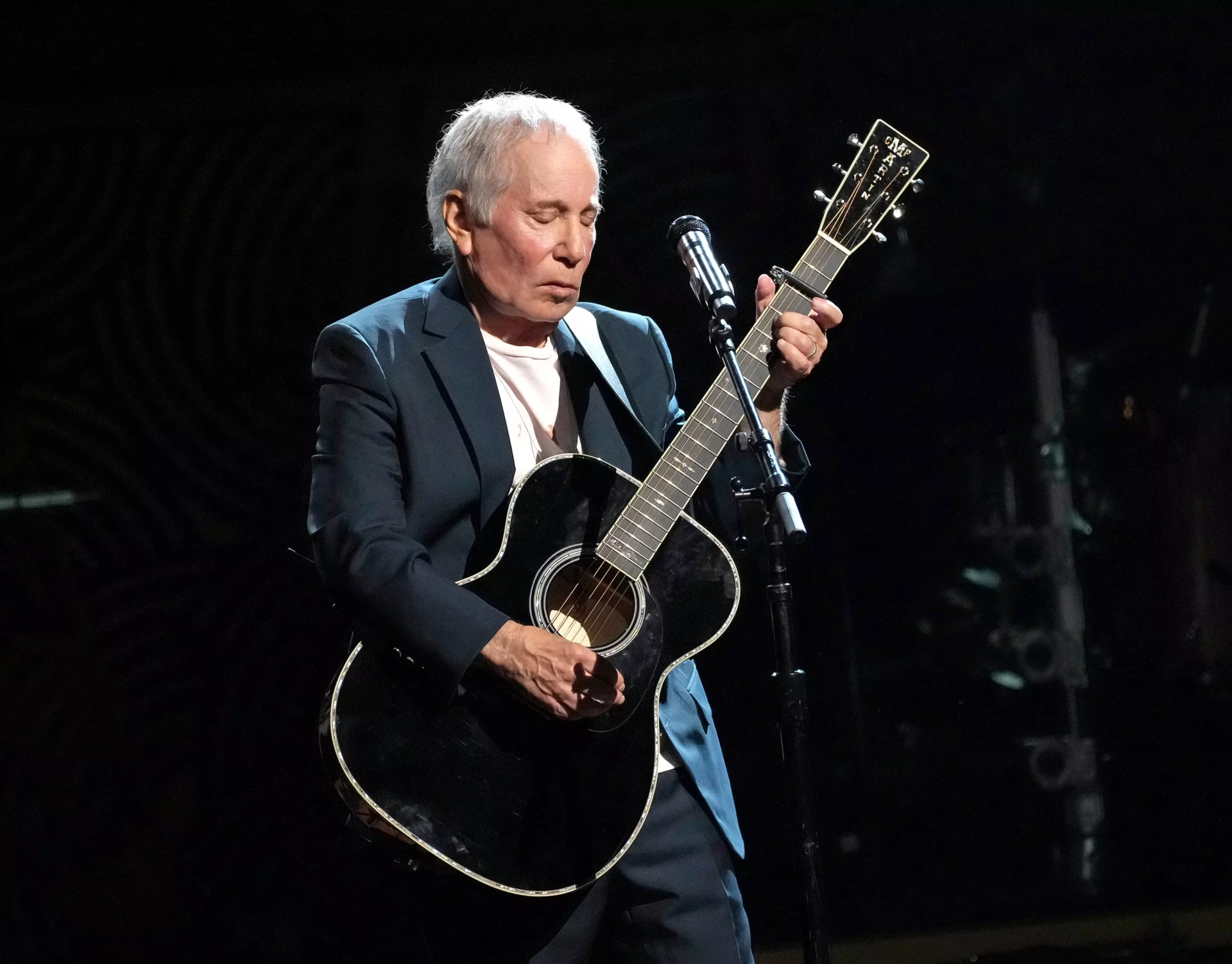
A psalm is a sacred song or hymn — especially one among King David's famous compendium in the Bible. Devotional music is obviously still around in different forms, but the ancient word is still on musician's tongues. Last year, Nick Cave and Warren Ellis released an album called Seven Psalms. And Paul Simon just revealed seven of his own.
Also called Seven Psalms, Simon's new album is out May 19, and it's a stunner. A 33-minute, all-acoustic, seven-song cycle meant to be listened to as one contiguous whole, it's one of the most intimate works the 16-time GRAMMY winner has ever crafted. That's saying something, given he put himself on the map with the pindrop "The Sound of Silence" nearly 60 years ago.
Seven Psalms is a work of heavy-duty spirituality; while it doesn't necessarily have a "confessional" nature, the listener will absorb reams of information about the state of Simon's artistry and psychology.
As you absorb this potent work from front to back, read on for a few things Seven Psalms reveals about Simon.
A Higher Power Is On His Mind
"The Lord is my engineer/ The Lord is the earth I ride on/ The Lord is the face in the atmosphere/The path I slip and I slide on," Simon sings in opening movement "The Lord" — a verse that becomes a motif throughout Seven Psalms.
But Simon isn't evangelical on the album; far be it from him to take a myopic view of anything in song. "Slip" and "slide" are the operative words here; Simon goes on to cast God as "the Covid virus," "the ocean rising," "a terrible, swift sword," "a puff of smoke" and "my personal joke."
Thus, the duality of religious belief permeates Seven Psalms — just as it did in "Questions for the Angels," "Old" and any number of other awe-inspiring songs about faith in his past.
"Dip your hand in heaven's waters," Simon sings in "Your Forgiveness," fully aware of the multitude of shades that concept encompasses.
His Guitar Skills Remain Undimmed
Occasionally, Simon barely touches his acoustic guitar during concerts, especially when his band is choogling away behind him. But he remains one of the greatest of his generation, and Seven Psalms displays that practically every second.
Simon played most of the instruments on Seven Psalms, including various bells and gongs, as well as far-flung instruments like gamelan and gobichand. But, naturally, it's the greatest treat to hear him stretch out on the acoustic guitar.
Harmonically, melodically and rhythmically, Simon's grace and facility on his instrument is second to none on Seven Psalms — and that's before he even gets to the words.
He's Still Very Funny
As psychologically and spiritually freighted as Simon's music can be, it's hard to remember a single song where he sounds ponderous. His razor-sharp sense of humor is a big part of that.
Simon’s one-liner game has always been strong; to hear "You Can Call Me Al" is to chuckle at least a little bit at the "roly-poly little bat-faced girl" line. (Ditto the opening line of "Kodachrome," which almost singlehandedly forged this author's opinion of the K-12 system.)
Third movement "My Professional Opinion" carries the lion's share of Seven Psalms' humor, from the opening verse: "Good morning Mr. Indignation/ Looks like you haven't slept all night/ In my professional opinion/ Go back to bed and turn off your light."
From there, Simon — or his character — continues to dispense unsolicited advice on everything — including the barnyard body politik. "I heard two cows in a conversation/ One called the other one a name," he sings. "In my professional opinion/ All cows in the country must bear the blame."
At the conclusion of "My Professional Opinion," Simon gets down to brass tacks and evokes Christ. "All that really matters/ Is the one who became us." (Sure.) "Anointed and gamed us." (Wait, gamed us?) "With his opinions." (Ba-dum-tsh.)
Edie Brickell Remains Indispensable To His Art
Simon's wife, Edie Brickell, is a GRAMMY winner in her own right who rose to prominence in the 1980s with her band, Edie Brickell & New Bohemians. The couple met in 1988 on the set of "Saturday Night Live" and married in 1992.
Since then, Brickell appeared on Simon's fantastic 2011 album So Beautiful or So What; his song "In the Garden of Edie," from 2016's Stranger to Stranger, is a tribute to her. She's also appeared onstage with him; during lockdown, they posted a video of themselves performing a luminous duet of the Everly Brothers' "I Wonder if I Care As Much."
During closing tracks "The Sacred Harp" and "Wait," Brickell appears and intertwines her voice with her husband's, right up to the final line: "Amen."
Simon May Not Tour Anymore, But He Remains A Force
Back in 2018, Simon announced his retirement. Sort of. Citing mental exhaustion, he booked one final tour — but didn't rule out occasional performances.
"I don't intend for it to be my last performance," he told CNN of the hometown show — in Queens — that wrapped up his farewell tour. "I'd like to do it for my own pleasure, in concert halls that have prestige sound and with perhaps different musicians that I admire, and play a repertoire that is different from what I've been playing." (Getting finicky about the details of concerts that haven't even been booked — classic Simon.)
Simon's still getting out there and playing — including at the "Homeward Bound: A GRAMMY Salute To Paul Simon" tribute last year. But more than that, the 81-year-old is still actively evolving and challenging himself.
"All of life's abundance in a drop of condensation," Simon sings midway through Seven Psalms, in "Your Forgiveness." That sums up Simon's art in microcosm: a three-minute song can leave you commensurately awestruck, puzzled, heartsick and laughing out loud.
As the craft of songwriting goes, that's just as high as you can climb — and on Seven Psalms, Simon waves to us from the summit.
15 Essential Tracks By Paul Simon: In A Burst Of Glory, Sound Becomes A Song