Updated Saturday, March 18, 2023, to include information about the "A GRAMMY Salute To The Beach Boys" tribute special.
The Recording Academy and CBS are honoring the Beach Boys with "A GRAMMY Salute To The Beach Boys," a star-studded, two-hour tribute special featuring a lineup of heavy hitters, including John Legend, Brandi Carlile, Beck, Fall Out Boy, Mumford & Sons, LeAnn Rimes, St. Vincent, Weezer, and many more, who will perform all your favorite Beach Boys classics. Learn more about "A GRAMMY Salute To The Beach Boys" and watch the tribute special on Sunday, April 9, from 8 – 10 p.m. ET/PT on the CBS Television Network and live and on demand on Paramount+.
Hindsight might be 20/20, but still: the fact we ever let strangers from 50 years ago dictate our understanding of music history cost us dearly. Case in point: the Beach Boys.
Through the lens of the critical aggregate, the story of America's Band goes something like this: Their imperial phase crescendoed with 1966's Pet Sounds: that album earned five stars across the board, while satellite albums like 1965's Today! and 1967's Wild Honey hover around four.
Which, fair. But here's where it gets strange.
If we're to take the critics at face value, 1971's Surf's Up is just about the final Beach Boys album worth hearing at all. (Their almost outsider-music-strange 1977 fluke The Beach Boys Love You and their polished 2012 reunion album That's Why God Made the Radio are the exceptions that prove the rule.)
A full 10 post-Pet Sounds albums generally earned lukewarm to flat-out scathing reviews. Some of them might be your bag; some might not be. But here's the implication: the Beach Boys' downfall began with 1972's Carl and the Passions — "So Tough" and 1973's Holland. (The Rolling Stone Album Guide gave both two stars, which tracks with the rest.)
Half a century on, it's difficult to listen to either in good faith and believe that to be true. Because whether or not you dig these tunes as much as their early hits and mid-'60s masterworks, the songwriting, performances and production are at a high caliber that's borderline inarguable. This isn't the Beach Boys at a low ebb. It's the Beach Boys at the top of their game.
A new boxed set out Dec. 2 provides just the portal to reexamine these albums — or hear them for the very first time. Containing both remastered albums and a litany of alternate takes and live tracks, Sail On Sailor - 1972 recontextualizes both Holland and Carl and the Passions not as creative drop-offs, but proof they maintained the flame longer than many thought.
The punchy, mid-fi Carl and the Passions — “So Tough” is a sampler platter of eight diverse personalities. (Bruce Johnston, who joined in 1965, had temporarily left the band at this point.) "He Come Down" is an inspired gospel pastiche; "Marcella" is one of their most radiant and infectious rockers; the mystical, intoxicating "All This is That" is like a realm unto itself.
At the top of 1973, they released the mellow, thoughtful Holland. Also featuring South African additions Blondie Chaplin and Ricky Fataar, the album may somewhat hinge on two uptempo R&B tracks, "Sail on Sailor" and "Funky Pretty." But it's a top-to-bottom marvel, from the elliptical "Steamboat" to the California Saga suite to Mount Vernon and Fairway (A Fairy Tale), its fantastical bonus EP composed by Brian Wilson.
"There are some great songs on that record," Brian Wilson wrote of Holland in his 2016 memoir. "'Steamboat' kicks ass. I really like 'Only With You' and 'Funky Pretty,' too. It's a damn good record no matter where or how we made it."
That same year, Mike Love dismissed Carl and the Passions in his own memoir, calling it "a disjointed rush job, hastily assembled between live gigs… More than anything, the album emphasized how confused we were about our brand."
But Elton John heard it differently.
"This is an album which I have loved for a long time," John gushed in the liner notes for the album's 2000 reissue. "This album is a step away from Pet Sounds, but still has moments of breathtaking genius and experimentation. When this record was released, I remember how different and fresh it sounded. It still does."
Together, the eclectic, driving Carl and the Passions and misty, faraway Holland act as two sides of the same coin. They are twin portals into the Beach Boys during the pivotal year of 1972, and can also reset fans' understandings of their creative vitality throughout that entire decade.
"It's the culmination of the [album-oriented rock] Beach Boys," says Howie Edelson, the creative consultant to the Beach Boys' Brother Records who played a major role in assembling Sail On Sailor. "They needed a lot of help to be pushed up the hill to become AOR. Because, as you know, Sunflower is this aural delight. But it ain't FM!"
"I'll put Holland alongside any Crosby-Nash album, or any Neil Young, or any Stills, or any Jackson Browne album." Edelson continues to GRAMMY.com. "They're all emanating from the same vibe and process."
But before we understand why the world didn't see it that way, it's worth examining the conditions that led to Carl and the Passions — "So Tough" and Holland.
Igniting A Flame
This era of the Beach Boys is partly defined by two ace South African musicians who had joined their ranks: guitarist Blondie Chaplin and drummer Ricky Fataar.
Carl Wilson had found the pair via their band the Flame; enthused, he asked them to join his band. With original member Dennis Wilson in front of the stage rather than behind the kit due to a serious hand injury, Chaplin and Fataar gave the once-innocent, striped-linen act propulsion and brawn.
"The members they brought on board are from South Africa during apartheid," Jerry Schilling, who managed the Beach Boys in the '70s and '80s and manages them again today, tells GRAMMY.com. "I think that's beautiful. I think that's what music does."
This new formulation of the Beach Boys hit the road hard, in a staggering live run that would crescendo in 1974 — when their Endless Summer compilation rocketed them back into the zeitgeist. "They didn't spend that much time off the road," Edelson says; for a dynamic example of their live prowess during this time, check out their full Carnegie Hall performance from Thanksgiving 1972, featured on Sail On Sailor.
"We can play harder rock than we've ever been able to before with Blondie and Ricky," Mike Love reported at the time, according to the Sail On Sailor liner notes. "Brian is still writing for the group; this is being fused with the new element of creativity within the group from the other fellas. Dennis is into strings and orchestrations; he wants to do classical things."
This quote speaks to the teeming, multifarious nature of the Beach Boys at the time. "It's like three different bands," Edelson observes. "I always think of them as an organization or conglomerate rather than a group."
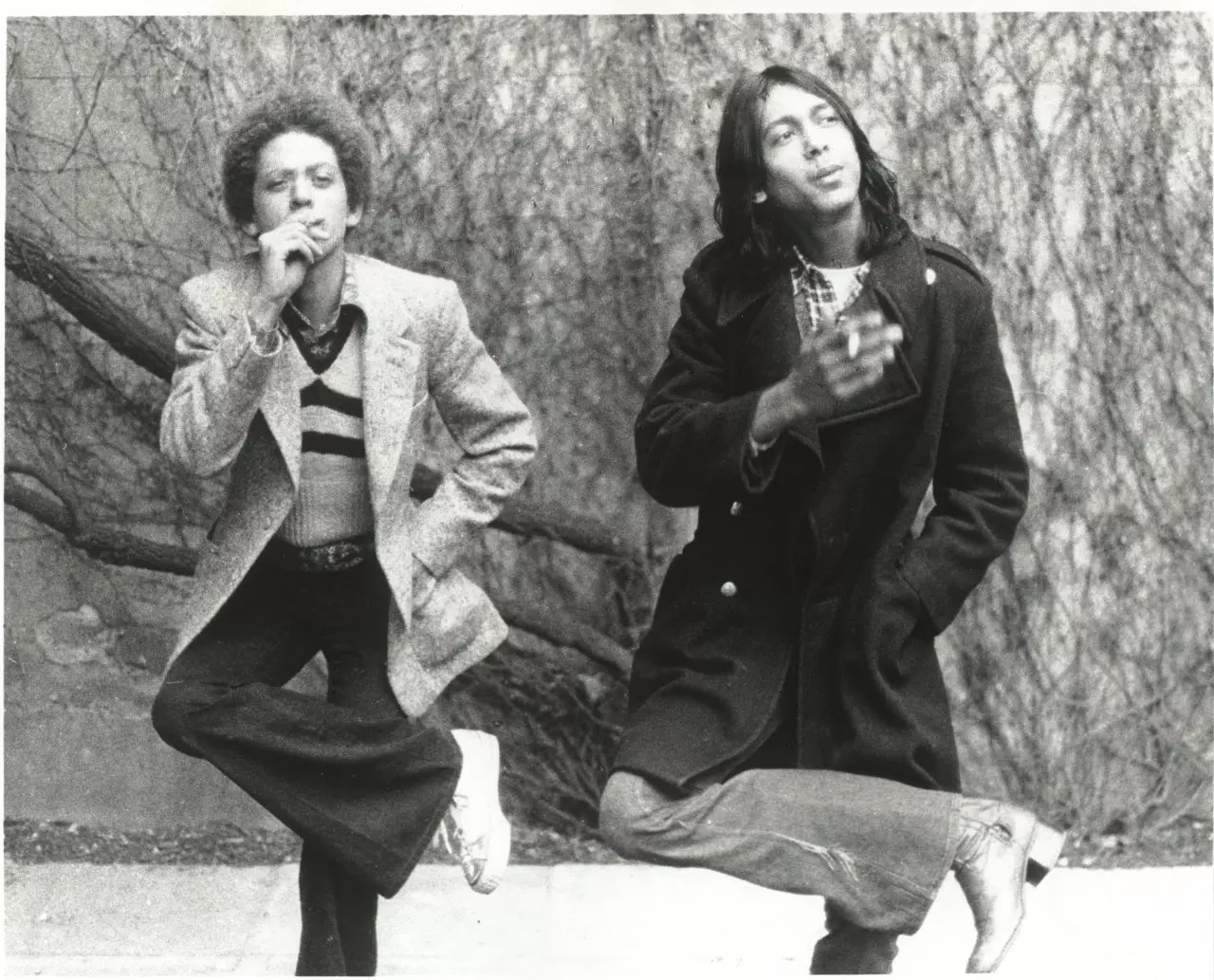
*Blondie Chaplin and Ricky Fataar. Photo courtesy of the artist.*
Although Brian Wilson was and is a once-in-a-generation phenom, this "organization" thrived even when he was in the backseat, as a non-proactive member.
"I would say that Brian Wilson — after six years of writing, arranging, performing, producing, playing and singing — downshifted," Edelson says. The music he made was more personal, with less of a frantic need to compete on the Billboard Hot 100.
"He might not have been competitive, but he was just holding his work to another standard," he continues. "There was no product or filler. Everything he created during this period was absolutely authentic. If he didn't end up finishing it, it stayed unfinished."
"We know that Brian Wilson is a genius, and it tells me that a genius like Brian was able to delegate," Schilling says. "He let the band show their talents as well, which is quite amazing."
The various chemical reactions within the expanded band made for startlingly variable music, from the oddly Band-sounding "Hold On Dear Brother" to the luxurious strings of "Cuddle Up" and beyond.
"The band was disjointed, recorded across random studios separate from each other," marvels Joshua Henry, who produces the rediscovered cult singer-songwriter Bill Fay. "Which makes the brilliant moments even more amazing."
This could have led to a behemoth triple album, like George Harrison's All Things Must Pass two years prior. "I thought that Carl and the Passions should have been three separate albums," Carl Wilson later reflected. "I wish that Brian had been strong enough to produce the record, because it could have been an ass-kicking, great record."
In the end, the band had to stuff all of their multitudes into 35 minutes — and instead of a feast, fans got an appetizer plate. "It's a pu pu platter. And a pu pu platter can be a meal, but it's a pretty weird f—ing meal," Edelson quips. "It's like, 'Did you eat?' 'Yeah, I ate, but I didn't really have a meal.'
"And that's the downfall of Carl and the Passions," he says. "It feels as though it's a taster for several large meals that don't come."
A No-Confidence Vote
What else contributed to Carl and the Passions being a flop in the marketplace? For one, the title was confusing to consumers — a tip of the hat to Carl Wilson's leadership, and a casually assembled pre-Beach Boys band. Whatever the motivation, it was released as something of a bonus disc to their masterpiece.
"It did not just come out as Carl and the Passions. You got Carl and the Passions — which didn't even say 'Beach Boys' on it — and Pet Sounds as a double LP," Beach Boys archivist Alan Boyd explains to GRAMMY.com.
As Boyd explains, a settlement with Capitol Records meant the band temporarily retained the rights to their post-1965 albums, so Warner/Reprise released Carl and the Passions as a bundle with Pet Sounds.
"The bright idea was every time they put a new Beach Boys album out, they attached one of the old ones from the late '60s that people didn't get to buy because Capitol didn't promote it or whatever," Boyd says. Mark Linett, who co-produced Sail On Sailor, characterizes it as "the confusion of these two completely disparate records that have no connection."
Edelson posits that Carl and the Passions' release only six months after Surf's Up made it slip through the cracks, and that second disc of live tracks — a la The Byrds' sprawling 1970 album (Untitled) — "would've probably pushed the album into a more positive space."
"I think the artists may have been ahead of the record companies," Schilling admits.
Leaving This Town
For Carl and the Passions' follow-up, the Beach Boys and their pivotal new manager, Jack Reiley, decided to decamp to the Netherlands for a change of scenery. But it wasn't that simple: each member and his family, as well as their staff, had to relocate to a different continent. On top of that, they dismantled and shipped their entire studio.
"Oh, the cost was tremendous," Brian Wilson later recalled, as per the Sail On Sailor liner notes. "I mean, the equipment in the first place cost $190,000 to build. . . it's an elaborate system. But the shipping costs, too, were tremendous to bring back." (Getting the increasingly fragile Brian to commit to the move was a Sisyphean ordeal on its own.)
Given their new, bucolic climes, Carl Wilson predicted they'd make music that would "breathe the atmosphere of this country — peaceful and relaxed."
And it does, sort of. Due to any number of factors associated with being so far from home, Holland swirls with a darker energy — even when it peps up for highlights like the hard-rocking, Chaplin-sung title track, "The Trader" (sung and especially beloved by Carl Wilson) and "California Saga: California."
"It seems like we were writing and singing about a California we were remembering," Brian Wilson wrote in his memoir, "but the truth is we were writing about a California we were imagining."
In the second section of "California Saga," "The Beaks of Eagles," Love recites a moody, primeval poem written by Al Jardine and his first wife, Lynda, based on Robinson Jeffers' poem of the same name.
"Lenin has lived and Jehovah died/ While the mother-eagle hunts the same hills, crying the same beautiful and lonely cry," he intones. And "Only With You" is a stunning piano ballad sung by Carl Wilson, suffused with melancholy and longing.
The 10-minute, six-section bonus EP Mount Vernon and Fairway — named after the location of Mike Love's childhood home in Baldwin Hills — was a burst of invention increasingly uncommon for Wilson at the time. And it bears the influence of Randy Newman's Sail Away, which Wilson clung to like an emotional life raft at the time.
"He's so far away from home. He's in Holland. He's scared and slipping away. He turned 30, and he didn't wear 30 well," Edelson says. And while Sail Away is full of dry, mordant character studies, Edelson thinks Wilson connected more to the Stephen Foster- or George Gershwin-style orchestration, and its portrait of American life — however satirical.
"It was this little piece of this unsophisticated, plain America," he says. "He didn't see all the things that we also saw. He just heard home, and he was a guy who needed home badly on every level."
Wresting The Waters
Although it earned stronger critical marks than Carl and the Passions (Rolling Stone hailed its “occasionally unnerving simplicity of viewpoint as at its frequently ornate perfection), Holland didn’t exactly rocket them back to 1964 fame.
This was despite an ad campaign that quizzically trumpeted a return to fun in the sun: "Holland is the best Beach Boys album in years," it read. "No qualification to that statement — this is music which captures the first freshness of those summer-y surfing days."
One reason why the album didn't do well, Edelson opines, comes down to the visual aspect of both. "The Beach Boys never had great cover art, in an era where you needed to have great cover art," he says, adding drolly: "I mean, Holland is brown. And the other one is just red."
Despite landing a modest FM hit in "Sail On, Sailor" — Holland was basically subsumed in the marketplace the following year by Endless Summer.
"They were the biggest band of '74 without a new album out. It wasn't like they were touring Holland; they were just touring," Edelson says. He evokes the Fab Four's bestselling 1973 greatest-hits compilations: "They could have topped Holland. But it's like the Beatles had gotten back together in '76 and had to top the Red and Blue albums."
Following the Endless Summer surge in interest and popularity was the infamous "Brian's Back!" period. Despite the rapid evolution of the band even with Brian Wilson absent or half-engaged, they hung their destiny on their once-driven leader. Then came the jukebox-like covers album 15 Big Ones, and the strange and handmade Love You.
"They believed, perhaps incorrectly, that by 'going back,' they would be able to finally move forward — e.g. Brian as the taskmasker 'hit machine,' which simply didn't exist anymore. It didn't even exist in 1968 let alone 1976," Edelson says.
"Despite the fantastic publicity and sold-out arenas," he adds, "that creative misstep caused them to lose important FM traction."
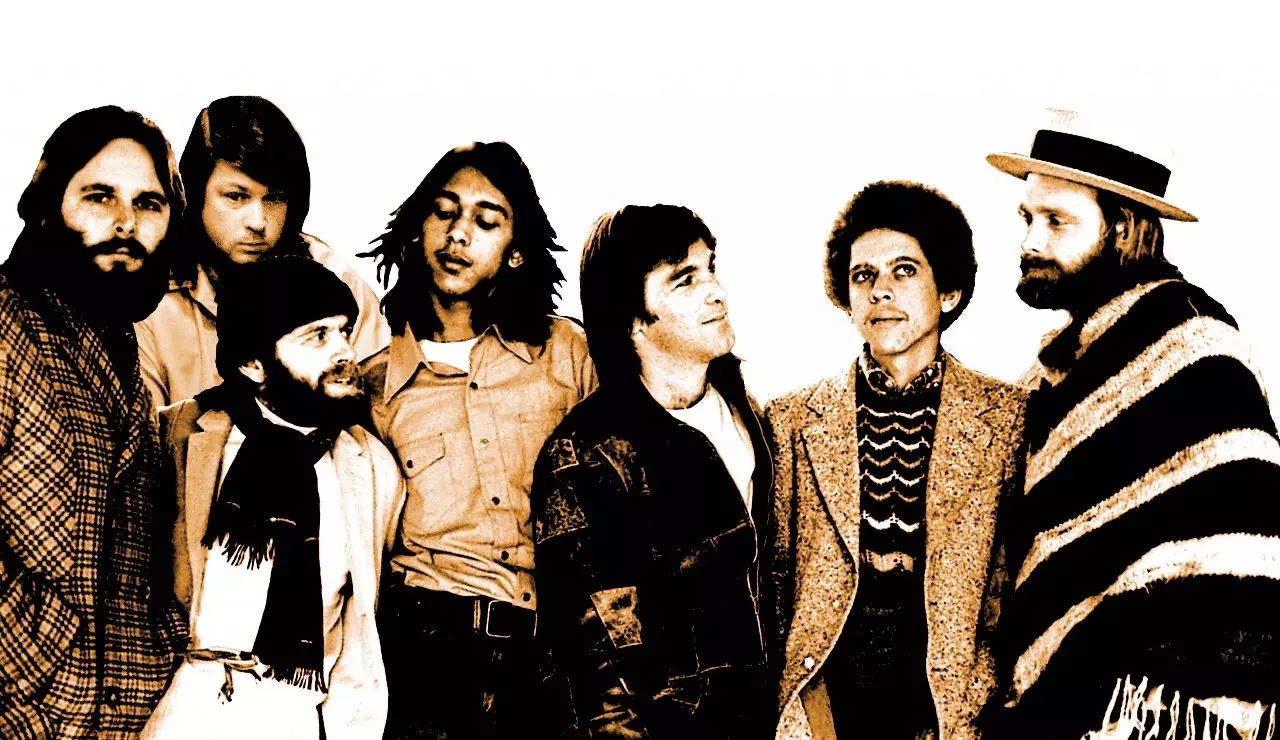
*The Beach Boys in 1972. Photo courtesy of the artist.*
The Beach Boys eventually split into competing and often warring touring factions, commanding what Linett calls "mutual, divergent and, at times, completely incompatible fanbases." The rest is history; today, Mike Love's Beach Boys and Brian Wilson's solo band soldier on in separate markets.
But to get a handle on this heretofore misunderstood chapter in the Book of Beach Boys, a line from Carl and the Passions' benediction "He Come Down" springs to mind.
"Hey-yon-du-coma-nauga-ton means 'Avoid the suffering before it comes,'" Love sings, evoking Sanskrit. "Krishna said a long time ago: 'To let the arrow fly, first pull back the bow.'"
"In other words, you can meditate and dissolve stress within, and have enough effect on the environment to change your trajectory just enough to where there's no terrible collision that's going to screw you up, or your family, or society," Love explained to Edelson during a recent GRAMMY Museum event.
The Beach Boys would go on to suffer much worse calamities than bad reviews — like the deaths of Carl and Dennis Wilson, and Brian's mental state entering freefall before his eventual salvation.
But on Holland and Carl and the Passions, you hear a band riding high, feeling the turbulence, but battening down the hatches and holding on tight. Through restful waters and deep commotion. Feeling frightened, unenlightened. But sailing on.
Brian Wilson Is A Once-In-A-Lifetime Creative Genius. But The Beach Boys Are More Than Just Him.