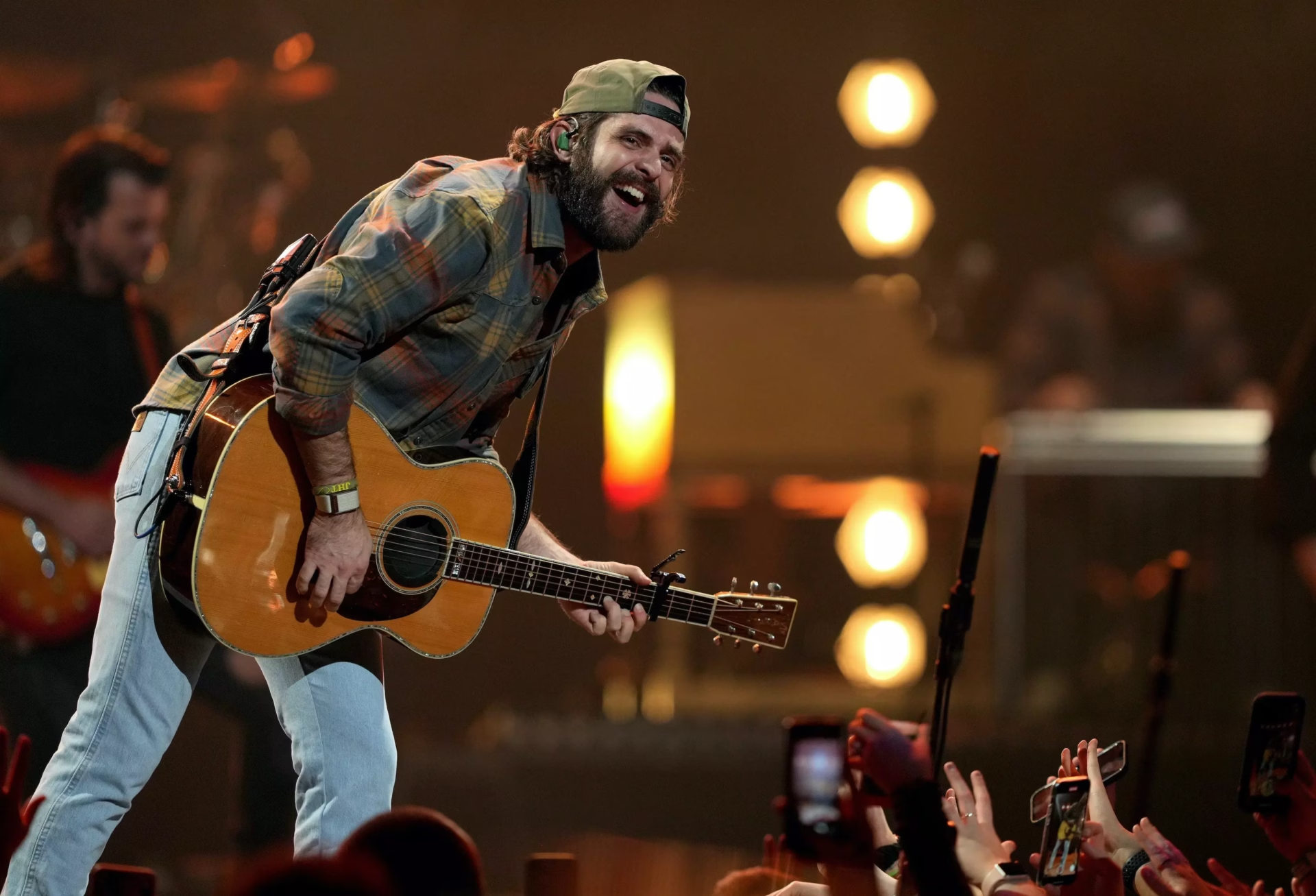
A few weeks before the release of his newest album, Where We Started, Thomas Rhett posted a video on social media of one of his earliest performances. In the clip, he looks like he's probably 4 or 5, wearing a cowboy hat and singing Joe Diffie's "Third Rock From the Sun" with acoustic guitar (and occasional singing) accompaniment from his country-singer dad, Rhett Akins — as Rhett aptly put it, "Where @RhettAkins and I started."
Fans already knew that Rhett's roots in the music business run deep. He grew up as the kid of a '90s hitmaker, who charted 14 hits on Billboard's Hot Country Songs chart and hit No. 1 in 1996 with his song "Don't Get Me Started." Since then, Akins has continued to hold a prominent place in the country songwriting community, and he's a co-writer on much of his son's discography, including Rhett's first two No. 1 hits, "It Goes Like This" and "Get Me Some of That."
Akins is a stalwart of country radio, but Rhett's career soon broadened beyond those borders. On top of his in-format success, Rhett has amassed a crossover audience with R&B influence and pop-driven production on songs like "Crash and Burn" and "Craving You," a duet with Maren Morris.
"I've made a living throwing curveballs," Rhett told Billboard in 2021. He specifically pointed out "Crash and Burn," acknowledging that part of him expected it to "crash and burn" at country radio. Instead, it became his fourth No. 1 hit. "It carved out a lane for me," he continued.
His crossover breakthrough came with 2015's "Die a Happy Man," a love song so catchy and eloquently written that it became a go-to first dance song for fans of all genres. In addition to topping country charts, the heartfelt ballad made it to No. 21 on the all-genre Billboard Hot 100 and No. 25 on the Adult Top 40. But the song accomplished more than just commercial success — it was also one of Rhett's first forays into personal, autobiographical writing about his relationship with his wife, Lauren Akins.
The singer got married when he was 22, and early on, his marriage had its share of naysayers in the country music industry; many thought it would hurt his career if fans knew he was off the market. But "Die a Happy Man" — so specifically written about Lauren that she even starred in its music video — actually had the opposite effect. Fans began to invest in Rhett's love story, dubbing the couple #relationshipgoals and following Lauren on social media (she now has 2.6 million followers on Instagram alone).
From there, Rhett began to mine his personal life for songwriting material, getting more and more specific with each release. That was particularly showcased in his 2018 single "Life Changes," which documents his journey from college, to marriage, to parenthood. Rhett even detailed the whirlwind experience with his first two daughters — Lauren found out she was pregnant amid adopting a baby girl from Uganda — and mentioned the girls by name: "Now there's Willa and sweet Ada James/ That's two under two, hey, what can I say."
By the time he released his fourth album, 2019's Center Point Road, Rhett had solidified his place as one of country's biggest current stars. With 12 No. 1s (a feat he has now extended to 17) and two sold-out arena tours, he went into his Center Point Road cycle nearing A-list status. Yet, in line with the album's nostalgic themes, Rhett reflected on his career — and began to have a change in perspective.
"I remember being like, I love all my past records, but I do feel like on every record there was something I was chasing," he told Rolling Stone. "There was a vibe I was chasing. There was a different artist I was comparing myself to and trying to write something along the lines [of what] they would write. Some of the things I used to put so much stock in, I didn't put stock in anymore."
Though he didn't regret any of the ventures he'd made into different genres — in the same Rolling Stone interview, Rhett declared, "Every artist, if they're not allowed to explore, if they're not allowed to expand and try things, it halts the creative process" — he began yearning to return home, musically speaking.
"Once I started to slow down and look back at my life a little bit, I was like, 'Dang, I haven't really sat down with a guitar in a very long time, and just tried to tell a really honest story from the heart,'" he added to RS.
That realization was furthered by the unexpected downtime he had during the COVID-19 quarantine. The more time he spent off the road, the more Rhett started digging into the simple stuff. "I had to figure out who I was without a guitar," Rhett told People of that time period. Partially at the suggestion of his wife, he decided to channel the energy that had previously gone towards his career into his home life, and his role as a dad to — at the time — three children. (The family has since added a fourth daughter to their brood.)
Those lifestyle changes brought a different kind of songwriting to the surface. "I've never been more creative," he gushed to People. "All of a sudden, my co-writes were just incredible. It was like everything was flowing out for a reason."
Many of those songs were more straight-ahead country, both in style and in subject matter, like "More Time Fishing," "Ya Heard" and "Country Again" — the latter of which would go on to be the title track for a double album, Country Again Side A and Side B. Side A was released in April 2021, with plans for Side B to follow later this year; in the meantime, another "curveball" arose.
Earlier this year, Rhett told The Tennesseean that he'd written over 200 songs over the past five years, and while many of them fit into the world of Country Again, not all his new material would feel at home under that umbrella. The result was yet another project, Where We Started, as a sort of middle ground between his traditional-focused material and his more experimental side. "This will be a versatile record with a song for everyone," he detailed.
Listening to Where We Started, you can see the different foundations that Rhett has been laying over the past few years. His commitment to making nostalgia-driven, traditional-leaning country music is apparent on songs like "Mama's Front Door" and "Half of Me"; the breezy, Jimmy Buffett-leaning "Paradise" and Latin-flavored bop "Bring the Bar" would feel perfectly at home on the pop charts. Though the title track is a duet with Katy Perry — and has quite the pop-driven anthemic feel as a result — its lyrics call back to his relationship with both music and his wife: "You knew one day I would make a/ Livin' out of singing 'bout you."
But the album is more than the sum of its parts; in fact, the dominant theme of Where We Started isn't Rhett's exploration of one musical style over another, but rather the maturity he's picked up along the way. "The Hill" is a retelling of Rhett's love story, this time with the additional weight of a man who has gained a very clear idea of what it might be like to lose his lover — and how crucial it is to him to avoid that possibility.
Rhett has said that he often wonders if he's ever going to run out of different ways to write love ballads. He's certainly released a large cache of them, but with each new album, Rhett dives further and spotlights new perspectives on the topic. Using familiar subject matter to sharpen his songwriting skills allows the singer to expand his pen into new and less comfortable territory.
One example of his growing songwriting prowess is the somber and conflicted Where We Started track "Death Row." A collaboration with Russell Dickerson and Tyler Hubbard, the song details the three artists' trip to a Tennessee men's prison to perform for its death row inmates.
"Never in a million years did I ever think I would have been [playing a show like that]...[I was] honestly a little terrified, you know?" Rhett admitted to Audacy's Katie Neal. Despite his apprehensions, the experience made a powerful impact on him, which is intricately detailed in the song's lyrics — particularly the chorus' final line "I learned a lot 'bout livin' from them boys down on death row."
Rhett keeps throwing curveballs — to the audience and to himself — in the songs on Where We Started. The album isn't defined by his roots, but every song on it is an expression or an outgrowth of that young boy in the home video, singing along to a Joe Diffie song as his dad strums the guitar.
Songs like "Us Someday," "Where We Started" and "Slow Down Summer" combine the influences of Rhett's past pop hits with his growth as a genre-melding artist. "Mama's Front Door" and "The Hill" exemplify the lessons he's learned about the power of nostalgia, and about the dividends it pays to write autobiographically.
Each era of Rhett's artistry informs Where We Started. But even though they're based on different kinds of music, they're not at odds with each other. The common thread is Rhett's vision of who he is as an artist: The more he settles into himself, the more the music falls into place around him.