Editor’s Note: This article was updated on Sept. 27, 2024 to include mention of Van Morrison's New Arrangements and Duets album.
Living Legends is a series that spotlights icons in music still going strong today. This week, GRAMMY.com presents an interview with two-time GRAMMY winner Van Morrison, one of the most influential singers, songwriters and bandleaders of the 20th century, who codified "Celtic soul" for a generation. His new album, Moving on Skiffle, is available now.
These days, Van Morrison tends to be in the news for reasons that have little to nothing to do with music.
His irascibility toward the World Economic Forum, the Bill and Melinda Gates Foundation, et al has been well documented — as have his public clashes with federal governments over pandemic lockdown policies. Sure, such policies have a lot to do with his livelihood; for a time, they precluded live performances for the master bandleader. In response, he released a string of protest singles with Eric Clapton: "The Rebels," "Stand & Deliver," "This Has Gotta Stop"; the topic made its way into his solo music as well. Robin Swann, the Northern Ireland Minister of Health, lambasted him as "dangerous" for his position on lockdowns; he cheekily responded with a song of the same name.
As such, the resultant discourse — and controversy — has lately earned him more attention as a political agitator than a still-vital musician. Which can threaten to obfuscate the ocean of output (or as he idiosyncratically calls it, "product") Morrison's released in the past decade and change.
That's a shame, because his recent run of albums has been fantastic; at 77, the two-time GRAMMY winner's talents remain essentially undimmed. 2016's autumnal Keep Me Singing was a treasure; so was You're Driving Me Crazy, his 2018 album with the late Hammond B-3 titan Joey DeFrancesco. Others, too, like 2018's rollicking The Prophet Speaks, which also featured DeFrancesco, and 2019's earthy Three Chords and the Truth are mightily satisfying as well. September 2024 saw the release of New Arrangements and Duets, a 17-track album full of collaborations with Willie Nelson, Kurt Elling, Joss Stone, and others.
2021's Latest Record Project, Vol. 1 and 2022's What's It Gonna Take?, were charged with dark, sardonic energy as Morrison took shots at the government, marking the seventh or eighth Van's Mad epoch in his discography.
Despite traces of said animus at the Man, everything about his latest album, Moving on Skiffle, out Mar. 10, signals a new beginning — from its premise (it's all from the skiffle songbook, reimagined to various degrees) to its sound (simple, breezy, ebullient) to its title, suggestive of dusting off and forging ahead.
In this edition of Living Legends, GRAMMY.com sat down with Morrison to discuss the making of Moving on Skiffle, getting back onstage after music ground to a halt, and why the folk-oriented genre of yore remains fundamental to everything he's made in its wake.
This interview has been edited for clarity.
Skiffle loomed so large in the music flowing out of the UK in the 1960s — among so many other artists, it birthed the Beatles, the Hollies and, from what I understand, you. Can you lay the groundwork as per your relationship to this beautiful mishmash of an artform?
"Mishmash," yeah. I don't know if you've done any history research, but it basically started with: Lead Belly, Woody Guthrie, Sonny Terry and Brownie McGhee, and Josh White got together to make this kind of music. Someone called it "skiffle." It was pre- the British kind of skiffle. It was forgotten about in the U.S., but it made its way to the U.K. and was incorporated into this kind of music.
It was basically a mixture of mostly American folk music and Black American folk music, stemming from Lead Belly and a guy in the U.K. called Lonnie Donegan. He came out with a record ["Rock Island Line"] and it was a big hit. So, that started the ball rolling.
How did it come into your life?
Well, because I heard it. It was all over the radio. There were programs that had people on Saturday mornings, and Lonnie Donegan was on the radio quite a bit. I got hold of the 78 r.p.m. with "Rock Island Line," and "John Henry" was on the B-side. But it was all over the place then, sometime in the '50s.
When I listen to Moving on Skiffle, I get the sense that these songs have been floating around your consciousness through all your eras, phases and decades. How did you boil down the skiffle songbook into this curated sequence of 23 tunes?
Well, with a lot of work.
I'd like to home in on a few tunes that stand out to me. Can you talk about your connection to "Sail Away Ladies"?
Yeah, well, I mean, again, it's one of those songs that's been in various versions, and it's an old song. I think it's from the Appalachians or something. It's also called "Don't You Rock Me Daddy-O." It came out as that. It came out as "Sail Away Ladies." There's, like, hundreds of versions of this song, you know? So, it's just part of the genre.
Another favorite is "Gypsy Davy," a Scottish ballad that runs so deep in the tradition, from what I was reading. My wife, who grew up on Celtic music, immediately recognized it. Can you talk about what appeals to you about that one?
Well, it's the same thing; it was part of the repertoire. I did it in a band I was in in 1963. It was also part of the folk memory, and it's also been under various titles. It's been done as "Black Jack Davy." In fact, there's a book that goes into all the history of that song, and other songs. I forget the title right now.
"Gov Don't Allow" also resonates with me. I connect to its anti-authoritarian message, which feels harmonious with some of the messages in your recent albums.
Well, that comes from the old song "Mama Don't Allow." I just changed the lyrics. It's what it says in the song. If you follow the lyrics, the lyrics can explain it better than I can right now.
Lastly, I want to bring up "Green Rocky Road." I was pretty blown away by it — it's nine minutes long. I've always known and loved it — Donovan and Tim Hardin's version in particular — but you brought it to a completely new space.
Again, it was one of those songs where there's loads of different versions of it. But I just stretched it out and made it longer, and added some lyrics. I put a few chords in it that I haven't heard before.
When you sing these songs live or in the studio, how does it make you feel to make these new connections with tunes you've known for 60-plus years?
[Slightly taken aback] How does it feel!
Yeah.
Well, it feels like the word you just used: connecting. But it's in the backdrop of everything I've ever done. I mean, this is what I came out of.
There was a book that came out in the UK when I was a kid called American Folk Guitar, by Alan Lomax and Peggy Seeger. Lomax and Seeger were both living in the UK then, and they were actually in a skiffle group themselves. So, it's all connected. This is where I'm coming from. These are the roots.
This is a 23-track album, and you've made so many in recent memory. More than that, they're really good. I listen to Three Chords and the Truth and Latest Record Project, Vol. 1 all the time. I feel like you don't get enough credit for bringing quality and quantity. What's been galvanizing you to make so much music lately?
Well, just 'cause I can do it, and the obvious reason is because of [chuckles] the obvious thing we're staring in the face, this plandemic that stopped the gigs.
You couldn't do gigs. Live gigs were banned. I don't know if you know about all this, but you couldn't travel. It was a couple of years where you really couldn't do gigs. So, the other thing is writing and recording.
It must have taken an emotional toll on you to not be able to connect with audiences. But I can feel that release in this music.
Yeah, yeah, yeah.
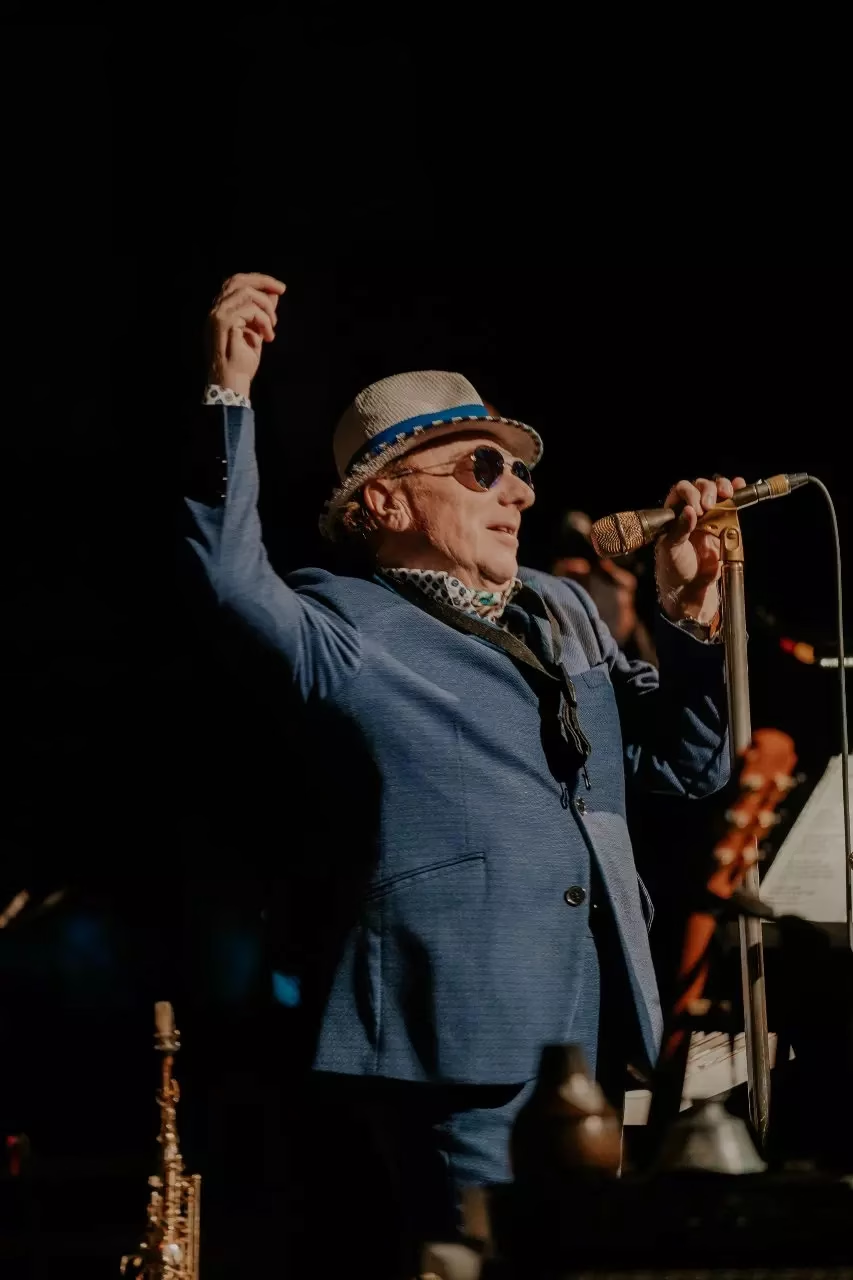
*Van Morrison performing live. Photo: Bradley Quinn*
Now that you've taken a trip through the skiffle songbook, what's next for you?
Well, there's other product, but it's pointless to talk about it now, because I don't know when it's going to come out. But if and when it comes out, we could do another interview about that, because there's so much stuff I have. I couldn't tell you when the next one's going to be, but we'll let you know when we put it out.
When I think of the throughline of your entire career, I see you as the consummate bandleader. Your interplay and telepathy with a large ensemble seems central to your art in some ways. Are there any musicians on Moving on Skiffle that you'd like to pay a token of appreciation to?
Well, all of them, because they work really well. Especially on this product, this album. There's Colin Griffin on drums, Pete Hurley on bass, Stuart McElroy on piano, Richard Dunn on organ, Dave Keary on guitar. Plus, there's backup singers like Crawford Bell, Dana Masters and Jolene O'Hara.
Don't forget "Sticky" Wicket on washboard! All these people need to be commended for doing such a good job.