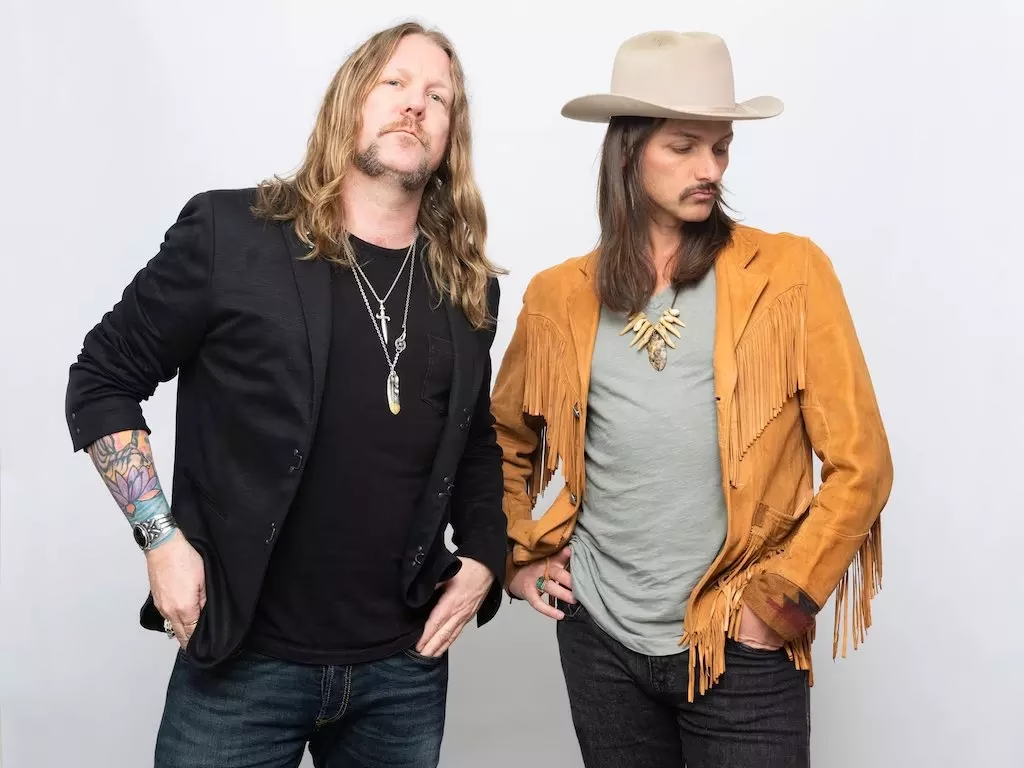
While his father, the late Gregg Allman, made an unmistakable impact on his musical growth, Devon Allman recognizes that he can't just coast off his famous last name or his family legacy via The Allman Brothers Band.
When Devon formed The Allman Betts Band several years ago with Duane Betts, son of Allman Brothers Band member Dickey Betts, and a lineup also featuring Berry Oakley Jr., son of original Allman Brothers Band bassist Berry Oakley, it certainly would have been easy to rely heavily on their musical heritage.
While there are definite shades of the past in their sound, The Allman Betts Band seek to create their own identity. It's evident on their 2019 debut album, Down To The River, and even more so on their latest double album, Bless Your Heart, which is out Aug. 28.
"I don't think anyone can prepare you for the path that you're going to go on. Only your work ethic can prepare you," Devon tells GRAMMY.com. "So at the end of the day, I think we have our own story to tell, and think that story is right there on Bless Your Heart."
Unlike their debut, which marked the first time the group had played and recorded together, Bless Your Heart showcases a much more seasoned band—thanks to a relentlessly busy touring schedule last year.
"If the debut album was like opening your eyes and waking up, then this record is like sitting up on the side of the bed, standing up [and] stretching out," Devon says of Bless Your Heart. "It's the next phase of the evolution of our conglomerate."
Ahead of the new LP's release this month, the band unveils the music video for album opener "Pale Horse Rider." Filmed at the iconic Joshua Tree National Park, the stunning visual matches the cinematic feel of the song.
GRAMMY.com recently caught up with Devon Allman and Duane Betts to talk about how they're forging a new path as The Allman Betts Band and how their latest album cements their own identity while also honoring their past.
<style>.embed-container { position: relative; padding-bottom: 56.25%; height: 0; overflow: hidden; max-width: 100%; } .embed-container iframe, .embed-container object, .embed-container embed { position: absolute; top: 0; left: 0; width: 100%; height: 100%; }</style><div class='embed-container'><iframe src='https://www.youtube.com/embed//w0SCZ3FSamg' frameborder='0' allowfullscreen></iframe></div>
"Pale Horse Rider" has a great cinematic feel. What was the inspiration for writing that song?
Devon Allman: It was really born out of kind of a descending, trippy guitar line of Duane's. And when we started to flesh it out, I think it was just kind of a universal theme having to do with "the man" breaking down this guy and him feeling like the world was out to get him, which I'm sure we can all relate to at some point or another in our lives.
Once the song kind of revealed itself to be that story, it really wrote itself. So it wasn't any kind of eureka moment inspiration. It was just three guys writing songs and sketching out some figures that came to a really cool conclusion.
What was it like filming the video for the song in the desert?
Devon Allman: It was hot. It was a lot of fun. We got to play cowboys for a couple days straight there, on horses and playing guitars out in the desert. Joshua Tree National Park is such a beautiful setting … It's a very photogenic setting, so it was a pleasure.
Duane Betts: It was a long day, but I'm really happy that we did it. And Joshua Tree is a really amazing place, with all the history with Graham Parsons, who's one of my favorite writers. He just has impeccable style, and I loved those records he did. We couldn't have picked a better place to do it.
How have the past few months influenced your opinion of this collection of songs featured on Bless Your Heart?
Devon Allman: I'm really proud of the band for its growth, for being able to stretch out and really believe in itself and its abilities. And I don't think that the time off has deepened my love affair with our growth. I'm still just as proud of the record as I was when we left the studio. Before it was even mixed, I knew that we had something that was the next step for us as a unit, as a creative force. If the debut album was like opening your eyes and waking up, then this record is like sitting up on the side of the bed, standing up [and] stretching out. It's the next phase of the evolution of our conglomerate.
Duane Betts: You don't take anything for granted because you see how quickly things can change … Music is supposed to kind of take you to a different place. And if it makes people feel good and does that, then that's part of what we would hope for and what we're trying to accomplish. So now more than ever, people need that medicine.
When you first joined forces as a band, what convinced you that it was a worthwhile endeavor?
Devon Allman: We formed the band out of our friendship, really. We had always kind of talked about the concept of us working together. But what really sent it over the edge was [when] we sat down and tried to write some songs together to see if we were compatible songwriting partners. And when we wrote the first couple tunes of the first record, we were like, "Wow, OK. We really are a pretty good songwriting team. It's pretty effortless, so let's see if we can write more songs."
And then we had enough to make a record. And we said, "Man, this would make a record that we could both be proud of." So it was a few steps into the process, each step solidifying this vibe that we would be a good team.
Duane Betts: I knew we had good ideas, and we had a great group of guys and musicians. I knew it was a worthwhile endeavor. I just didn't know exactly what we were going to create. And just from the first record to this record, I think that it's definitely a worthwhile endeavor. I think that the proof is in the pudding.
Watch: Gregg Allman recalls joining the Allman Brothers Band
The band's been on a pretty prolific pace of writing songs. What did it mean to record a double album so soon after your debut record?
Devon Allman: I think it means that we were more comfortable. We trusted the process. We trusted our chemistry as writing partners. We trusted the band to bring the songs to life. Having a couple hundred shows under our belt, it just felt right to write as much as we could. And I think there might've been 20 or 25 songs in the works, and we trimmed them down to 13—lucky No. 13. And it felt like those 13 [songs] were the most cohesive that could live in the same space together and complement each other and make one pretty direct story that had focus.
Duane Betts: We were just really grateful to be able to get it all in the can, to get it all completed before the pandemic really took hold and shut everything down.
When the band recorded its debut, it marked the first time when everyone in the group played together. But on the new one, the band is a lot more seasoned thanks to your heavy touring schedule in 2019. What did it mean to be able to stretch your sound even further and try new things thanks to that experience?
Devon Allman: Just again, having the trust in the unit. Having been on tour that long, we know what everybody brings to the table.
Duane Betts: I think that spirit is kind of in us inherently … I think that some of the most unique stuff that we have to offer is a song like "Pale Horse Rider." It's some of the best, most innovative work that I think Devon and I have done together. It's not always about being pure to that old sound. It's about just doing what feels right in the moment. And we love a lot of music, so there's a lot of influences to pull from besides that, besides The Allman Brothers Band.
What were some of your favorite new things that you tried on the record?
Devon Allman: I think that there are a couple songs that were maybe a little outside of our wheelhouse. It was fun to sing in kind of more of a low baritone, almost [like a] Johnny Cash vibe, for the song "Much Obliged." It was fun to play bass on the track "The Doctor's Daughter," where [bassist and singer] Berry Oakley went over to keyboards, played piano and sang that track. So obviously when he switches over to piano, somebody has to play bass, and I was happy to play bass on that track. So some little maneuvers like that are just fun to keep the spirit of the band elastic and … showing a different face.
<style>.embed-container { position: relative; padding-bottom: 56.25%; height: 0; overflow: hidden; max-width: 100%; } .embed-container iframe, .embed-container object, .embed-container embed { position: absolute; top: 0; left: 0; width: 100%; height: 100%; }</style><div class='embed-container'><iframe src='https://www.youtube.com/embed//okdcPis_byM' frameborder='0' allowfullscreen></iframe></div>
Stoll Vaughan, with whom you collaborated on your debut album, wrote the semi-autobiographical song, "Magnolia Road." What was it like having your life story told by him?
Devon Allman: There's certainly a lot to our personal stories to really sum up in four lines. But I think that Stoll Vaughn did a really great job of capturing at least the essence of who we are and where we've been, and he did a really concise way of doing that inside of one song.
Devon has described the album as a band having a love affair with being a band. Why do you think that's important in today's music world?
Devon Allman: I think anyone that does something should do it with love, whether they're a chef in a restaurant or an architect building a new place for people to thrive and work or live. I think you get much better results if you love what you do. So at the end of the day, I think you come out of the gate in a brand-new band when you're seasoned veterans and you're kind of feeling your way and seeing who's going to do what and what the roles are and what the colors and tones and textures are of each person.
And I think once you get comfortable knowing a lay of the land, that's where you can really thrive. And I think that's where we're at in this band. And I think that we're having a love affair with being in a band together … I hope when people hear this record, they really hear a band that's in love with being in a band with each other.
There's a lot of sonic diversity on the album. You don't really know what's going to come next.
Devon Allman: I like that aspect. I think it's good to take people on a journey. Some of my most favorite films are the ones that really take you for a ride and keep you guessing, where you're not figuring out the end 20 minutes in. So I really think that diversity works for us, and we tip our hat to our heroes. Like The Rolling Stones could play blues, they could play something country-tinged, they could play something reggae-tinged. And I think it's important to be able to stretch out and do some things that are maybe not cookie-cutter experiences.
Duane Betts: There's just kind of a wider spectrum of influences, and, on the whole level, it's just kind of a wider palette.
The Allman Betts Band | Photo: Kaelan Barowsky
I imagine your fathers, who performed together in The Allman Brothers Band, played a vital role in your musical growth. How does having a musician father prepare you for fronting your own band?
Duane Betts: I think a lot of that stuff you learn just by watching people, by observing your environment … I started watching my father [Dickey Betts] front his bands and the dynamics he had with his band members.
You're kind of leading just by expressing what you're hearing to the band, and then the band is there to execute that vision. Being a band leader, per se, like on tour, is a different kind of thing. I definitely learned a lot from watching him on- and off-stage.
There was always music playing [growing up]. I think there were guitars around, and there was kind of a junior-size guitar or ukulele or something around. And I picked it up when I was really young, and it kind of seemed really difficult to me. I decided I didn't want to play guitar, in other words. We went to a warehouse where his solo band was rehearsing at that time. And there were kind of some spare drums, and he kind of made a makeshift drum kit. And I started playing drums from that set that he put together, probably around the age of 5 or 6.
By the age of 13, I would say, I switched to guitar. He was always around, just showing me fundamental stuff in guitar playing, like Chuck Berry licks and 12-bar blues and just stuff like that to get me started.
He was there every step of the way. He was there to kind of guide me, but I didn't really want to take too much advice from him, [me] being a teenager. I kind of wanted to learn stuff on my own, which is kind of a joke to this day that we have with each other.
Devon Allman: I really found music on my own. I had punk rock bands in the garage at age 15. But I think my dad and I had some of the same favorite singers in common, like Bobby Bland and Ray Charles.
I don't think anyone can prepare you for the path that you're going to go on. Only your work ethic can prepare you. So at the end of the day, I think we have our own story to tell, and think that story is right there on Bless Your Heart.
How do you balance tradition and forging a new path?
Duane Betts: I think just by us making art and expressing our true selves, I think that is carrying on the legacy, because that's what they did … We are focused on forging a new path, and I think that this record is a pretty strong statement of that. When we play our dads' tunes, I would say we definitely hold that in high regard, and we try to play that with respect; we feel like we do a good job, and we don't take it for granted. We hold it in a special place.
Guitars have a similar importance in Allman Betts songs. Can you talk about the importance of guitars on your new album?
Duane Betts: It's a song record, but it's also a guitar record … Guitars are very important to our band. That's where we come from … It's in the family, you know?
I imagine everyone is eager to hit the road again whenever things get back to normal.
Duane Betts: Absolutely—as soon as the coast is clear and it's safe and responsible. We're actually doing a show in New Hampshire at a drive-in at the end of August, which is really cool. We're really looking forward to doing that. We're just really excited to put some new music out and make some new fans, and hopefully people dig it.
Devon, I've noticed you've also been doing some livestreams. What's it been like to do these virtual performances?
Devon Allman: It's definitely a different dynamic, but you roll with the punches and you have to connect with your audience in some manner. This [pandemic], if it lasts up to a year—I couldn't imagine not staying in contact with our fan base. So I'm grateful for any way we have to connect.
Warren Haynes Talks New Gov't Mule Doc, Writing With Gregg Allman & Growing Young