With their 1994 debut album, A.M., Wilco accrued the "country" genre tag; for their latest album, they teased a full-chested embrace of it. "Wilco goes Country!" they announced; after famously swerving around the genre for almost 30 years with drone sculptures, Dadaist poeticism and motorik meltdowns, it was time to drink straight from the bottle, as it were.
But if you think about this multifarious band for a few moments, it was obvious that Cruel Country wouldn't — couldn't — have been as one-note as Wilco implied it would be.
The tongue-in-cheek lead single, "Falling Apart (Right Now)," offered zero foreshadowing of the aerodynamic suite "Bird Without a Tail / Base of my Skull." Or the heart-in-throat ballad "The Universe," which unfurls into the celestial "Many Worlds." Or the poppy "Hearts Hard to Find" — which is practically destined to remain in setlists as a swoony sing-along, on par with classics like "California Stars."
No, Cruel Country, which was released May 27, isn't strictly a country album — it adheres to the form more as a North Star than as a hard-and-fast requisite. What binds these songs more profoundly than their stylistic conceit is Jeff Tweedy's songwriting — which frequently explores how seemingly opposed human emotions commingle and inform each other.
"My experience of my own emotions is that they all interact," Tweedy tells GRAMMY.com over the phone. "They aren't individual, isolated things that you experience one at a time, and I think that's a really beautiful thing about being alive."
Hence, a song like "Tonight's the Day.""Between good and bad/ And what is true/ Between happy and sad/ I choose you," Tweedy sings: "Between hard and easy/ Surrender and escape/I heard you say/ There is no way/ It's the only way." Meanwhile, drummer Glenn Kotche plays pensively — like he's chewing on a heavy thought, weighing two equal and opposing truths.
Because of how Tweedy's brain works, he can tread a seemingly limitless breadth of philosophical territory — like the vast American horizons evoked in Cruel Country.
As a lifelong student of folk and country music dating back to pre-Wilco band Uncle Tupelo (and before), Tweedy's songs seem to fill the air, ground and water; every leaf he turns over might reveal a new tune, however strange and oblong.
"I do look at the act of writing songs as discovery as much as composition," Tweedy reflects. "It's like finding stones on the beach or something. They all have a certain value, if you're into looking at them… I get into a certain state of mind, and think to myself: I wonder what song I'm going to sing today."
Whatever might follow Cruel Country is bound to be interesting, at the very least. Comparing Wilco’s upcoming material to the new album, he says it's like "somebody dropped a weird shape into the desert." (The monolith from 2001 comes to mind — an unexpected, futuristic structure in what was thought to be a vast, unbroken plain.)
Until then, this double album, which is loosely conceptualized around the subject of America, is worth repeated communion — every spin of its commentary on messy democracy, westward expansion and philosophical contradiction will reveal something new. Especially when Cruel Country deals with human emotions — which, like the United States, can't be easily compartmentalized.
GRAMMY.com caught up with Tweedy about the process behind writing and recording Cruel Country and why he saw a rare form of communal love in lockdown-era society.
He also discussed Wilco's recent triage of surprise sets at Carol's Pub in Chicago, the band's hometown, where they played cuts from the album as well as Americana classics.
This interview has been edited for clarity.
How was the Carol's Pub show? Did it engender a different sort of satisfaction than a typical Wilco show?
[Chuckles] It was really awesome. A fun, fun night.
We love playing, and we love getting to play in these beautiful theaters and festival stages and all the different places we get to play. But we very, very rarely get to play the way I think music was intended to be heard, you know?
The shows that mean the most to me in my life have been the shows I've seen in small clubs — just having that visceral connection, and being able to hear the instruments coming off the stage, and not just through the PA. There's just nothing like that kind of connection.
You can make a communal experience in any room, and you can make a big spectacle — arena shows, everything has their place, and music is an incredible force for good. But, in my opinion, nothing ever sounds quite as good as the way it sounds in a small room.
The sheer capacity of a giant venue might lend itself to a sort of passivity between the artist and crowd. I'm sure you get to touch more of an active force in a smaller room.
Yeah. I mean, the stage is low. You're almost eye-to-eye with the audience. I feel like you can hear people listening in a different way. The movement in the audience becomes more a part of how the band's playing. It's just a much more immediate give-and-take, I think.
Can you touch on some of the covers you performed, starting with Bob Dylan's "Tonight I'll Be Staying Here With You"? What does that tune mean to you guys?
I've done that song a couple of times; I opened up a couple of acoustic shows with it one time. The Tweedy band — when I do shows with [sons] Spencer and Sammy, and our friends — we've done it maybe once or twice.
I just love the way it opens up a set. This message of "Tonight I'll Be Staying Here With You" is, obviously, not what the song's about, but it's a nice thing to say to an audience. I think it's a nice introduction to a set.
How about the Tom T. Hall song "That's How I Got to Memphis"?
[Chuckles] That's just a great song. Something we just started playing in our dressing-room jam room, so we just threw it in the set.
One more: the Grateful Dead's "U.S. Blues," which I'm actually not that familiar with.
Deadheads are sure familiar with it. Boy, it really highlights and underlines the people in the audience who have that vocabulary [laughs]. When we play that song, it's amazing. There's a fair amount of crossover with our fans, it seems like.
When we kicked into that song the first time we did it, in an encore, I don't know if I've ever seen a reaction like that from such a sizable portion from the audience.
[Wilco guitarist] Nels [Cline] and I played a show with Phil Lesh and Friends; we were invited to do this festival set with them in Chicago. They wanted me to sing some Dead songs, and I picked a few that I felt like I could do well. That was one of them.
And then, when we got back to the Wilco tour, Nels and I were playing it in the dressing room again. It just sounded like something that fit in with the lyrics of Cruel Country; it has a similar commentary on the brokenness of the community.
And musically, it felt right in our wheelhouse, so we just kept playing it. It's fun.
To get into Cruel Country, I love that you waited months to play this show and open up to the press a little bit. Was this in an effort to let fans sit with the album for a while, to give it some space?
I think it's more just the reality of how Wilco operates. We're not super-concerned with album cycles. We [didn't] have the physical record to sell, or anything like that. We wanted to put the record out at our festival [Solid Sound], so we did it digitally.
It's probably not the best business decision, but it's the best artistic decision to just have these new songs and new material to play, and have people know what it is, because we like playing it.
We have another release this year; that's an archival release. We've done some stuff with that, but mostly, we're just out playing the songs that fit in with what we feel like playing right now.
When I watched you do an interview on camera at the Loft a few years ago, you were talking about how human emotions can't be neatly compartmentalized — you can be sad-hopeful, or pensive-hopeful, or happy-concerned.
Mm-hmm.
It seems like Cruel Country's songs mutually gnaw at these nuanced psychological concepts. Was that something you were thinking about during the writing process? Is that partly why they swim in the same tank?
Well, I certainly think it's part of a broader philosophy of making music that feels honest to me. It generally involves blurring the lines a little bit in that regard; a song that's entirely joyous generally feels even more joyous to me if there's a little bit of darkness allowed into it — just as a reminder, or something.
I think that's the way life works. My experience of my own emotions is that they all interact. They aren't individual, isolated things that you experience one at a time, and I think that's a really beautiful thing about being alive. You can have a thought of mortality at the same time you're having a hot dog at a baseball game. [Laughs]
Can you talk about the song "Ambulance" a little bit? It's presented as this harrowing, autobiographical story, but I'm reluctant to take that at face value. I'd rather ask you about it.
Well, it's nothing autobiographical. Certainly, not literally. I was just trying to intuit a different scenario where there's some redemption for all of us. As a person that's an addict and in recovery, I think a lot about all the different paths that people take to getting healthier, and in some cases, I'm really relieved and grateful that I didn't experience more suffering.
At the same time, I'm pretty sure I suffered enough, [laughs] you know?
I'm not sure if this is intentional, but to me, "All Across the World" so succinctly captures the post-pandemic, post-Trump presidency milieu. So many people I deal with are trying to be functional and happy and return to normalcy, but there's a shell-shocked look in their eyes. Is that in the ballpark of what you were going for?
I mean, the way I feel is that one of the things everyone is really struggling with is being immediately presented with the world's suffering upon requesting it. At any given moment during any day, we have more access to the lives and struggles of the globe, and the fears and concerns of everybody, everywhere.
Modern social media has provided us with what conceivably could be a really good thing — that we're more tuned in to each other in a way that you hope would present an opportunity to unite in some common understanding that we're all doing our best, and we're all pointing toward the future with the hope that it's better — or good.
So far, we haven't really evolved to that. The thing I think we have evolved to is that it's emotionally overwhelming, and most people have a difficult time processing all of that. Instead of talking about solutions and ways to problem-solve all of this suffering and awareness of global concerns, it's much easier to find people to blame.
That seems to be where we're stuck. So, in my mind, that song is kind of about, at the same time, being aware of all the things that I'm glad that I'm not experiencing. For example: just say a hurricane — whatever it is. Being aware of it, and finding some negativity to add to it doesn't help anyone.
It's like "putting your oxygen mask on, first thing" — that's a pretty succinct analogy to the way I think you kind of have to live right now.
I think it's important to converge your ability to be inspired, your ability to be joyous, and your ability to give a beautiful thing to the world, and hope for the best — and do everything you can to alleviate the suffering that you can have an immediate impact on.
I'm really moved by "The Universe." The impression I get is that it would seem it would take your whole life to write that song. What led you to write that one?
Not to give you a super-long answer, again, for a song that's, like, three minutes long. I don't know if all of what I just said is contained in "All Across the World," but that's what the thought process is that leads to a song like that. Same thing for "The Universe" and "Many Worlds."
At the beginning of the pandemic, one of the things that made me a little hopeful was the idea that, in a really fractured society that doesn't tend to share a lot of experiences across the board, we were all going through something similar. At least there was a similar fear being expressed around the world.
I think the opportunity was mostly squandered by leaders around the world not acknowledging it. Some places did better than others. But I felt moved by the idea that movie stars and presidents and dishwashers and trash collectors — everyone across the board — was basically navigating this one topic.
Whereas, for most of my life, I don't remember there being a single topic that you could guarantee everyone was at least somewhat aware of. It just underlined and highlighted a belief that we've maybe all expressed at some point — that we're all kind of in this together.
That was just made completely visible in that moment — in these moments that are still continuing, I guess, but it's definitely not the way it was at the beginning.
Probably, the thing that probably most inspired it was: early in the pandemic, when things were really shut down, I took a drive with my kids, and the highways were completely empty around Chicago. It seemed like a really powerful moment of love. There was enough concern for each other that people were actually adhering to these public health guidelines.
It wasn't like, "Oh my god; everyone's being controlled by the government." It was more like, "OK, everybody gets it — at least enough to know this is what needs to be done right now." I found that really beautiful.
"Story to Tell" seems to exist hand-in-hand with "Darkness is Cheap," in the sense that it deals with notions of sticky narratives, of gripping tales, of plundering or killing yourself to be legendary. Which is obviously so pervasive in rock 'n' roll lore. What were you trying to impart with that first one?
I think we hear about it a lot in the art and music worlds, because of the pervasiveness around tortured artists and creators and the connection between that type of suffering and creativity.
But I don't think that there's any market being cornered by [laughs] a musician on that particular topic, because I know a lot of people who don't make songs or art in my life that have caused themselves needless suffering — almost as a way to create what they feel like is a real life. To not feel numb or alienated.
I think at one point, when I was younger, it did feel like I wouldn't have anything to write about of value to anybody if I wasn't in pain. And that's nonsense, and everybody should know it's nonsense.
The last one I want to touch on is "Country Song Upside-down." The melody just seems to fall out of your guitar and voice, and it comports with what I imagine the Cruel Country sessions were like — just grabbing country songs out of the air.
We have a place in Michigan that's a little bit more secluded in the woods. We call it "the cabin." That's what that song makes me think of.
I do look at the act of writing songs as discovery as much as composition. In fact, I'm much more comfortable with the idea — not that I'm opening myself up as a conduit to the universe or something like that; I don't necessarily believe in that.
I just think that I'm trying to open myself up enough to see what's inside me, clearly. To discover something I didn't know I wanted to say. And that's just what I'm full of. [Laughs] I'm just full of country songs and folk songs.
It's what I've listened to the most in my life, or something. I'm not tired of them, either. It's like finding stones on the beach or something. They all have a certain value, if you're into looking at them, you know? That's how I feel.
It's a much less judging state of mind — just pretty thrilled at the idea that, to keep with the analogy, that maybe I'm going to find a really good, flat stone to toss out on the lake.
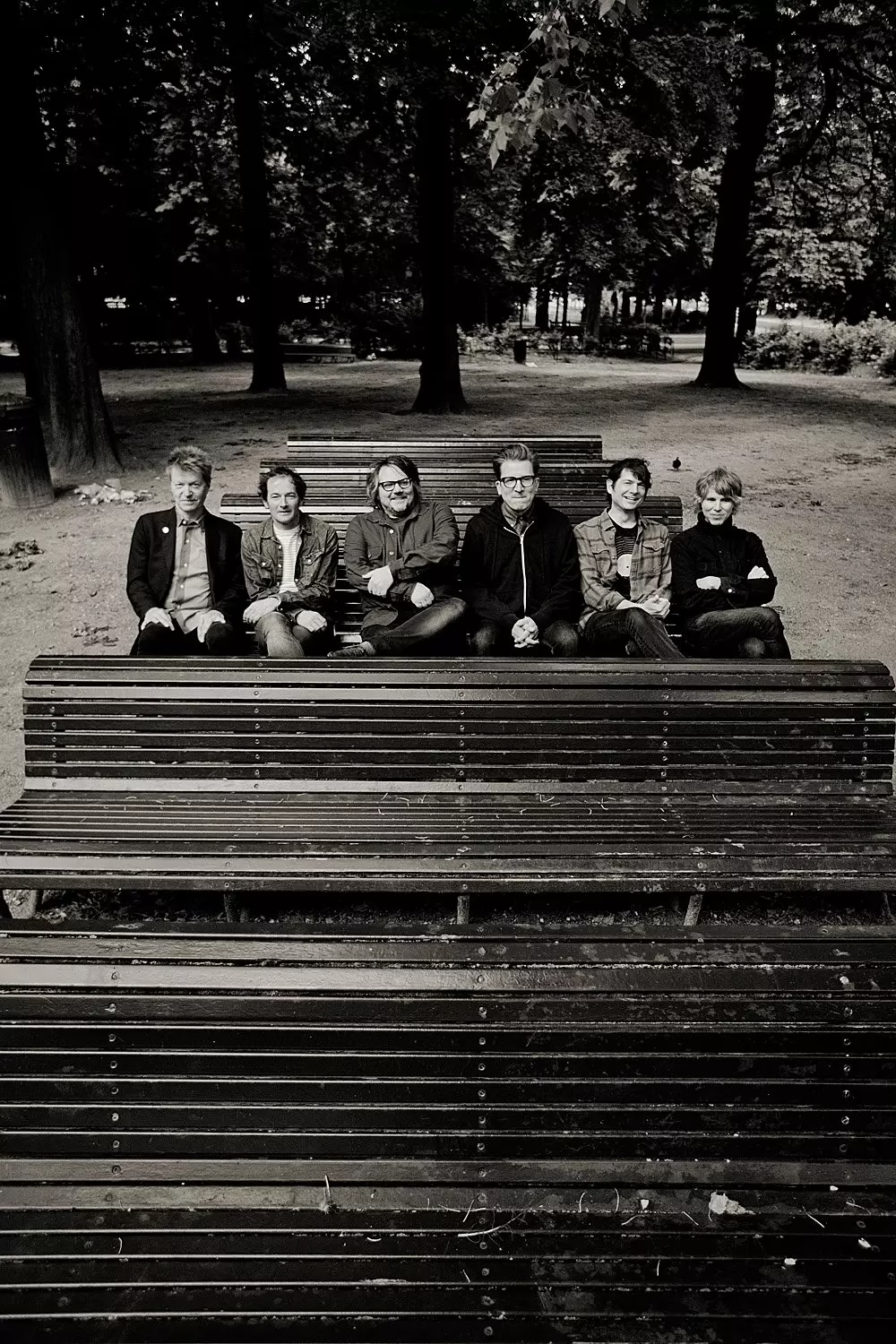
*Wilco. Photo: Anton Coene*
Stepping away from your songwriting a little bit, can you talk about your bandmates' MVP moments on Cruel Country? I think of Glenn on "Tonight's the Day"; I can't imagine any other drum part on the song than the one he played.
Oh, yeah. That, and I think Pat really has a lot of breakout moments on this record, where he gets to play more guitar than I think he's ever played on a Wilco record. It just colors the whole record in a really beautiful way.
It's like a tapestry, or something — the way he and Nels started figuring out how to interact with each other. It's like an audible commune, you know? [Chuckles]
The band as a whole is really visible on this record, or really audible — partially, or mostly, because of the nature of recording it all in the same room, at the same time. We've made a lot of records in a lot of different ways, but it's been a while since we've done that.
We've played a lot of music together since the last time we did it, and that's what I hear when I hear this record.
People think of musicians and bands as being these static things — they got to a certain point where they were good enough to be heard and put out records. The way I look at it, almost all the bands and musicians I'm interested in and care about feel like they never quite got there — and they continue to grow, and continue to aspire to find out more of what it is they're capable of.
It's along the same lines as the songwriting concepts I was discussing. It's really, really gratifying to feel like you got a little bit better at something. And as a band, it's really gratifying to feel like we made something that we very, very profoundly, deeply know we couldn't have made five years ago, without all the miles that we've traveled together in between.
What can you reveal about the eventual follow-up to Cruel Country?
I don't know if the style of recording is going to change that much, but the types of songs — it's a collection of songs that really wouldn't fit into the Cruel Country landscape.
Maybe they would! They'll definitely fit in live. But it's going to be more like somebody dropped a weird shape into the desert, or something.
It's the furthest-out, striving kind of material for the band — striving for a new shape, striving for something that's exciting to us, that we don't feel like we've heard before. Definitely, something we don't think we heard ourselves play before.
28 Essential Songs By Wilco Ahead Of Their New Album Cruel Country