Just before logging on to Zoom to interview Will Sheff, who's out under his own name 20 years after his proper debut, this journalist spent some time tearing down vines climbing up a tree — sapping its nutrients, stymying its growth, and, if left unchecked, killing it.
Given Sheff's ups and downs in the business, the scene led to the question: Is the tree the thousands-year-old wellspring of human musical expression, which is fully able to survive and thrive regardless of capitalistic hijacking? And are the vines the music industry?
"The music business doesn't have to be this way," Sheff, a GRAMMY nominee, tells GRAMMY.com. Coming from him, this is a weighty statement.
The Okkervil River bandleader had just been describing how press narratives distort and reduce reality into cartoonish, unrecognizable forms. Six years ago, a candid, self-written bio for his album Away that touched on his grandfather's death — but was about a multitude of subjects — led to the narrative that it was all about that. Damaging in a more immediate, practical sense is the financial hit he projects he'll take from his upcoming US and Europe tours — thousands in the red.
That financial horror is partly because Sheff finally decided to put Okkervil River to bed. Despite him being the final original member still in the band, that name carried a cachet which led to steeper guarantees.
In return, Sheff has gained an artistic freedom like he's arguably never experienced before — free reign to make whatever music he wants, unfettered from the expectations of those who really, really, really want him to make another Don't Fall in Love With Everyone You See, or Black Sheep Boy. And Sheff's new album, Nothing Special, released Oct. 7, shimmers with the hues of everything he is now, and all he can be from now on.
Musically, Nothing Special isn't so different from records like Away: if you trisect his career, Sheff has spent roughly the last third writing from a zone of serenity, devotion and encouragement — pretty much the polar opposite of old Okkervil River songs about murder and revenge and psychospiritual downfalls.
But his current collaborators — including Will Graefe, Christian Lee Hutson, and Death Cab for Cutie's Zac Rae —, give his approach a new depth, a fresh lilt. To say nothing of vocal contributions from Cassandra Jenkins and Eric D. Johnson of Fruit Bats and Bonny Light Horseman — who are both at the vanguard of forward-thinking singer-songwriter music.
Lyrically, we're dealing with a similar matrix as Away in terms of life stuff. But where said familial loss, including the partial dissolution of the previous Okkervil River band, informed Away, Nothing Special expands its scope. The album partly deals with moving to California, winding down his old band, swearing off alcohol, and caring for his ailing rescue dog, Larry.
And there's a profound loss at the center of it — that of Travis Nelsen, Okkervil River's awe-inspiring drummer and a larger-than-life personality, who had a fraternal bond with Sheff played in the band during their commercial zenith in the mid-2000s. Their friendship ended on a messy and sad note: as Nothing Special's title track goes, Nelsen "failed and fought/ In a pattern he was caught/And his family, they could not break through." Soon after the pandemic hit, Nelsen passed away.
Back to the tree, choked by the vines: Sheff would be "really unhappy" if Nelsen's life and legacy were sleuced into the oversimplification machine. He could have not mentioned him at all in this press cycle, for good reason — look what happened regarding the story of Away — but he chose to speak about him.
"Travis was a true connoisseur of rock lore, and I know that he wants to be remembered," Sheff says. "I didn't want to feel like I was profiting off of his sad story, and I want people to remember him. I want to do what I can to keep his name out there. Those were the factors that led me to be like, 'Alright: I'm going to be honest about this album.'"
And no matter whether Nothing Special is your thing or not — Sheff's intentionally not reading his own press — there's no question about it: honesty permeates every word, every groove, every expression.
GRAMMY.com sat down with Sheff to discuss the new album, his place in the industry apparatus, and the breathtaking vista of potential before him, now that he's been unshackled from the band that defined him — and somewhat confined him.
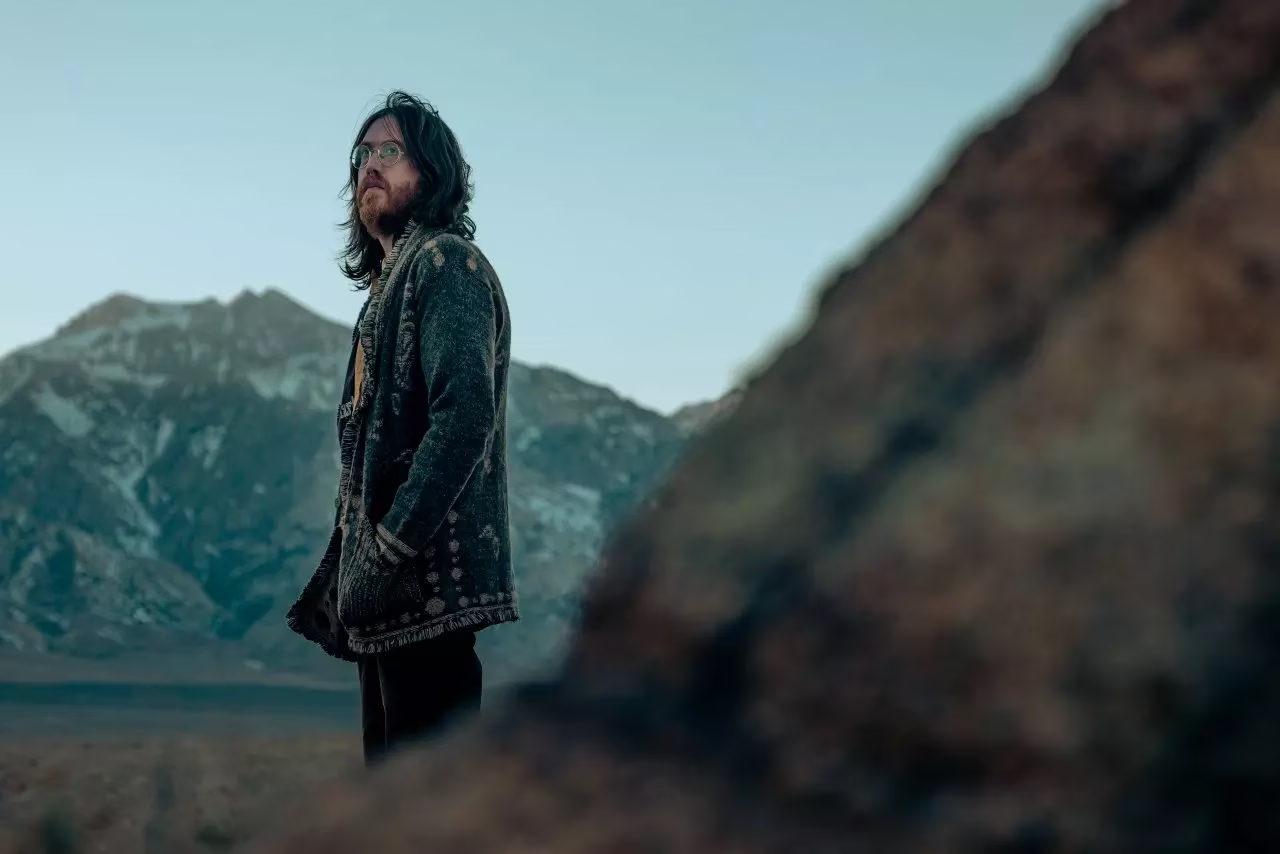
*Will Sheff. Photo: Bret Curry*
This interview has been edited for clarity.
It's common for artists to get burned out on their offerings long before they're actually released. Are you tired of talking about Nothing Special yet?
No, no, no. I barely talk to anybody about it, and I'm enjoying talking about it. I'll never stop feeling enthusiastic about the record. The only thing that's the mind — is anything to do with the business, which encompasses publicity and branding, which is what I'm engaging in right now as I'm talking to you.
I was saying this yesterday — I feel like I will very soon start repeating the same things. And I'll probably, always very tediously, say, "I've said this before, but…" because otherwise, I feel like a phony.
But the thing that's really a head trip is that you make an album, a song, or a collection of songs. And not everybody's like this — I think a lot of people are — but you're not necessarily thinking about the audience. What people are going to say it is, or what genre it is, or whatever.
You have to turn off that voice, or else you can't create.
Yeah, and you're kind of chewing on something in a song. It could be some really big thing that obsesses you that you need to solve, or it could be just some way to express beauty that you want to feel.
And then somebody comes around, if you're lucky enough that people care about what you did, and interviews you about it, and they ask you what went into the songs. And you tell them, because they asked you.
It inevitably ends up seeming very oversimplified, because that's what stories do. A good storyteller throws out some of the details and pumps up some of the other details to get people hooked.
It becomes crystallized, canonized. Reduced to primary colors.
Maybe other animals tell stories, but it feels like the most human thing in the universe — to tell stories and construct narratives. Story is one of the most beautiful things that we do, and one of the most damaging things that we do.
Thousands of people can die in a single day because of a story. Genocide, prejudice — these things come with all of these stories, you know what I mean? Or, like, "I'm in the right; I'm doing the right thing. The end justifies the means because of this story."
The point is, like you say, it's this complicated thing, and it gets simplified. And then somebody reads that interview — the simplified interview — and they're already imposing this simplified story on you.
Essentially, you end up with this thing that was really subtle, complex, reaching out in the darkness, a dialogue between you and whatever it is that makes you write, and it just kind of gets turned into a cartoon really, really quickly. And then you have to play along, or push against it, [when] pushing against it just seems sort of churlish or something like that.
The supreme irony of all of this is that this is something I've been trying to unpack for myself for decades, and oftentimes contributes to a lot of unhappiness for me, personally.
How would you apply this thinking to Nothing Special?
One of the things I was grappling with on this album was trying to not tell myself fake stories, and trying to not think too much about extrinsic rewards for what I'm doing.
Also, not trying to particularly peddle a really clichéd story that it feels like everybody has to peddle now, just to get somebody to turn their heads. Which is to say, "I'm the greatest!" — the most obvious thing. Rappers do it all the time; indie people do it sort of fake-ironically. It's just the currency we're asked to exchange ourselves in.
So, I do all this stuff, and then try to make this record, which really is a personal reflection of all this. But then, I have to promote it. I, like, literally pay a guy to promote it! I pay a company to get people to try to talk about me on this album, that's sort of like, "Hey, don't worry. Don't think about me too much." There's this really bizarre irony-slash-hypocrisy that may be in there that is really interesting, that I'm trying to negotiate.
In the four or five interviews I've done [at the time of this conversation], I don't feel like I've done anything really gross yet, in terms of selling myself in that cartoonish way. But it also feels like it's such a slippery slope — you know what I mean?
Just have fun with that tension! Conceptual dissonance is where so much beauty comes from. There's also that real danger of Travis and his legacy becoming distorted.
When I was working on Away, my grandfather had died, and he was a really big influence on my personality and all that stuff. It was very much on my mind. And I decided that for that press cycle, to not pay somebody to write a bio and just write the most transparent thing I could myself. And it didn't work the way I hoped it would.
What ended up happening was, there emerged this narrative of some guy who was devastated by his grandfather's death and wrote an album about it — which is, like, criminally distorted.
I had a lot going on, and I had him on my mind because his death was very sad. It was also very expected, and it was kind of a culmination of his story and life. I just feel like it turned into a distortion that made me unhappy.
When I wrote a lot of these songs [on Nothing Special] — and some of the songs that aren't on the record, because I wrote a lot of them — Travis would flit in and out of many of them. All the different ways that I was trying to celebrate him and grapple with what had happened. I could not say that. I could tell them to not put that in the biography. But I'm trying to be honest; that was a big part of it.
There are a lot of things that were a big part of it — moving, coming out to California, looking back on Okkervil River, then sort of dissolving Okkervil River. Caring for another being, starting over again, aging, looking at the rock 'n' roll business and the myth of rock 'n' roll.
And these things were not separated from each other; they were all in dialogue. I also wanted to pay tribute to Travis, because we loved each other like brothers.
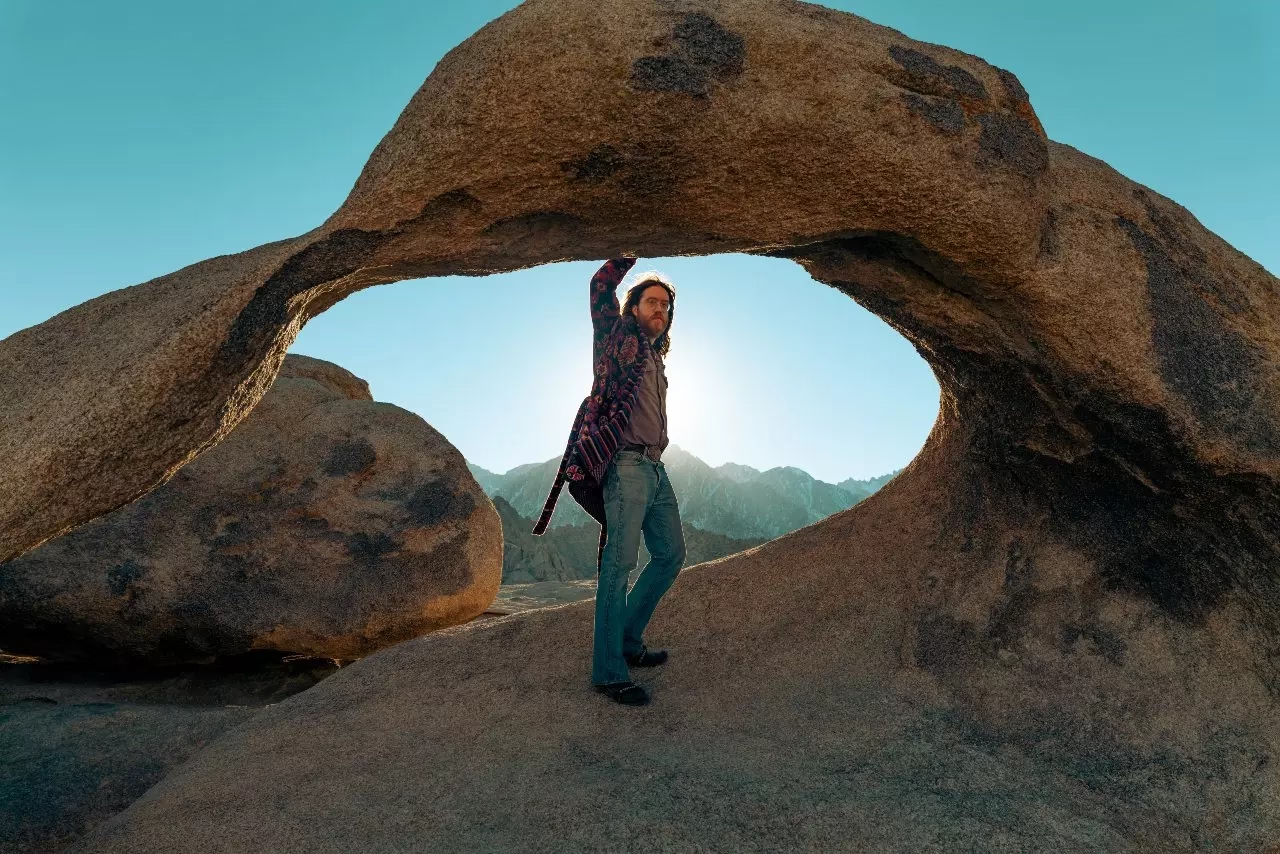
*Will Sheff. Photo: Bret Curry*
Can you talk a little more about your relationship with Travis?
That's the most important friendship I've had in my life; maybe my friendship with Jonathan [Meiburg, author and leader of Shearwater], who is equally important. But Travis was a true connoisseur of rock lore, and I know that he wants to be remembered.
We had had a falling out over a really complicated bunch of factors. But I know from knowing him as well as I did, and from talking to a lot of his friends, that we still always loved each other and always wanted to reconcile.
I didn't want to feel like I was profiting off of his sad story, and I want people to remember him. I want to do what I can to keep his name out there. Those were the factors that led me to be like, "Alright: I'm going to be honest about this album."
But at the same time, I will be really unhappy if, when I look back on this whole promotion cycle, it got boiled down to "This was the concept album about how he was sad about Travis dying." Because it's not true. This album is about so many things, and it's all interwoven and intermingled.
Right before this interview, I tore down a bunch of vines off a tree in my yard because they were sucking out the nutrients. Does the tree symbolize art as a whole, and the vines are the music business?
Music has always been around, and the idea that it should have anything to do with business is crazy, when you think about it a little bit. It's just this bizarre shotgun wedding, trying to reconcile capitalism with an activity that people do that other people really appreciate.
Furthermore, I think the idea of musical celebrities, and musical stars, is also slightly gross. I like the idea that up until very recently, music was just something that a lot of people did. And they did it for fun! They did it for community, and for entertainment.
It was like, "My daughter's getting married! Have Joe come over; he plays the fiddle!" It wasn't like everybody was sitting around, interviewing Joe and asking him for the influences on the jig he just played, and Joe was wearing Wayfarers, giving cryptic answers to their questions before hopping on his private jet. It's kind of disgusting.
And those stories we talked about fold into that.
We love stories; I love those stories. I love stories about Bob Dylan and David Bowie and Iggy Pop and Alex Chilton. But as fun to think about as it is, it's a sick and f—ed up system — especially when it comes to getting to live a life that's extravagant, while other people are living these miserable, hand-to-mouth existences.
Because we love stories, it's really entertaining to have a Bowie. Maybe you can see yourself in the exaggerated, larger-than-life aspects of things that happened with Bowie. [But] I like that David Bowie never changed his name, and he was David Robert Jones.
I guess the best way to try to be a rock star is to just understand that you're really like a vessel for other people's projections and entertainment, and just go, "Hey, man, I'm just here to entertain. Please don't worship me. If I make you laugh, make you smile, give you a good Saturday night's entertainment, then it's worth me wearing this stupid outfit and acting like such an ass."
But if it's all about me getting some disproportionate reward, then it kind of becomes gross.
For a while, you've been making music that deals with something close to serenity, which is not a sexy nor clickable concept. Most fans probably got into Okkervil River almost 20 years ago, when you were screaming about murder. Can you talk about that tension between who you are and what people want you to be — or pay you to be?
Like any artist, you follow your nose — and when I was younger, I wrote in a younger way. I wrote in a way that was really informed by where I was at in my life, and where I had been — specifically, what I had experienced.
And I don't mean to make it sound like it's worse than anybody else, but I'd experienced a lot of pain and hurt. And — this is not uncommon with men — it sort of transformed into anger, and I had a lot to prove.
I think this is true of me now, and has always been true: I have a tendency to go there. When I'm writing, I have a tendency to want to go to the place that makes people — or me — uncomfortable.
Those songs, where I dealt with things like murder and suicide and very violent feelings — I don't regret any of those songs. I don't think that they came from a hurtful place, and I think, probably, at the end of the day, they were a net positive for people who really liked them. I hope and think they were more cathartic than stirring up shittiness, or anything like that.
But the engine for a lot of that was anger and hurt and pain, and as a human, I very much felt like I needed to figure out how to not hurt people, and how to help people, and be present for the people I loved and notice them and see them and pay attention to their feelings and not be unhappy.
Like, nobody wants me — and I certainly don't want any of my friends who are in their 40s — to be drug-addled, chasing tail, only wanting to play three chords on an electric guitar. You get older, and you start to see all the different tones and all the diversity of musical expression, and it's my job to always try to make it new and reflect what I want out of music. That was a real big shift.
Which isn't always appreciated by the drunken frat boys screaming for "Westfall."
Yeah, there are some people who really imprinted on the anger and the rage. And it wasn't just young men; I think it was women, too, who kind of identified with it.
Maybe they put me in that drawer. I don't think it was malicious, but it's like, they just want that again. But I don't want to be miserable. These days, I feel like I go there with religion and spirituality and big existential questions.
I think that maybe that actually makes people uncomfortable. And I think the discomfort that people feel about murder and violence is actually very familiar. We all like gross, grimy, dark anger, and I think some of the more spiritual stuff actually makes people very uncomfortable.
I really enjoyed watching critics squirm at lines like "Brother, I believe in love" from the last record [2018's In the Rainbow Rain].
Yeah, yeah. What's fun about that is just going full[-on] risking being called a stupid hippie. I like the idea of exposing yourself to criticism and failure.
I was talking to somebody about some record in the past, and they were encouraging me to write quote-unquote bulletproof pop songs. I was thinking about that metaphor, and nothing could be further from describing the kind of music I like.
I don't want my muse to be an impregnable fortress, a bulletproof vest, a tank rolling through town. I want it to be porous and vaporous. Easy to ignore, easy to make fun of. Going out on a limb, inviting the listener in.
It shouldn't be like an irrefutable argument; it should be just a strange artifact that you are called to interact with, or something.
Even on that extreme end, your work never lands in a sense of gross grandiosity, or a Messianic complex. I love the ending of "Evidence" from Nothing Special, because a lesser songwriter or arranger would have built that chorus to absurd heights. Instead, you chose to let it waft in and out, and gently settle.
It's funny how you talk about it being a decision, because I never thought about that. It speaks to the difference between the two ways of looking at a song — the making of it, and then the talking about it after, which are equally important, I think.
I always want to say "This is the song I'm most proud of," because I love all these songs in different ways. But "Evidence" really articulates a lot of fundamental feelings I have about life, at this point in my life. And I think the music does just as much to articulate them as the words. I really did want that song to be comforting. Soothing, and not necessarily papering over pain, but something that would make people feel fundamentally good.
When you're talking about turning it into a big chorus, that was something I thought a lot about in its absence on this record — never pushing anything.
"Like the Last Time" pushes, I guess, because that's just what naturally happened in the studio. That song wasn't supposed to rock out that hard. It just sort of happened. I'd say my biggest goal on this record was to never oversell anything.
I love how Nothing Special is predicated on these diatonic, very simple melodies. I know you've talked about Bill Fay in those terms.
When you say that, it's funny, because I don't think about things in terms of theory too much. But I definitely had this thing where I was like, "I want these songs to be melodically very singable, and lyrically very gettable," even if there's a lot in them.
You've made the difficult decision to go under your own name, despite the financial hit. But now, you've torn off the Band-Aid. You could theoretically just keep making solo records of any kind, and the fans will continue to follow you wherever you go. How do you see the next decade of your career?
I don't know what the future holds. And sometimes, when I look back on my favorite artists, it does feel like decades really have the power to destroy people's careers. A really obvious example is when alternative rock and grunge came along, and suddenly, all these '80s bands seemed like they were 100 years old. Some of them never recovered.
The closest thing we ever had to being connected to the zeitgeist was that brief 2006-to-2010 stretch. I don't think we were ever the front-runners. We would just be mentioned in the same conversation as a bunch of other bands.
I feel like I've managed to keep going and fly under the radar. When I think about my favorite artists with the longest careers — Dylan is an exception that proves the rule; he's not a good artist to compare your career to — I think about somebody like Michael Hurley.
I love that he's just been doing the same thing his whole life, and there's really never been a drop-off in quality. His records all sound the same; they're all really good! You're never like, "He's over the hill; he's passed around the bend now."
The most exciting thing about getting to be Will Sheff instead of Okkervil River is that I feel like there aren't any rules about what I can and can't do. When I made this record, I wasn't really thinking about whether it was Okkervil River or Will Sheff or anything other than just making music.
But as a result, I think [with] the next record, I'll feel a lot more emboldened to do whatever I want stylistically, and not feel like it has to square with someone's conception of what the brand Okkervil River sounds like.
You could go full Lovestreams, or you could play a single lute.
[Laughs.] Yeah, exactly! I could go like Sting and just start playing John Dowland on lute, and more power to me!
Alice Coltrane's Kirtan: Turiya Sings: Inside The Unearthly Beauty Of Her Long-Lost Devotional Album