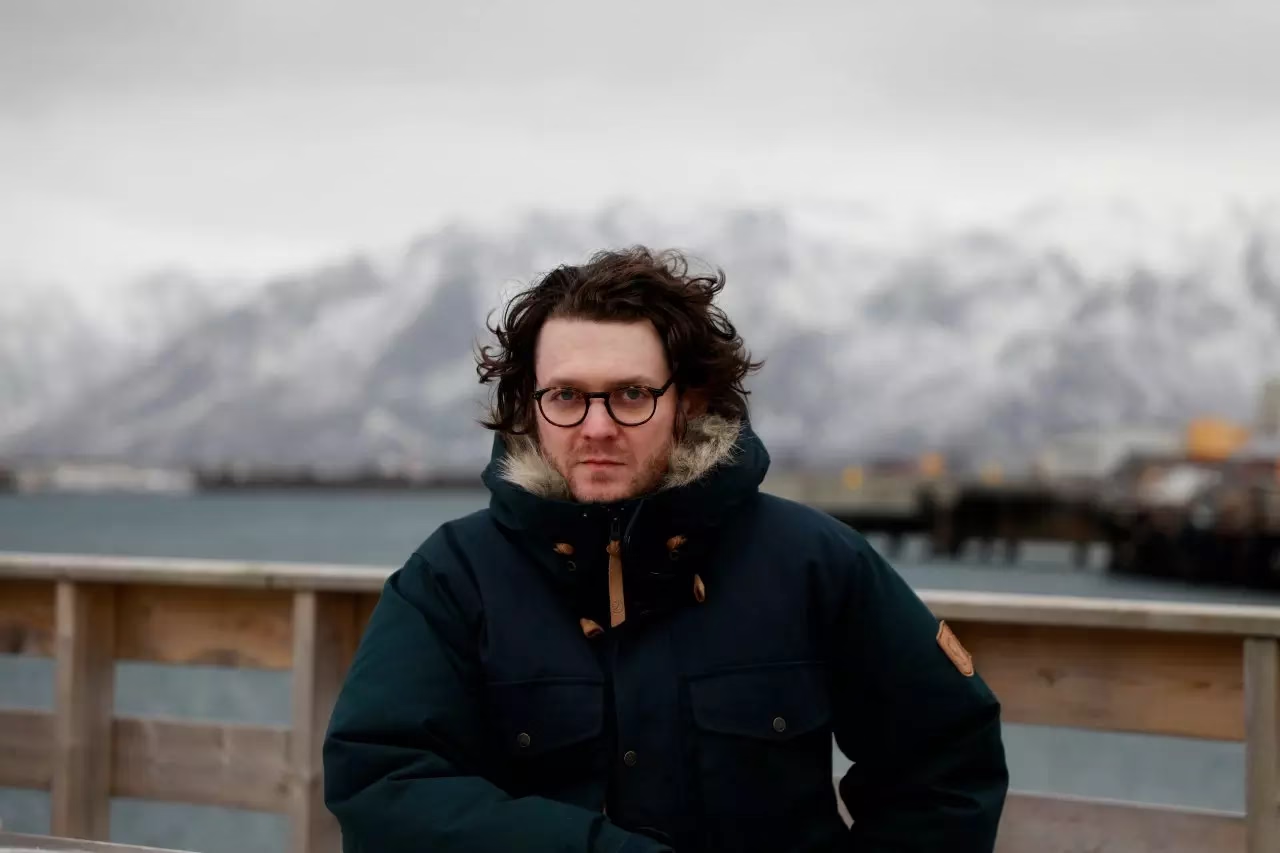
Since the release of his first album as Beirut, in 2006, Zach Condon has both enjoyed numberless enviable successes and been through the wringer. Divorce, mental illness — which clobbered his body and grounded him as a touring act — the whole nine yards.
"I canceled everything, and I just told the band, 'Sorry, guys, it's not working,'" Condon tells GRAMMY.com from his home in Berlin, of a third tour that had fallen through due to respiratory maladies. "Clearly, these physical issues were clearly caused by some mental issue.
"I think my body was just like, We've tried everything," elaborates the walking definition of an uneasy tourer. He takes on the voice of his physiology: "Oh, if you take the voice out, he just goes home."
The experience left Condon demoralized and "shattered." But there was a silver lining. In an effort to lick his wounds — and regroup from the mental maladies that had made him turn to substances, and sober up in 2018 — Condon absconded to the arctic Norwegian island of Hadsel. On a colossal organ in a 19th century church, began to throw ideas at the wall.
The result is the magisterial, borderline liturgical Hadsel, which finds the tenacious Pitchfork-era indie darling of yore completing a circle.
"It enabled me to work on my own again; I think I had come more and more to rely on the and and even in the studio," he says. "Doing this one completely alone reminded me of how I started, which was just as a bedroom kind of four track guy.
"It is very liberating to be like, oh, you know what? I'm actually more capable of this than I thought," he continues. "And it's not like I've just creatively worn out and burnt out. It's like there's really a fire burning underneath — if I don't kill myself going on tour."
Read on for an interview with the erudite, incisive Condon, where he elaborates on Hadsel from all directions.
The first thing I thought of while listening to Hadsel was the timbral multitudes of the church organ. The entire record seems to exude from it. What speaks to you about the pure sound of the instrument?
So, there's the pump organ and the church organ. And the pump organ, which is on most of the record, feels like a warm blanket of an embrace, sonically. It's just like the warmest roundest tone and it's just breathing and wheezing in this really nice way and it's kind of droning.
So for me, that was the fireplace at the center of the album — the warmth and the shelter and all that stuff. And then I was getting really into these modular synth things.
[Looks over Zach's shoulder] I noticed.
And when you say timbral, I'm often thinking of that kind of stuff — because there you're teasing out all these frequencies and overtones. And the better you get at it, the more you can get these really interesting tonalities.
But [the organ] is much more chaotic and woozy. And I kind of considered that to be almost like the outside forces, or almost like the weather patterns outside rather than the kind of warm focus in the center.
I liked mixing those too. It wasn't conscious; It's not like I went there and I was like, Oh, you know what's going to be great, is modular synth and pump organ. I just happened to be really interested in both, and that's what happened.
Where do the two connect for you?
What's funny to me is, the church organ feels like the first modular instrument to me. This is all about sound manipulation and tone manipulation. And then the church organ is basically the insane, gothic version of that where it's like, I'm going to make an orchestra of flutes that you can play by hand, but then you can change them into trumpets and mix it with both of them and you can get exactly the sound you're looking for.
So it's that kind of insanity that only humans have. That's one of the reasons I love that instrument so much.
There are so many lineages and pantheons of the organ. Which one are you most interested or steeped in?
I've been learning a lot about the church organs, because it's just so fascinating. But my bread and butter is certainly with the reed organs because they make the most sense to me and they're the most versatile in some ways.
The funniest thing I've stumbled upon is they still have [church] organs in places like Spain and Italy that are so old that they use the system they had before they had electric air pumps. Literally, one monk would just sit there with the giant bellows trying not to push too hard or too slow in order to keep the tone steady, while another monk would sit there and play. Which is quite funny to watch, actually.
That rickety, unwieldy inhalation and exhalation — I'm sure that affected what you were writing, as far as pulse is concerned.
Yeah, it does, too. Usually, they have a kind of bellow — like a reservoir that you fill, and it [emits] one constant amount all the time. It never changes.
But the way I've been using it is not like that. It's like the moment you press down, it'll swell and then go back. And so there really is a kind of expressiveness, even though it drones. And I feel like that's the best way it sounds is when it drones, there is some room for expression.
You lay out the story of Hadsel rather well in the press release. But what place of the heart did the album spring from?
I was quite shattered in 2019. That's a big part of the story. I don't even know if I wrote that down in that part.
But 2018 was the year that I had sobered up, and I was like, 2019, I'm going to take over the world. As in, I'm going to do this world tour, and I'm going to pay my band really well, and it's going to be this triumphant return to form. And the moment I got on the road — I went through three tours. The first one I spent the whole time on steroids and antibiotics because I was sick the entire time.
Jesus.
The second one, I was sick again. Within one week. I got a horrible upper respiratory infection, and I was on antibiotics and steroids, and it got so bad I still had to cancel that tour.
And, then I went on a third tour in Europe. And again, one week into the road, I got terribly sick. And I went to a doctor and was like, "Just give me the drugs." And he was like, "If you keep doing this, you're not going to sing anymore and your body's going to fall apart." It was like, Why would you do this to yourself?
So I canceled everything. I still had all these European dates. I had Brazil, and Mexico, and much more, even. And I canceled everything. And I just told the band, "Sorry, guys, it's not working." Clearly, these physical issues were clearly caused by some mental issue.
And so, when I went up to Hadsel, I was kind of fleeing from all that. I had had these difficult dealings with insurance companies. I had just told the band that we probably wouldn't be touring ever again, which is still true.
I was in a really, really low place. I was fleeing things and all these things that I had pushed aside since I was quite young, 15, 16 years old. Covering everything up with alcohol, and with all sorts of things.
It was all just hitting me at the same time while I was making this record, I didn't think, it's not like I went up there with this perfect plan. I actually was more like, I'm going to go up there and relax.
But then, I saw that they had this organ. So, I brought equipment with me, and I thought it would just kind of be hobby style — just get lost in the music, or whatever. So it wasn't until I came back from Berlin that I actually was like, I can make this mess an album if I try.
To bring it back to the music, how did the other necessary musical ingredients announce themselves — from that warm, foggy, musty bed of the organ?
Well, usually the bed actually started with the frame of the drums. So because I'm not really a percussionist, actually, that's one of the reasons I was bringing this along is I was like, "This will be my drum machine."
I'm super obsessed with old analog drum machines. [Gestures] I have the old Rolands over there, for example. And I would mix the two. And then I started using the modular almost entirely as a drum machine, which originally wasn't why I started using it, but I realized it made these very interesting, bongo-like electroacoustic sounds.
Then, I would just spend hours deep in that sound-making without thinking about melody or harmony or anything at all. That would just get you in this weird, repetitious, kind of train-like state.
Eventually, I would stand back and let the machine just go and go and go, and then I would start playing the organ over it. It just seemed like the natural next step. And then that would lead [elsewhere]; I mean, if you listen, most of the songs are pretty much built around that.
And then, I would throw some melodic elements on and some hand drums, for example. Then, maybe a trumpet line or some French horn. And eventually, I got the baritone ukulele, and I realized that it had the same warmth as the organ somehow.
Overall, what was your approach to harmony on Hadsel?
I was listening to a lot of choir music at the time, but I don't know if I learned anything from it or if I was just impressed by it.
My way of harmony is weird — because when I work with other people, I realize they do it super differently. I have a couple well-schooled brass guys that play live in the band, and they think about it beforehand.
I'll sing one part, and then mute that part, and then I'll sing another part that just sounds nice to me. And then I'll mute that one, and I'll sing a third part that sounds nice to me. And then I'll just unmute and be like, Does that work? Flying blind is kind of the way I go.
I had no idea you were into modular synths, or even theory. Have you always been an under-the-hood kind of guy?
The only instrument I was trained in was trumpet. And then, my teacher spent a whole year [with me] when I was in high school. He sat me down with music theory, and I was so furious with him. In hindsight, I'm like, "That's quite helpful."
I just know the very basics. With this stuff, this is normally not what I'm interested in. I'm normally a crash-and-burn, throw a microphone in the general direction of the instrument. I've never played it before, but this sounds good to me.
And I feel like with production, I got a little more hands-on with this record, obviously. So all of a sudden I was using compressors and all that stuff for the first time in my life.
If it's related to music, I can get into it, basically.

*Zach Condon of Beirut. Photo: Lina Gaißer*
All of this recontextualizes the use of the ukulele, which has been integral to Beirut's music for a long time. Back in 2007, that might have been slotted into the "twee" milieu. But arrangement-wise, it's a counterweight to the gigantism of the organ.
I spend almost all my time on organs and pianos in the same two octaves, which are down towards the bottom. They're under middle C or something like that. I never go above that, because that's the room for those other instruments.
I can get why people would've thought of my music as twee. But for me, that was never what the purpose or intent of it was at all.
In the music industry, I've witnessed firsthand how artist friends of mine have been sloppily tagged and shoved through the system. Was there any resentment, any getting over the indignity of being in the machine?
Oh, absolutely. I would be lying if I was like, "Oh, it never affected me." I hated it. And I spent some years attempting to crawl out of it.
Notably, during [2011's] The Rip Tide and the record after that [2015's No No No], if things were coming to me and I thought they could be misperceived in that way, I would be like, "All right, maybe we skip to a different song," or something like that.
Which is a horrible way to work. I felt very handicapped. I felt like I always had one hand tied behind my back. I felt like I had to prove something to the world, and I was building up this kind of facade. And it's exhausting to do that.
So with the last two records, and definitely with this one, I really just stripped all of that off. I really was like, "I'm old enough now to know I don't come from that generation of cynicism." That's my older brother's voice, practically.
And it's not like he's just this asshole that's always cynical of what I do; he's super supportive. But his friends in those groups — it's like I saw the way that they would chew things up, they'd tear it apart. If it had any vulnerabilities, they would tear it apart.
And with this record, I was like, The vulnerabilities are what made it interesting in the first place. So I'm leaving them. All of it. I don't care anymore.
On New Album Jonny, The Drums' Jonny Pierce Is Finished "Setting Myself Up To Lose"