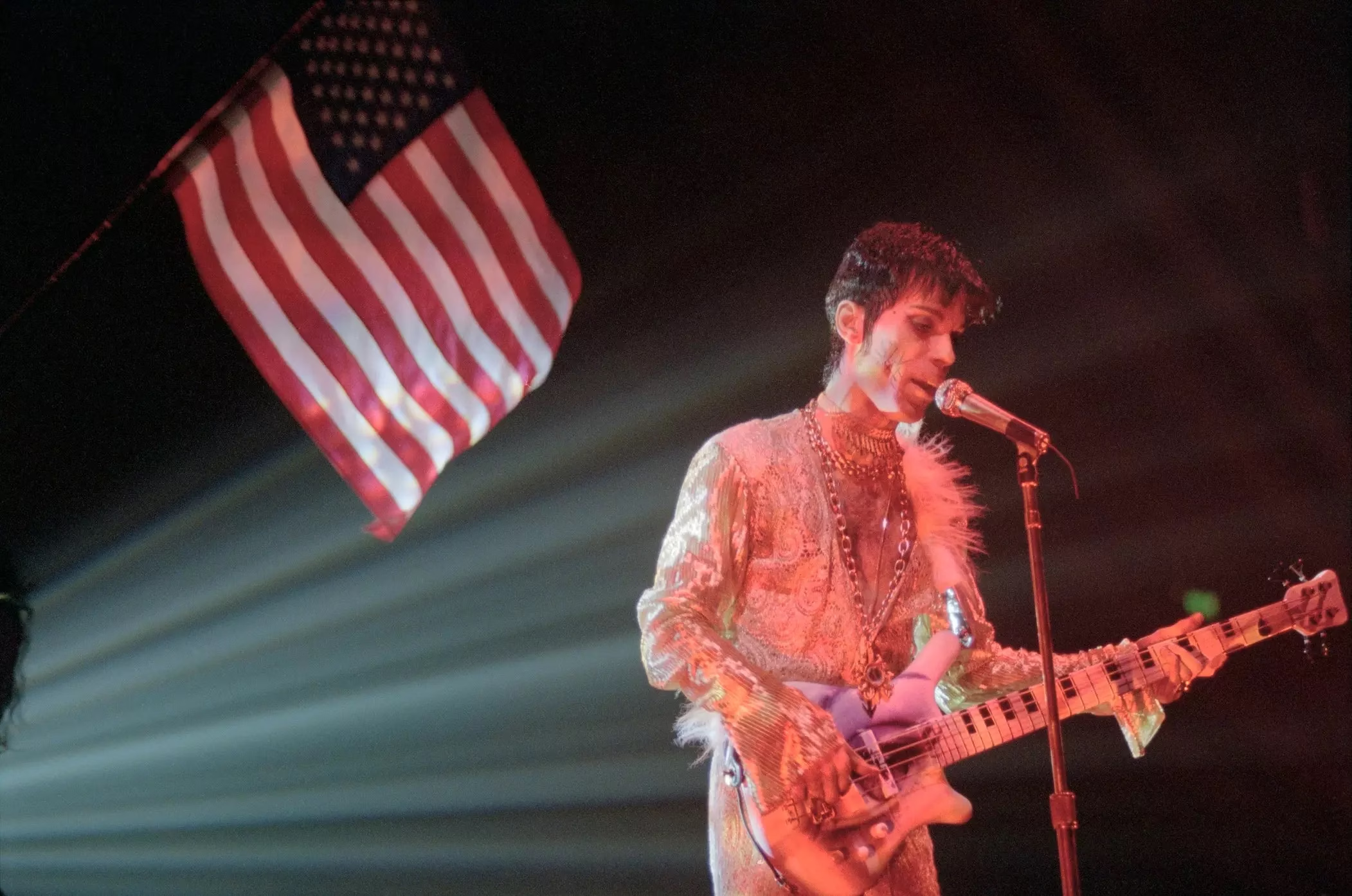
This Independence Day may not find most Americans feeling as free as they might have on Fourth of Julys past. Yet, as the fight to maintain democracy heats up to an uncomfortable degree, we can still seek solace and strength from the songs that are written about America and use them to inspire change.
The 11 songs presented here span more than 50 years of social activism. They collectively illuminate how fighting for rights and equality have threaded American society, and how there's still plenty of room for growth. There's a lot to despair over right now, but the accompanying playlist is intended as a reminder not to lose hope during the long fight ahead.
However you're commemorating the holiday, dive into these powerful songs from Prince and The Revolution, Rage Against the Machine, Dolly Parton and more.
Nina Simone — "Mississippi Goddam" (1964)
Racial segregation and oppression in the civil rights movement battleground states — Mississippi, Alabama and Tennessee — are Nina Simone's focus in "Mississippi Goddam." "Desegregation," she sings, as her band responds, "Do it slow." "Mass participation (do it slow)/ Reunification (do it slow)/ Do things gradually (do it slow)/ But bring more tragedy (do it slow)/ Why don't you see it/ Why don't you feel it?"
"I didn't like 'protest music' because a lot of it was so simple and unimaginative it stripped the dignity away from the people it was trying to celebrate," she wrote in her 2003 book I Put a Spell On You. "But the Alabama church bombing and the murder of Medgar Evers stopped that argument and with 'Mississippi Goddam,' I realized there was no turning back."
Gil Scott Heron — "The Revolution Will Not Be Televised" (1971)
Originally recorded as a poem for Gil Scott Heron's 1970 album Small Talk at 125th and Lenox, "The Revolution Will Not Be Televised" was set to music for his Pieces of a Man album that was released the following year. The idea of not being able to just sit home and watch real change take place still resonates in a digital activism era.
"The revolution will not be right back/ After a message about a white tornado," he says in the piece. "White lightning, or white people/ You will not have to worry about a dove in your bedroom."
Pointer Sisters — "Yes We Can Can" (1973)
Oakland's hit-making Pointer Sisters recorded "Yes We Can Can" the same year as the case of Roe vs. Wade was decided in the Supreme Court. It's an apt time to return to the song's hopefulness as fuel in the fire to regain reproductive rights.
"We got to iron out our problems/ And iron out our quarrels," the Sisters sing. "And try to live as brothers/ And try to find peace within/ Without stepping on one another/ And do respect the women of the world/ Remember you all have mothers."
Prince and The Revolution — "America" (1985)
Thanks to a funked-up thread of the familiar refrain of "America, America, God shed his grace on thee" — from the 19th Century standard "America the Beautiful" — Prince's "America" can pass as a thoroughly patriotic song to people who don't dig deeply into the still-relevant critiques in his lyrics.
"Jimmy Nothing never went to school/ They made him pledge allegiance/ He said it wasn't cool/ Nothing made Jimmy proud/ Now Jimmy lives on a mushroom cloud."
The anxiety of nuclear war that weighed heavily on songs of this era can be understood in the context of the present, with Russian attacks on Ukrainian nuclear power plants that have taken place in just the last few months.
Rage Against The Machine — "Take The Power Back" (1992)
This early Rage Against The Machine song from 1992 stands well today as an activist anthem in the disinformation age of book-banning and school curriculum upheaval. "Take The Power Back" advocates for the truth to be told and for the power to return to the people.
"In the right light, study becomes insight," sings frontman Zack de la Rocha. "But the system that dissed us/ Teaches us to read and write/ So called facts are fraud/ They want us to allege and pledge/ And bow down to their god."
Tune-Yards — "My Country" (2011)
It's been over a decade since Oakland musicians Merrill Garbus and Nate Brenner — together, known as Tune-Yards — released "My Country." But the song's lyrics about America's vast inequalities, especially for those seeking a new home here, still apply just as much as they did in 2011.
"My country, 'tis of thee/ Sweet land of liberty/ How come I cannot see my future within your arms," Garbus sings angrily.
Childish Gambino — "This Is America" (2018)
Donald Glover's unflinching look at being Black in America hits hard — and is especially potent when absorbed with the accompanying music video, which won the GRAMMY for Best Music Video in 2019. The video brings the song to life in vivid detail, including burning cars, police terror and Gambino murdering a choir with a machine gun.
The song's lyrics about the anxiety of guns expresses a sentiment that unfortunately still holds true today, as the first half of 2022 has been particularly deadly with gun violence across the country. "Yeah, this is America," he raps with increasing alarm on the song. "Guns in my area/ I got the strap/ I gotta carry 'em."
"I just wanted to make, you know, a good song," Glover told E! in an interview on the red carpet at the Met Gala in 2018. "Something people could play on Fourth of July."
Glover took home three more GRAMMY Awards for "This Is America" in 2019: Record of the Year, Song of the Year and Best Rap/Sung Performance.
Dolly Parton — "19th Amendment" (2018)
Dolly Parton steps in with some crucial history about women's rights in "19th Amendment," presented in her endearingly bubbly style. The song is a highlight of 27: The Most Perfect Album, a compilation of songs from various artists who wrote about one of the 27 Amendments to the Constitution. (On the album, it's titled "19th Amendment," as each track's title is the Amendment it's about. Parton refers to the song as "A Woman's Right.") The project was released in 2018 by Radiolab at New York's WNYC Studios before the midterm elections.
"It is the duty of the women of this country to secure for themselves the sacred right to vote," she insists in the song.
"Being lucky enough to be a successful woman in business, I wanted to exercise my right to write about the 19th Amendment to praise and uplift women," Parton said in an interview with WNYC.
Gary Clark Jr. — "This Land" (2019)
Gary Clark Jr. is a six-time GRAMMY winner who is lauded around the world for his artistic prowess. But as an American — and, more specifically, as a Texan — he is still keenly aware of how racism still persists in this country. "This Land," which is the title track to his 2019 album, was written after a neighbor confronted him in disbelief that a Black man could own the property where Clark lives, a 50-acre horse ranch in Kyle, Texas.
"N**** run, n****a run/ Go back where you come from," stings the chorus.
"I just wanted to let it be known: this land is your land, but it's mine too, and we all, as Americans, as citizens of this country, should all have an equal shot," he told The Guardian.
Maino — "I Can't Breathe" (2020)
The death of George Floyd inspired a lot of powerful music in 2020. Before the late Eric Garner was killed at the hands of NYPD in 2014, he said, "I can't breathe," which Floyd also said when he was killed by former Minneapolis police officer Derek Chauvin. The phrase is now associated with the Black Lives Matter movement and international activism against police brutality.
While several artists have released songs pertaining to police brutality, a few have specifically named songs "I Can't Breathe" — including H.E.R., whose single won the GRAMMY for Song Of The Year in 2021. "Stripped of bloodlines, whipped and confined/This is the American pride," she says in a spoken word portion of the song.
Brooklyn rapper Maino also released a song called "I Can't Breathe" in 2020, using the compelling track to call out the history of the continued police brutality against Black people. "Think I'm tired of bein' silent," he rhymes over an interpolation of the music from Fugees' "Ready or Not." "Tired of people not tired to see us dyin.'"
Lukas Nelson — "Untitled" (2022)
On June 27 — three days after the Supreme Court overturned Roe vs. Wade — Lukas Nelson performed an untitled song on his Instagram account that reacts to the controversial decision.
"Now the stars don't shine for her at night/ They're just holes in the sky," sings Nelson (who is Willie Nelson's son and the frontman of Lukas Nelson & Promise of the Real). "They don't give no light/ And the darkness lingers/ Endlessly/ For she must carry the seed."
Rolling Stone noted that it joins notable songs about abortion that have recently been released, such as "Disorders" by Ani DeFranco and Stone Gossard, or re-recorded, like Cyndi Lauper's new version of 1993's "Sally's Rights."
The soul of America has long been reflected in the music that's written about it. As history has shown, artists aren't afraid to speak their minds in song — and as the fight for a more equal, peaceful country continues, there are likely many more to follow.