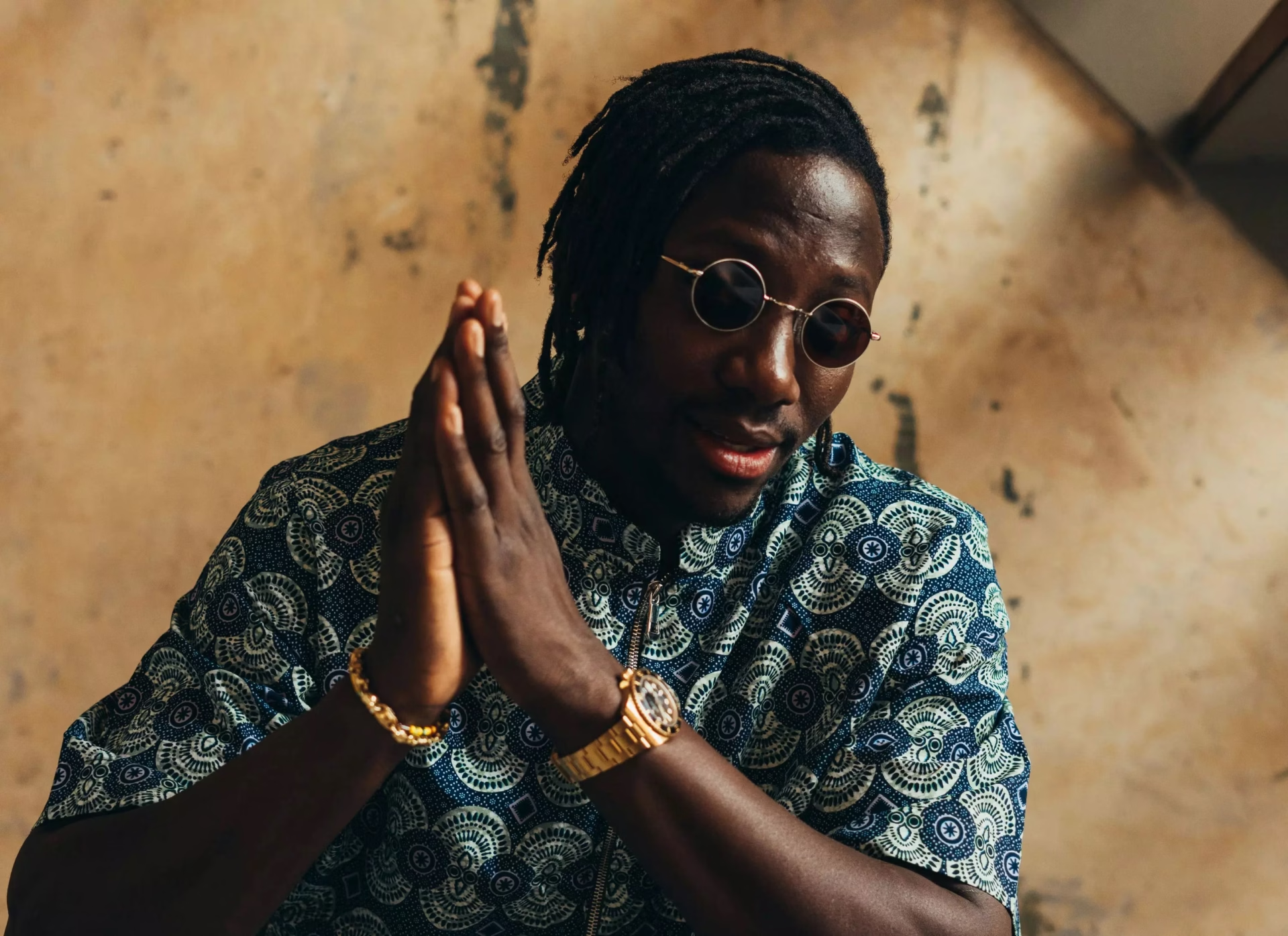
New York City's dance music scene is notoriously hard to break into, especially as top promoters compete to book big name DJs rather than foster local talent. But that hasn't stopped Brooklyn-based, Benin-born AMÉMÉ from making a name for himself and getting recognition from lauded dance acts like Black Coffee, Jamie Jones, RÜFÜS DÜ SOL, Damian Lazarus and BLOND:ISH.
Last year, Mixmag named AMÉMÉ one of their breakthrough DJs of the year and Beatportal included him in their Beatport Next class of 2022. When he was having trouble getting DJ gigs, he created his own party, "One Tribe," at popular Bushwick venue House of Yes in 2017 to promote African-leaning house music. When labels weren't signing his tracks, he got their attention with his own One Tribe Records.
Inspired by his stylish mother and with support from his fashion designer sister, AMÉMÉ launched a One Tribe clothing brand and DJed New York Fashion Week parties. His commitment to carving out a path to spread his percussive, synth-laden brand of Afro House has paid off and catapulted him towards his dreams in ways he could never imagine; including forging mentorships and friendships with Jones and Black Coffee.
During the pandemic, he was a regular on BLOND:ISH's Abracadabra DJ set livestreams on Twitch, spreading his infectious sound beyond New York City. Soon after, he gained traction in the party zone of Tulum, Mexico where he first got to play with his idol Black Coffee. Things have only gone up from there: He's since played in other dance music hubs Ibiza, Miami, Berlin and Amsterdam, and major festivals like Coachella, Outside Lands, CRSSD and Burning Man.
Raised by a Nigerian mother — who is a best friend, business and spiritual advisor — a Beninese father, and Togolese grandmother, in a household filled with an eclectic mix of music, it's only natural for AMÉMÉ to imbue his work with multicultural elements. The track, "Kaleta," which he released in March on One Tribe Records, features his mom singing a traditional Nigerian children's chant. "Patchido," released in 2020 on One Tribe Records, featuring Don Bello Ni, is a traditional chant from Benin about fixing and reusing things.
GRAMMY.com recently sat down with the artist born Hubert Amémé Sodogandji at the Arlo Williamsburg Hotel in Brooklyn — where he helped build their music program and was a resident DJ. AMÉMÉ radiates warmth and creativity, proof that he has lived up to the meaning of his last name: "the thunder is about to strike."
His mother, Hélène D., also joined, and shared what it meant to her to see her son representing West Africa on the global stage: "[I feel] pride. He has a deep conviction that was made for this. And this is just the beginning; I know he will be doing this for a long time."
Your latest single is "Ando High" with Tom & Collins out of Mexico City. Can you tell me about the different sonic elements on the track?
I have been friends with the guys from Tom & Collins for a while. I met Jorge maybe six years ago when I first played in Mexico City; he booked me to play at the club [he was working at]. After that, They came to see me play and I could see that they were doing their homework, like, Let's see where this kid is sonically. They realized I mix a couple of [different styles] when I'm playing. They reached out to me; "We have this Latin vocal and want you to bring your vibe to it."
The vocal hit me the first time. When I hear something for the first time, I always let my emotion kick in. I don't like to listen to it twice. Because at the end of the day, you want to do something you like and you want to do something that's going to work.
The drums, djembe, toms, percussions, shakers and everything else came from me. They had the vocal, and had already laid a little bit of the kicks and snares and most of the tech house elements in the track. I brought all the German synthesizers and some of the melodic aspects of this track. Latin house meets Afro. It's a great example of what I always wanted to do, of what I wanted to stand for. Obviously, stick to my original sounds, but then bridge a couple of different gaps by bringing different elements together. This is about expanding the boundaries of what Afro house is.
Afro house has definitely been having a moment in the global dance scene. What do you hope comes with it as it continues to rise?
The next big move that I hope happens and I hope I am a part of is for the Afro house world to collide with the Afrobeats world. I think that's when major things are gonna start happening. Afrobeat is massive on a commercial and pop level. Guys like Burna Boy, Davido, Wizkid and Asake are crushing it all around — they're selling out stadiums.
Afro house is still a smaller bubble and we just need some of those DJ/producers to start communicating and connecting with those Afrobeat artists to bring Afro house to the popular crowd. You can see it with amapiano, which just came out a couple of years ago and is more popular than Afro house.
Amapiano is the closest thing to electronic music that has happened in the Afrobeat world. A win for amapiano is a win for all of us because it's an extension of what we do.
Do you ever feel like you get pigeonholed into Afro house?
Automatically, because of my origin, but also because that's the sound I've championed for some time. A lot of the Afro house DJs and producers are kind of stuck in this in a box where they play the same lineups with the same promoters booking them.
It's a very restricted scene if you're not at a "Black Coffee level", and he's probably the only one breaking those boundaries. Most of the promoters that are booking purely Afro sounds are in a restrictive space where the artists don't really get to jump on other festivals.
What kind of music did you listen to growing up? What was playing in your house?
Coupé-décalé from the Ivory Coast. Fela [Kuti] — the original Afrobeat. P-Square — they paved the way for guys like Burna Boy and Wizkid. Dombolo, which is this sound from the Congo. And my mom used to listen to French music, French classical sounds. And I loved French rap and was in a French rap band. There was always music at home.
How have you balanced being an artist on the rise with your own goals and taking care of yourself?
I've always been a workaholic at the core. I've done it all. I had three jobs at the same time while going to school. I never said no. Anything I've done professionally, I've always done it well. I will outwork most people. I think of 50,000 things at the same time but I will have the patience to sit down the whole day and be disciplined about how to manage my time. I just try over and over and think about it until I get it right. Honestly, that's just how I was raised. I think everything I did before prepared me for the load of work that needs to be done.
I'm a naturally competitive human being but I never look at anybody outside of myself as major competition, I look at them as inspiration. I love to see what other people are doing because that can only inspire me to find my own path. The cake is so big that everybody can have a piece of it. It's easier said than done, for sure, because it's such a fluctuating space. Some people become crazy viral in a day and other people just have to work for it. I'm okay with that. I definitely see a plus in building something from the ground up.
What's the meaning of "Kaleta" and what inspired you to feature your mom on it?
I always wanted to bring her into my creative process because we have a very close relationship. I was looking for different traditional chants from my culture. "Kaleta" is a chant that kids sing, so you need a high-pitched voice. She has an unusual high-pitched voice that could blend into that space. We recorded it in my living room. The first version of "Kaleta" happened almost eight years ago, but it never came out.
When I was in Berlin, I went back to the vocals and wanted to create more of a club banger. I came back to New York and recorded a couple more samples from her. [My mom's] a very active part of my life and she's always giving me ideas. I'm always asking her what she thinks about [things I'm working on]. There's actually a second track with her coming out next year that I spent almost half of the year testing out.
What does it mean to you to have support from House giants like Jamie Jones and Black Coffee? And how did you first get connected with each of them?
Black Coffee has always been an idol of mine. It's crazy what he's accomplished with all the setbacks that he has had in his life. When I started to play, a lot of people said, "You remind me of Black Coffee musically." But I wanted to create my own story. I think this is also one of the reasons why we have such a great relationship, because he knows I'm not trying to be him.
The second show I played with him in Tulum, he played right after me. I saw his face [when I was playing] and he was shaking his head [to the music], he was feeling it. [When it was his turn] he stopped the music and he gave me a round of applause in front of the crowd. These are the moments you live for. And this was right before my rise. Sometimes it's important for me to slow down and have appreciation for these things because this is not normal. It's very easy to get into the normality of things and not appreciate it.
Jamie's managed by my manager as well, but there's a lot of other artists on the team. We got close two years ago during Art Basel. Louis Vuitton was doing an event and we were invited and our manager was like, "I'm not gonna go, you guys want to go together?" I was literally crossing my fingers to see if he'd say yes. We spent the whole day together…and spoke about so many things. At the end of the day he looks at me and says, "Let's work on a track together," and the next day, he sent me something. I like to believe that there was a nice, genuine vibe around what he does and what I do.
I have a lot of respect for those two individuals; it's always a good vibe when I'm around them. And hopefully soon I get to do something with Black Coffee.
Can you share your vision and dreams for One Tribe?
The first version of One Tribe was a space where we could champion African-inspired electronic music. I could not get gigs in New York and I wanted to create a space for it. And then, when I had challenges with releasing my first song, I launched One Tribe and put the team together. All the labels that I had sent music to were like, "How come you didn't send us this track?" I said, "Check your email from six months ago, you got it." A lot of people nowadays don't have the backbone to say they like it, but they will when they see everybody else jumping on it. So don't be discouraged if some people are not giving you the "yes" that you want. If you really believe in it, and things are moving, look at all the little wins and keep going.
When I started really touring a lot as AMÉMÉ and I wanted to really bring One Tribe to the next level, I decided that 2022 was only going to be about the music. Next year, we have some very exciting news and lots of very interesting stuff, like showcases, partnerships, and stage takeovers at very interesting festivals and iconic venues.
The fashion side, we'll be coming back through capsule collection releases and collaborations. It's gonna be a 360 experience. I can't wait because this is even bigger than me, this is about being able to create a movement where the sound is championed.
Tell me about some of the artists that you've recently signed to One Tribe [Records].
Bontan is UK-based and is honestly one of my favorite artists of all time. I always wanted to get him in because of the way he lays his drums. He has had a very amazing year; he's remixed Green Velvet and is on most of the Paradise lineups. I'm also very aware of creating a diverse space because I also want to give space to other upcoming, as well as established, African artists to flourish. I've spoken to guys like Shinza and more on-the-ground artists like Vanco from South Africa, and we have [released music from] NenaHalena from the UK.
I live in New York and travel all over Europe, so I'm a lot more exposed to European and American artists. Now I'm trying to actively get more in touch with African artists. We are opening our doors to the world and the representation needs to be there; also on the female side. I want to make sure we have an open-door policy and people can see that.
Who are some other African dance music producers that you think should be on people's radar right now, or that you want to sign to One Tribe?
There's Nitefreak. Musically, he's really crushing it and he definitely deserves more recognition for the work he's done. There're guys like Van Gogh. He hasn't put much out there lately, but I've heard some of the tracks he's been working on I'm like, "Wow, dude, people need to hear more of this." I would like to hear more from Sona, Black Coffee's son, on a musical level, not just on a DJ level.
The reality is there are producers in West, East, North and South Africa that are talented and I'm not doing enough work to have access to those sounds. I want to put on a South and West and East African tour. It's not a money thing, it's more like let me get there and try to figure out how I can impact and support it. And also let it be a learning moment for myself as well. I'm West African and I grew up in Africa for 17 years, but I've been away for a while. Things have changed.
What are your dreams and goals for AMÉMÉ and One Tribe in 2024?
I think who AMÉMÉ is right now and what maybe it was the last two years is a little different. I've matured a lot in terms of who I am and what I want. Everything happens so fast, that I had to take a little step back and ask where is this thing going? And where do I want it to be? I want to have a legacy. I'm still committed to creating something that is bringing people together; I want to be that bridge. I want to be the individual that is pushing the boundaries of things to allow more people to come into the space.
The one thing that is different from me two, three years ago, was that I wanted to get to the top. I truly believe that if I do something impactful enough, it will speak for itself. I'm gonna focus in more on creating versus chasing, but I'm still dedicated.
Mr. Eazi’s Gallery: How The Afrobeats Star Brought His Long-Awaited Album To Life With African Art