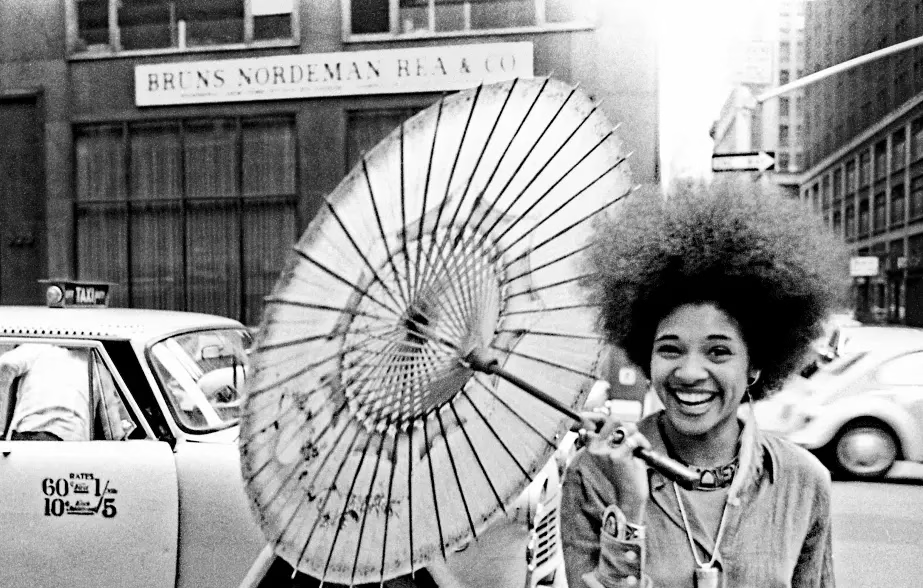
You know the Bechdel test, which measures the number of women in fiction who talk about something other than a man? Let's apply a metric like that to singer/songwriter Betty Davis.
Sure, her husband of a year, Miles Davis, is a big part of her story, and she of his. She inspired his tunes "Mademoiselle Mabry" and "Back Seat Betty," and appeared on the cover of his 1968 Filles de Kilimanjaro album. Davis even shepherded him into the look and sound of '60s rock, spurring her husband to make albums like Bitches Brew. In his infamous 1989 biography Miles, the musician called his former wife "a free spirit — talented as a motherf***er — who was a rocker and a street woman."
But if you remove the Prince of Darkness from her timeline completely, Betty Davis would still be a major player in the funk sphere — with unforgettable style, attitude and autonomy.
Davis' body of work may be mostly confined to the early- and mid-'70s before dropping out of music for decades — but what a catalog. Despite not getting their proper due until the 21st century, 1973's Betty Davis, 1974's They Say I'm Different and 1975's Nasty Gal are must-haves for any funk collection — and so is Is It Love or Desire?, recorded in 1976 but unreleased until 2009, when Light in the Attic saved the day.
All four albums are imbued with ferocity, sexuality and rhythms that could compel a corpse to get on the dancefloor — and today, the world is a little less kinetic. Davis died on Feb. 9, in her almost-lifelong hometown of Homestead, Pennsylvania. She was 76.
In recent years, Davis had enjoyed a resurgence in popularity. In 2017, she got her own documentary, Betty: They Say I'm Different. In 2018, Davis had her own episode of Mike Judge’s animated “Tales From The Tour Bus,” ending a season that featured Bootsy Collins and James Brown. With Questlove's 2021 documentary Summer of Soul, her tune "Uptown (To Harlem)" — recorded by the Chambers Brothers — reached a new audience. Her music was featured in TV series from "Girlboss" to "High Fidelity" and "Orange is the New Black."
Davis may have not been a capital-F feminist, but They Say I'm Different is full of examples of how she led the charge as an independent Black woman — and how young, female musicians of color can follow her lead. "I asked my grandmother if I just had to do as I was told — be sweet and pretty for the boys," she's quoted as saying in the 2018 documentary. Grandma responded by playing her Ma Rainey — charting her a course in the lineage of the Mother of the Blues.
Contemporary artists took notice. According to the aforementioned statement, eight-time GRAMMY nominee Janelle Monae called her "one of the godmothers of redefining how Black women in music can be viewed"; four-time GRAMMY winner Erykah Badu added, "We just grains of sand in her Bettyness." And Light in the Attic's Matt Sullivan cited her "unbending DIY ethic," which she forged by taking control of her songwriting, production and image.
For a brief tour through the career that funked up the world, here are five essential tracks by Betty Davis.
"Get Ready for Betty" (single, 1964)
Before Davis was Davis, she was Betty Mabry — and she knocked out this self-referential single in 1964. While it fits more in a streetwise girl group mold than the funk-with-teeth Davis would become famous for, it's nonetheless a charming, hooky and driving statement of purpose. "Get ready for Betty," she sings in the chorus. "I don't mess around." True that!
"If I'm In Luck I Might Get Picked Up" (Betty Davis, 1973)
This is about where primo Davis begins — her self-titled debut can shoot electricity through your cells. If you don't reflexively nod along with "If I'm In Luck I Might Get Picked Up," do you even have a nervous system? Her cat-in-heat yowl with a male accompanist egging her on is pure joy — and it's not hard to hear how this music galvanized a generation of Afropunks.
"He Was a Big Freak" (They Say I'm Different, 1974)
Davis got even more savage with They Say I'm Different, perhaps her ultimate statement of intent. "He Was a Big Freak" turns up both the volume and sex: "When I was his mother/I'd hold him like a baby in my arms/ When I was his lover/ Oh, I'd drive him out of his mind!" she insists. It all sounds like she's got a furry, high-heeled boot on his neck, demanding satisfaction — or else.
"You and I" (Nasty Gal, 1975)
Any number of clock-cleaning funk tracks could conceivably make this list. But to get a fuller scope of Davis as an artist, consider how she could operate in the blue part of the flame. "You and I" finds her not roaring, but vulnerably crooning. "I'm just a child tryin' to be a woman," Davis sings, though she sounds nothing if not womanly.
"Bottom of the Barrel" (Is It Love or Desire?, 2009)
Any '70s artist with a random album in 2009 is bound to raise eyebrows — did some bushy-tailed up-and-comer write songs for them, produce them and trot them back into the spotlight? (No names named here.) But Is it Love or Desire? was recorded back in '76 — it just didn't see the light of day for decades. The whole program is worth hearing, but the mighty "Bottom of the Barrel" displays how her music could have only grown more brazen and inspired.
Luckily, in 2022, we get one more: Crashin' from Passion, a reissue of a 1979 release. Until then, if you love funk but don't know Betty Davis, you're in luck — get picked up.