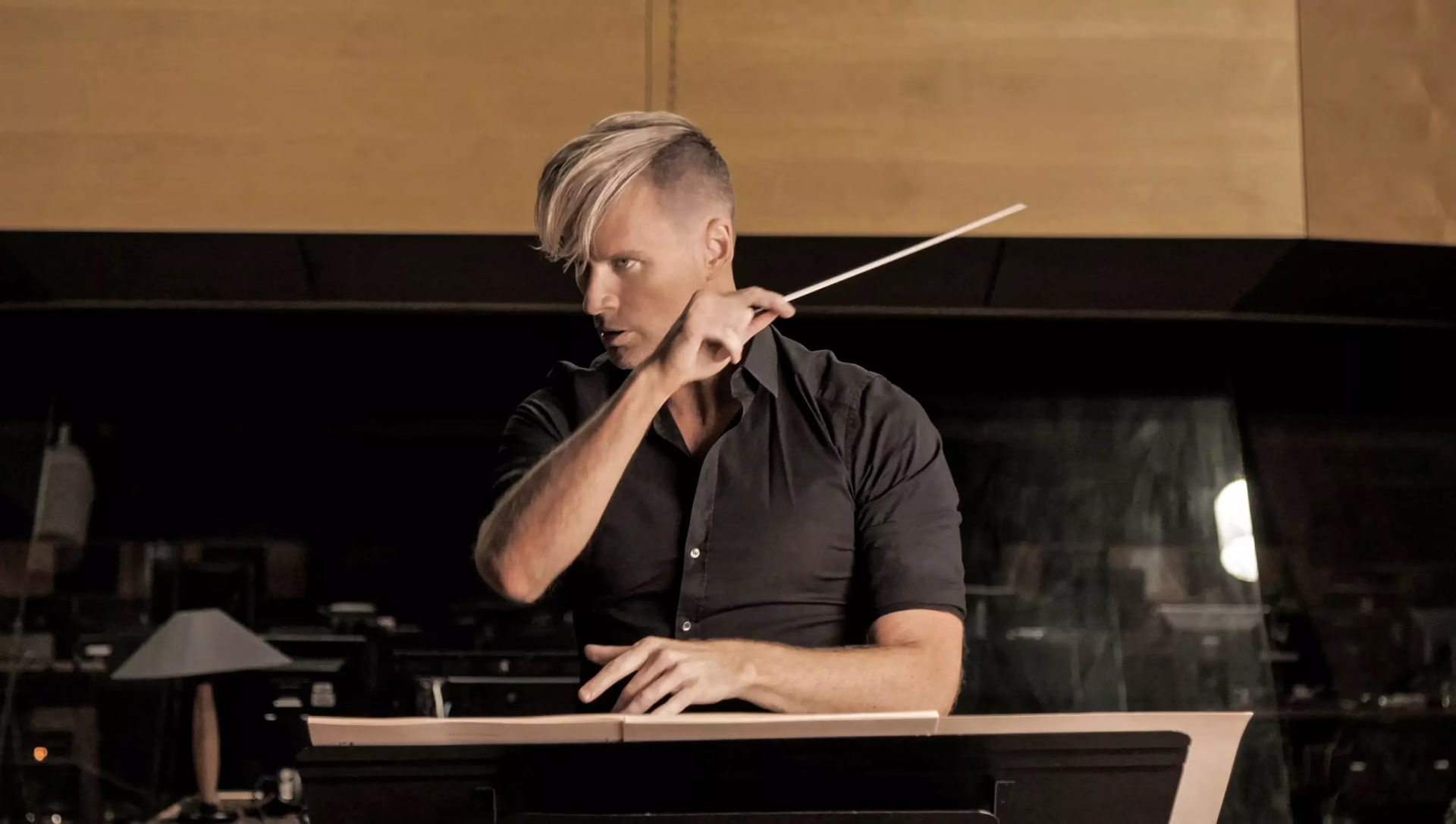
Even after nearly 30 years in the entertainment business, Brian Tyler is still seeing his childhood dreams come true. He's scored reboots of Rambo, Rescue Rangers, Teenage Mutant Ninja Turtles, Transformers and Power Rangers, and worked with heroes like Steven Spielberg and Danny Elfman.
This year, the award-winning composer added the 2023 reimagining of Super Mario Brothers to his extensive list of dream gigs. Like many kids growing up in the '80s and '90s, Nintendo was a fixture in Tyler's life, so when "Mario" creator Shigeru Miyamoto reached out to him about scoring the reboot, the decision was a no-brainer.
A longtime admirer of legendary composer John Williams, Tyler decided to craft new themes imbued with what he calls "built-in nostalgia" (á la Williams' E.T. score) while paying homage to the trailblazing game. His strategy worked — the bombastic score has earned praise from critics and fans alike.
Six weeks after The Super Mario Bros. Movie was released, Tyler had another big-time score hit theaters: Fast X. He has helped craft and evolve the sound of the blockbuster Fast & Furious franchise since 2006, and while he counts all of his Fast work among his proudest achievements, Fast X is his favorite to date.
Whether he's working on a theme for Rita Repulsa, Luigi or Dom Toretto, one thing can be certain: Tyler is giving it his all. "The only thing that gives me any anxiety about writing music is that I don't wanna let down anybody that created this thing that I love. I want to be associated with it. I want the movie to be great."
In the midst of preparing for his next endeavor — an immersive live concert experience — GRAMMY.com caught up with the composer to chat about some of the most epic moments of his career.
Passing Out Programs To His Musical Heroes At The GRAMMYs
At 12, I was a drummer on The NAMM Show, and I remember talking to a producer, either Elton John's or Metallica's, and telling them, "I want to go to the GRAMMYs. It's my dream." And they were like, "Okay, you're not really hired. But you can come, you can wear a little suit and hand out [the programs]."
So I was there and they put me where the artists come in. I was meeting legends, one after another — Joe Satriani, Metallica, A Tribe Called Quest, Chuck D, Q-Tip. It was crazy. I was so stoked because I was looking up at these artists, like, "Wow, that's the impossible dream."
The funny thing is, Tom Morello from Rage Against the Machine — who I met at either NAMM or the GRAMMYs — now we're friends. Years later, we've reconnected and now, as Madsonik, I've recorded a song with him called "Divebomb."
Playing With Taylor Hawkins
I was in a band with Taylor Hawkins from the Foo Fighters when I was 13, and he was a little older. We were both drummers. I introduced him to hip-hop and Depeche Mode, and he played me Rush for the first time, which changed my life. He was such a fan and, of course, he became friends with them. I met Neil [Peart] and all that. But Taylor was a friend, and we recorded together here at my last studio. We did songs together through the years.
I remember we played in these battle of the bands [competitions], and one of the bands — right before they hit it big — was No Doubt. We were the younger guys, [and] we loved playing super-complicated things. You know, you're like 13 and you want to run before you can walk. We would just shred.
Befriending Kobe Bryant
I met him at a John Williams concert at the Hollywood Bowl. Kobe is my favorite all-time sports figure. I started scoring the same year Kobe joined the Lakers, so we have this thing, right?
I've known John Williams for years and years. He helped me out early on and has always been supportive. And I'm backstage, and then I look over and it's Kobe Bryant! I'm like, "Oh. My. God." And I'm standing there, and he's kinda looking over at me and I go over, and he's like, "You are? Oh yeah, yeah, I know who you are!"
Turns out, he's a huge film score guy. His daughter too. He rehabbed his Achilles to the Ironman 3 score, amongst other things. He loved Hans [Zimmer] and John Williams.
We ended up becoming friends. We would go to lunch and dinners and talk about how he was the heir apparent to Jordan. And how we're standing on the shoulders of giants. He saw John Williams, who is my Michael Jordan. And when he saw me conduct, he noticed that I copy this same really idiosyncratic move that John Williams does when he's conducting. I didn't even realize that I did it! And Kobe is like, "That's just like me. I didn't realize I stuck my tongue out when I would be in iso," which is a Jordan thing.
When he was coming back right after rehabbing his Achilles, Nike wanted to do an ad campaign about how he's weathered the storm and he's coming back. So Kobe's like, "Do you wanna write my theme?" So I did. This is my favorite basketball player, and we became friends, and I didn't wanna let him down.
Composing For "Yellowstone"
With ["Yellowstone" co-creator] Taylor Sheridan, whether we're working on "1883" or "Yellowstone" he sends me the script and I start writing just based on an impression. I don't write to scenes; I usually write themes and suites.
In a sense, the music has a true actual history to it before they even film. As opposed to, I get the film, I look at it, then dive into some random theme in the middle — and it might only be 30 seconds, and you can't develop the whole theme.
What I want is to be almost like a writer — good screenwriters do this — for even a minor character, they'll write a whole background for themselves, and they [share it] with the actors. I want all those themes and everything to almost feel like they exist outside of time and before the story happened. So I'm already making references and kind of variations on a theme at the beginning of the movie. It's not the exact way the theme ends up being developed later in the movie. It's almost like doing it ahead of time, telegraphing what it might become and then it can develop. \
\
I always find it very important to establish those things at the very beginning. The cool thing about Taylor Sheridan, he takes those themes and plays them on set, like through the speakers while they're doing the scenes. And whenever I meet the actors, like Sam Elliott and everyone on the show, they know my music. Even the costume designer and the director of photography.
Our lives are marked by music. You get married, you have your first dance — and the music as you walk down the aisle — and you go to work out or take a run. So it's really cool that Taylor recognized that and will imbue the performances with this kind of musical soul that I was already giving it before they even shot anything.
Reimagining "Super Mario"
When I was growing up, I played "Mario Kart" and "Donkey Kong Arcade." I had my N64. And when I was a little kid, I would get [Electronic] Gaming magazine. I remember I had cutouts of stuff, and I remember articles about Koji Kondo and Shigeru Miyamoto — the guy that invented Mario. And then, here I am, just cruising along working and it's like, "Hey Brian, we want to set up a Zoom call with Shigeru Miyamoto." And I was like, "What?!" We talked about Mario.
I told them I wanted to pay tribute at times to the original themes from the game, but do new things that could flow into the scale of what a movie is, as opposed to a game. I wanted to pay homage, but at the same time, I want to write new themes — like the music John Williams did for E.T. — that feel like what I call "built-in nostalgia," where it's new themes, but you feel like it is Mario already. They loved that idea.
I wrote this 12-minute suite before I started the movie, and played it for them. By the end of it, they're like, "This is also Mario. And we want these themes to be the new Mario themes, along with making a nod to me — a love letter to my experience as a kid playing the game. Like it became real, you know?
There was no ego from Nintendo at all. And the fact that they came to me, way on the other side of the world. Koji Kondo, the guy that wrote all the original Mario themes, he's showing me his DVD collection on Zoom to prove that he's a fan. It was so cool.
Adding To The "Fast & The Furious" Legacy
At the very beginning, the movie's conceit was, "Hey, what's up? I'll race you for pink slips. Sick." So I did more hip-hop. Let's say 80 percent was licensed songs and 20 percent was score. Then all of a sudden Fast and Furious Five comes along, and it starts becoming a little more serious. It's about heists and family, and it's epic.
As each movie kept going, the balance started switching. The score started becoming more prominent. We're always kind of pushing forward the envelope of what you can do with the idea of orchestra with beats, and sound, and groove, and all those things that are sonic ear candy. But at that point — and now it's evolved even more with each movie — the big change is I started writing leitmotifs [themes] for a character.
Before we knew it, the sound of Fast and the Furious was utterly its own. If you look at a chart of how I did the score, it most closely resembles something like a Star Wars or a Lord of the Rings, where you have all of these different themes. It's like an old-school John Williams' score but it sounds modern.
Now we have [Jason] Momoa, the coolest villain ever. And the new theme for him, I'm so happy with it. Typically, with a villain in a movie, people go low dirge-y, just bad-guy music. And here's the thing — Momoa's character, since this is told from his perspective, you have empathy for him, and you understand his origins and sympathize with why he became who he was. So I didn't wanna write, like, a bad guy theme.
It's elegant. It starts in the strings, violins and the harp, but it kind of has this sneaky, sensual vibe that's very attractive. You almost admire the way he cuts you down and talks to you. And he's one of those villains that you have to admit to yourself that you like. So the theme is really elegant and kind of sophisticated, but you know something is f—ed up with this guy, in a beautiful way.
I feel that Fast X is our Empire Strikes Back. It's dark. It's intense. It's really amazing. And you have an introduction of a character that kind of takes over. He can walk in a room and suck all the air out of it, you know? So the theme had to be up to par, and a central idea — which is usually not the case in these types of films that are usually kind of relegated to commercial summer blockbusters.
For me, the bar of difficulty is in a different universe than anything else, because people have associations and judge books by their covers. For me, it's always been the most interesting, challenging, pushing forward. And this is my favorite score of the series.
From 'Encanto' To "Euphoria" And "Grand Theft Auto V": Behind The Making Of A Great Soundtrack