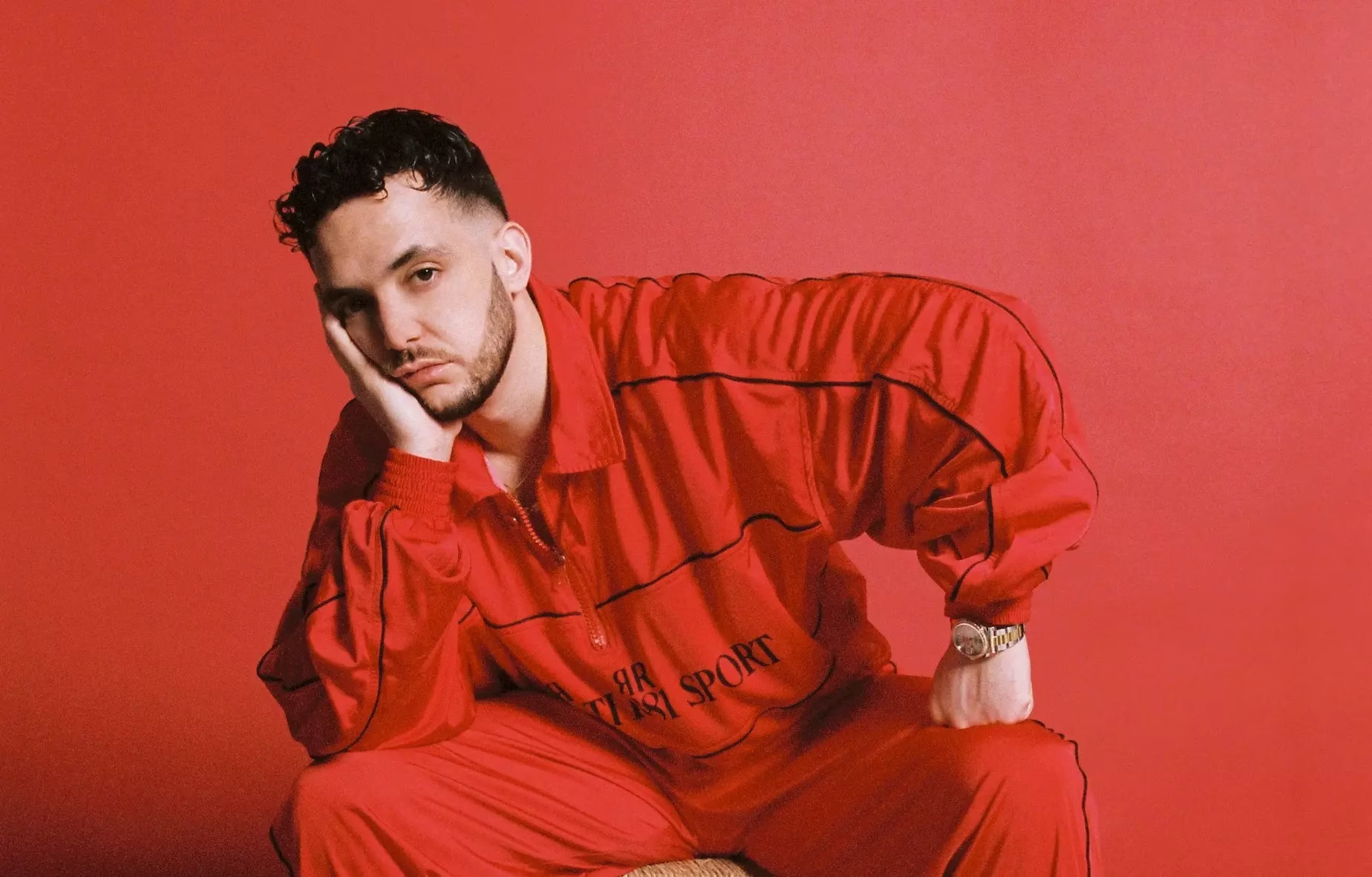
As soon as El Madrileño — C. Tangana's majestic, all-encompassing tour de force of an album — came out in February of 2021, the Latin music community unanimously agreed that this was one of those rare records that single-handedly define the zeitgeist of an era.
Moving effortlessly from confessional folk-rock to flamenco roots, the album also explores urbano beats, Regional Mexican harmonies and progressive pop. The 14-song LP boasts a stellar gallery of guests and collaborators, including Toquinho, Eliades Ochoa, Jorge Drexler, Kiko Veneno, Andrés Calamaro, José Feliciano, and the Gipsy Kings, among others; a 2022 re-release featured six new songs, including a duet with Nathy Peluso.
It's an unprecedented boom of both critical and commercial success for 31-year-old Antón Álvarez Alfaro, who began his career in 2005 rapping under the moniker Crema. After studying philosophy in his native Madrid, he joined the band Agorazein in 2008 before releasing his first solo LP as C. Tangana in 2011.
After landing a top 5 hit in Spain with “Mala Mujer” in 2017, he further gained recognition (and a few Latin GRAMMYs) for co-writing on Rosalía's 2018 album El Mal Querer, including her now classic flamenco-pop single "Malamente." By the time he set out to create his second album, C. Tangana had a number of Spanish hits of his own — and had ultimately found his true voice as a pan-Latin revolutionary.
With El Madrileño, C. Tangana confirmed his status as one of the most creative singer/songwriters in contemporary Latin music. That's now been proven with his first GRAMMY nomination, as El Madrileño is up for Best Latin Rock or Alternative Album at the 2022 GRAMMYs. (The album won C. Tangana three more Latin GRAMMYs in 2021, where it was also nominated for Album Of the Year.)
C. Tangana spoke with GRAMMY.com about his globe-spanning album process, how his "cosmovision" inspired such wide-ranging sounds, and what his nomination means to him.
El Madrileño is the kind of sprawling album that functions as a defining cultural mosaic. It reminds me of the Beatles' Sgt. Pepper's, Beastie Boys' Paul's Boutique and The Avalanches' Since I Left You — all albums that conjure the illusion of a thousand songs wrapped up into one. How did you tackle the process of creating such an ambitious piece of work?
I've always been curious about many different things and enjoy stepping outside of my comfort zone. The initial challenge with El Madrileño was going beyond the urbano genre. Once I took the first step, I felt I could do anything.
The initial track was "Un Veneno" — the original version with just Niño de Elche. After I finished that one, it was all about seeing how far I could get with the other tracks. So I allowed my intuition and personal taste to act as guides, trying to visit as many different soundscapes as I could.
A couple of things ended up staying in the recording studio. I wasn't able to complete every single track from those sessions. But I did manage to create this big mosaic of an album, like you say. Fragments from different styles of music, strikingly different elements all thrown together, almost like a collage.
I enjoyed the process immensely. In the end it took an inordinate amount of time, but it's the most entertaining recording process that I ever experienced, because it allowed me to suddenly find myself in Cuba or Buenos Aires, then travel to the South of Spain, or the Caribbean.
It's also an album that invariably puts the listener in a good mood because it depicts life as an infinite experience — brimming with colors, textures and places to visit. Was this intentional?
It was not intentional, but it does stem from my cosmovision. Maybe because I grew up in Madrid, my idea of the world is informed by a feeling of respect for migration and the mixture of cultures. My father is from Galicia, my mother from the South, and most madrileños are not entirely from Madrid. It's a city where people are always arriving from other places, their village or country. It's a city that shelters you.
Kiko Veneno was listening to the album and told me that it felt like an anthology of popular songs. I wasn't aware of it, but then realized that it's true — I've been in love with songs all my life.
Jorge Drexler told me that it was an album that promotes harmony, because it brings together people from different generations, countries and cultures. You throw a reggaetón beat on a traditional rumba. Or combine a classic bachata with an 808. The bringing together of disparate elements. None of it was thought out. I think it just reflects my own interpretation of life.
There are moments that are edgy and danceable, but the album as a whole exudes a very particular softness. The way it grooves feels like touching a piece of velvet, and the overall feeling is intoxicating. How did you achieve that?
That was definitely intentional. Throughout the year, I have attempted to make up for my technical shortcomings through the development of a personal style. I've often said in interviews that I'm not even a musician, since I can't perform a song on an instrument, except for a few chords on the piano and guitar. I'm not academically trained, and therefore cannot communicate ideas to musicians in that way.
In the end, I found a place of my own in that voice — a tranquility and softness that reminds me of sophisticated genres that I love, such as bossa nova and R&B. People who sing without trying to show you that they're singing. This can also apply to aesthetic references, like a piece of jewelry, a medallion or a '70s suit. That velvety quality you speak of is my way of tackling my own limitations head on.
On the opening track, "Demasiadas Mujeres," you almost sound like a cursed poet from the romantic era: pensive, melancholy, fatalistic.
That song came to me during a party hosted by Gucci in Paris. I met a girl who had worked as a model for high-end brands. We spent the entire evening in deep conversation.
At the time, I was starting to look for relationships that were a little more meaningful, because I was having a lot of casual sex. There was not a lot of purpose in ending up at someone's home at 7 a.m. just because it looked like we were going to hook up. With this girl, it was apparent that we liked each other. At one point of the night I decided to look for her and make a move, but when I finally found her, she had fallen asleep on a sofa. I was pondering [whether] I should find a valid excuse to wake her up, or just let the whole thing go. At that moment, I started scribbling down the lyrics. It was winter time and the setting was bucolic.
I had the first verses when I returned to Madrid, and started putting them to music. The track took two and a half years to complete, as we kept tinkering with samples and harmonies. The vocal line remained unchanged from the go, though.
I often think that it took us only 60 years to transition from "I Want To Hold Your Hand" to the most graphic descriptions of sex imaginable. I myself have contradictory feelings about this new era of erotic frankness in pop. What are your thoughts?
I believe poetry is manifested wherever poetry is meant to be. I don't think a song will be more poetic just because you speak softly, nor is it more valuable because you chose to use vulgar language.
It's all about the artist's style and his craft. Jorge Drexler can write a delicate lyric, and Andrés Calamaro may prefer a more coarse discourse, but one is not better than the other. The truth is that the majority of songs that come out every year are forgotten, no matter how successful they may initially be.
I've always been drawn to the darker side of life, and prefer literature connected to movements like the Beat Generation and dirty realism. Same with my music taste. But I'm also fed up — not necessarily of the words per se, or the explicit sex — but more of the monotony that prevails. Right now, it's all about that.
It would be equally boring if we only had lyrics about the moon and the flowers. [Laughs.] Neither option is good by itself. Lyrics work on an emotional level. They either connect, or they don't.
I've been in the home of GRAMMY winners and have seen the statues on mantelpieces. I can definitely corroborate that there's a mystique associated with the GRAMMY. How do you feel about being nominated?
It's very moving. A very special moment in life, like arriving somewhere. Because I don't think of the GRAMMYs like going to Vegas, betting on red and winning. It's more like a team in La Liga [the Spanish soccer league], finding yourself in first place and realizing that you may win the competition.
The entire process of El Madrileño was a point of inflection for me, the ending of a 15-year journey. The most intense component of that is realizing that your work is having an impact on music culture. The final prize of all that is a GRAMMY nomination.
How do you manage to be so prolific?
About five years ago, I had developed the routine of writing songs several times a month. Just like athletes train regularly, I would go to the studio even if there wasn't a specific direction to follow.
Since I finished El Madrileño, though, I changed my method drastically. I now treat the recording studio like an emergency. I stopped going just to work on a demo that we may finish at a later time. I now try to generate a sense of urgency, a passionate urge that makes me feel as if this will end up being the most important song of my life.
We go to the studio for 12 or 16 hours straight, and maybe it is only during four of those hours that things actually happen. Working as if my life depended on it has allowed me to easily discard ideas and be more prolific in my output.
Perhaps the thing that I love the most about your presence in the music scene is that you offer a different perspective of what an album can be. You have given us a novel vision, as you continue to innovate and expand genres. As a kid, did you ever imagine that you would be able to change lives through music?
Not at all. I always harbored grand dreams, but never imagined that music would play such a big part in my life. I thought that eventually somebody would acknowledge my creativity, that I would be able to offer a unique perspective. I saw myself as a writer. I could have never guessed that I would end up having an impact in pop culture, that millions of kids would listen to my songs.
I just saw an opening when I was 25. I realized that things could happen through the process of making music, and invested all my energy into it. But I never imagined it would get to something like this.