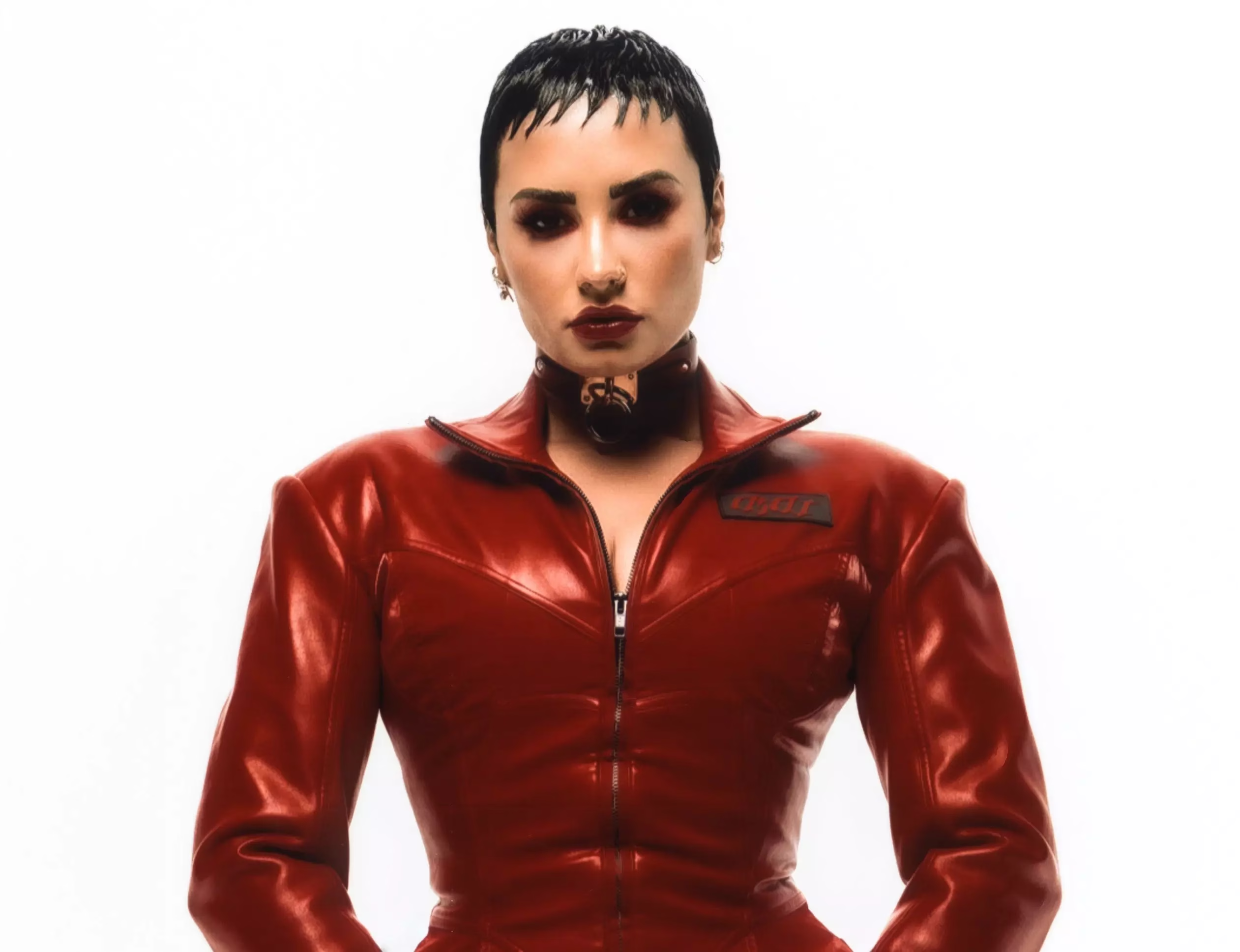
In January, Demi Lovato held an impromptu funeral for her pop music. After wiping her Instagram feed clean, the singer posted a single photo: A solemn Lovato serving up two middle fingers, surrounded by her team all dressed in black, the wall behind them adorned with relics of her past musical eras.
What fans didn't know at the time was that the makeshift memorial marked the start of a new chapter for the two-time GRAMMY nominee, slyly laying the groundwork for her eighth studio album HOLY FVCK. The singer — who recently re-adopted the use of feminine pronouns in addition to the nonbinary 'they/them' — would officially announce the full-length in June, after months of teasing lyrics alongside sultry Instagram photos showing off her newly-shorn brunette buzzcut.
If the album's cleverly misspelled title and sacrilegious cover art are any indication, Lovato seems primed to embrace a new level of sexuality and subversion heretofore unexplored. "I wanted to flip the phrase 'holy f–k' on its head. And instead of just saying 'holy f–k,' I wanted to write a song that says, 'I'm a holy f–k," she revealed in a July interview with SiriusXM Hits 1, calling the NSFW title track "definitely a sexually charged song, but it's really fun."
Arriving August 19 via Island Records, HOLY FVCK promises to decisively — and fittingly — set fire to the pop-star persona Lovato has so carefully crafted for the past 11 years. This time around, Lovato dives headfirst into the emo-influenced rock that inspired her 2008 debut Don't Forget and its 2009 follow-up Here We Go Again.
"I went into this album with the intention of separating myself from the music that I've been doing and embarking on a new journey that was grounded in the roots of where my music started," she told Billboard in June. "If you go back into my older catalog — listen to my first album, my second album — [there's] definitely the pop-rock influence."
More than merely influential, the combination of electric guitars and bright, pop-oriented melodies was actually the bedrock of Lovato's brand when she first catapulted to stardom in Camp Rock, the 2008 Disney Channel Original Movie she headlined opposite the Jonas Brothers. Thanks to the star-making power of the Disney machine, her debut album arrived three months later — putting her pop-rock princess identity on full display with effervescent tracks like lead single "Get Back," sassy Hollywood takedown "La La Land" and fan-favorite emo anthem "Don't Forget."
Roles on Sonny with a Chance — her very own Disney show — and 2009's Princess Protection Program with then-bestie Selena Gomez soon followed. But it was always Lovato's magnetic voice and image as the network's resident rocker girl that helped her stand out amid a crowded Disney Channel class that included Miley Cyrus, Gomez, the JoBros, Cole and Dylan Sprouse, Emily Osment, Debby Ryan, and more.
"I'm the new kid, and that's how I kind of felt when I came into the whole Selena-Miley-Jonas Brothers thing," the then-rising star admitted in a 2009 profile for The New York Times when she was just 16. "Like, O.K., where do I come in? How am I different?"
Of course, Lovato's musical journey from fresh-faced Disney Channel starlet to re-christened rocker is inextricably tied to the life-or-death demons she's faced in the glare of the spotlight. Over the years, she's battled addiction to drugs and alcohol, grappled very publicly with an eating disorder and mental health struggles, and opened up about her painful history of both sexual and familial trauma.
The first time the star entered in-patient treatment was in 2010 after making headlines for punching a back-up dancer in the face on the Camp Rock 2 tour. Though she admitted years later that she began using cocaine at age 17, any mention of drugs and alcohol was kept decidedly vague as Lovato made the requisite press rounds post-rehab.
In September 2011 — eight months after leaving treatment — Lovato was kicking off another album cycle for her third studio set, Unbroken, which found her abandoning the pop-rock of her first two records for a sprawling sonic palette rooted in early 2010s R&B, with tinges of electro-pop and soul balladry.
She channeled the angst and trauma of the preceding year into the album's soaring lead single "Skyscraper," which became her first solo Top 10 hit on the Billboard Hot 100. But though she projected a narrative of sobriety to her army of Lovatics, the 18-year-old quickly relapsed and fell back into dangerous old patterns. "I wasn't working my program," she recounted in her 2017 documentary Demi Lovato: Simply Complicated. "I wasn't ready to get sober…I was either craving drugs or on drugs."
The rest of the singer's beleaguered history with addiction is well-documented at this point — even if, sometimes, the truth about her drug and alcohol abuse has revealed itself much later. In the same documentary, she came clean about the fact that she'd filmed her 2012 MTV doc Demi Lovato: Stay Strong under the influence of cocaine, all while espousing the virtues of her newly sober lifestyle. Soon enough, an intervention by her management team prompted a drastic course correction, and at 19, Lovato began her first real year of sobriety.
The following year, she leaned even harder into the pop-centric sound she'd started exploring with Unbroken on her fourth album, Demi. As its eponymous title suggests, the 2013 effort was meant to be more personal than its predecessor, which meant paring down the number of guest features and collaborators to deliver electro-leaning power pop (lead single "Heart Attack"), middle-of-the-road country-pop ("Made in the U.S.A.) and club-ready dance tracks ("Neon Lights").
By 2015, Lovato had fully established herself as an unequivocal pop star with the release of her fifth studio set, Confident. The album debuted at No. 2 on the Billboard 200 — her highest chart entry since Here We Go Again reigned atop the list in July 2009 — and earned the singer her very first GRAMMY nomination, for Best Pop Vocal Album.
In retrospect, though, Lovato confessed that the bold, seductive persona she was projecting at the time on singles like "Cool for the Summer" and the Max Martin-produced title track — as well as the album's very title itself — was nothing more than a facade.
"I wasn't confident at all. I had a false confidence because I was conforming to everybody else's ideals," she admitted to Glamour for the outlet's April 2021 cover story. "I was trying on different identities that felt authentic to me but weren't me. The super-feminine pop star was an identity that sounded like it fit and looked like it fit, so I put it on like it fit."
According to her 2021 docu-series Dancing with the Devil, no one in Lovato's inner circle knew when she had secretly relapsed in early 2018 while promoting her sixth album Tell Me You Love Me. Six months later, she was fighting for her life in the intensive care unit of L.A.'s Cedars-Sinai Medical Center having overdosed on a lethal combination of opioids laced with fentanyl.
Lovato's near-fatal ordeal and subsequent recovery hung heavily over the proceedings of her seventh studio set, 2021's Dancing with the Devil… the Art of Starting Over. Standalone single "Sober" — a heart-wrenching confessional ballad she released just one month prior to the overdose — served as a chilling cry for help before the LP's arrival, and album tracks like "ICU (Madison's Lullabye)" and "Dancing with the Devil" reopened the proverbial wound and forced fans not to look away.
However, cut to a year later and, for the moment, Lovato seems to have grown past the impulse to sit in that same trauma. "Demi leaves rehab again/ When is this s–t gonna end?" she snarls in the opening line of HOLY FVCK's lead single, "SKIN OF MY TEETH." But rather than kick off a shame spiral, the world-weary declaration morphs into a hard-charging anthem of survival that's equal parts rebellious and resolute — indicating that she's celebrating a new lease on life.
Second single "SUBSTANCE" similarly serves as a winking double entendre, flipping the script on what listeners may assume for a more high-minded quest: Lovato gleefully wails, "So I ask myself/ 'Am I the only one looking for substance?'/ Got high, it only left me lonely and loveless/ Don't wanna end up in a casket, head full of maggots/ Body full of jack s–t, I get an abundance/ Am I the only one looking for substance?"
That's not to say HOLY FVCK traffics solely in themes of survival and addiction. Ahead of the album's full unveiling, the singer premiered a number of tracks live with a hard-charging performance at the Illinois State Fair.
Whether tearing through a sexual tour of Los Angeles ("CITY OF ANGELS"), inviting fans into her rock 'n' roll circus ("FREAK") or demanding they place her status as a role model firmly on the funeral pyre ("EAT ME"), Lovato howled like a banshee unleashed — finally letting loose the rocker girl she's seemingly kept locked inside for the past 13 years. It seems the last f-word she had to give was the one she put in her album title.
Take, for example, "29," a scorched-earth indictment of her six-year relationship with actor Wilmer Valderrama, which she now examines — as the title suggests — from the same age her ex was when their romance began.
"Finally 29/ Funny, just like you were at the time/ Thought it was a teenage dream, just a fantasy/ But was it yours or was it mine?" she questions on the chorus. The stark turnabout is certainly a shock, considering the singer referred to Valderrama in the 2017 documentary as "my everything." But the song's damning lyrics explicitly reveal that she's gained a new, clear-eyed perspective — a theme that rings true across many of HOLY FVCK's 16 songs.
While the album proves to be a major sonic shift, HOLY FVCK ultimately seems to serve two major purposes for Lovato: to represent the truest version of herself as an artist, and honor just how far she's come on her journey.
"I've definitely been through a ton," she told Jimmy Fallon during a June visit to "The Tonight Show Starring Jimmy Fallon." "That's no secret to the world… I came out of treatment [last year], and I realized I really want to do this for myself and I want to make the best album possible — something that really represents who I am.
"I think the best way to do that — the easiest way to do something, the most authentic — is to do it clean and sober," she continued. "So I made this album clean and sober. I can't say that about my last album. But this one I'm really, really proud about."
Machine Gun Kelly Returns Home: 7 Highlights From His Biggest Cleveland Show Yet