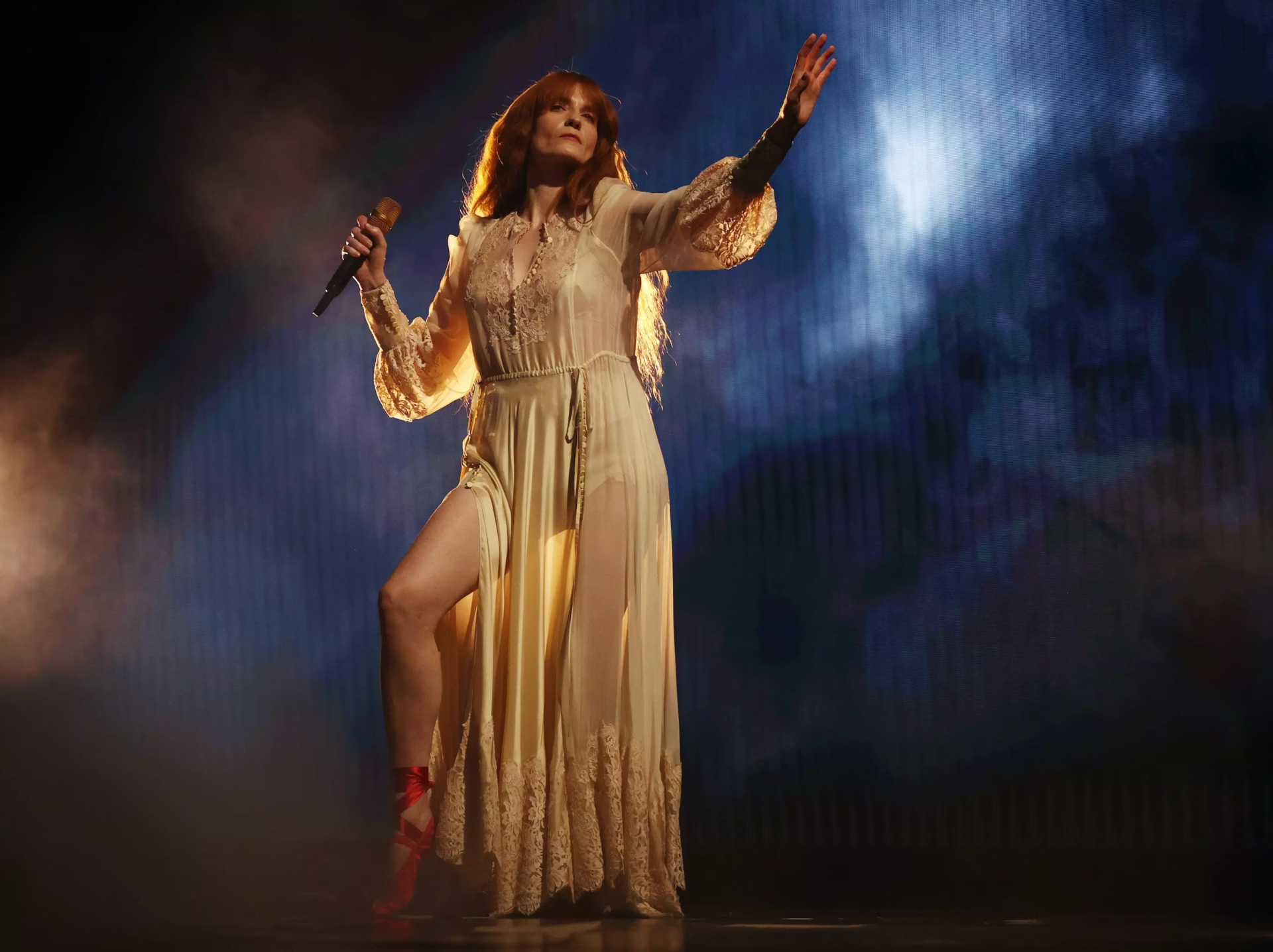
In February, Florence Welch announced the May 13 release of Dance Fever — the fifth album from her six-time GRAMMY-nominated band Florence + the Machine — with a press statement describing it as "a fairytale in 14 songs." But amid the whimsical, Welch suggested that the album also offers a window into some realizations about her biological clock.
"As an artist, I never actually thought about my gender that much, I just got on with it," Welch, 35, said in the statement. "I was as good as the men, and I just went out there and matched them every time. But now, thinking about being a woman in my 30s and the future, I suddenly feel this tearing of my identity and my desires. That to be a performer, but also to want a family, might not be as simple for me as it is for my male counterparts. I had modeled myself almost exclusively on male performers, and for the first time I felt a wall come down between me and my idols as I have to make decisions they did not."
Welch has made touring the focus of her career, spending more than a year on the road after each Florence + the Machine album since their 2009 debut, Lungs. That project almost immediately launched Florence + the Machine to global success, particularly thanks to its many arena-ready anthems like "Dog Days Are Over" and a cover of The Source and Candi Staton's 1986 song "You've Got The Love."
Her star continued soaring with Florence + the Machine's second album, 2011's Ceremonials, which saw a thematic shift from anthemic to tragic. Leaning more toward the introspection of the group's later albums, Ceremonials was inspired by Welch's obsession with drowning and, as she told NME in 2011, "succumbing and being completely overwhelmed by something that's bigger than everything." While it still had its brighter moments, like the liberating hit "Shake It Out," the album preceded an eye-opening — and life-altering — experience on the singer's 27th birthday.
As Welch recalled to Vogue UK in 2019, her mother made a speech at her birthday party ("a plea, really," she admitted) asking her daughter's friends to keep her out of the notorious "27 Club" — the group of troubled rock stars like Kurt Cobain, Janis Joplin, Jim Morrison, Jimi Hendrix and more who passed at that age.
Her mother's words offered a pivotal reality check that shifted her into a new era. Welch was sober when creating and recording the two albums that followed, 2015's How Big, How Blue, How Beautiful and 2018's High As Hope. The latter marked a new era of expression in her music.
"I think I used metaphor a lot in earlier work to hide what it was that I was actually trying to say," she told NPR in 2018. "If I could, [I'd] dress up the pain or the guilt or the shame in these sort of cathedral-esque — like dress up the mess. Then when you're further away from the things you're ashamed of, and you've maybe come to a better place with them, it's really much more easy to be truthful in your music because you're not trying to hide. You're like, this is what it is. This is kind of what went down and it takes you into a different form of songwriting, I think."
Even as Welch explored new ways to express herself in her music, Florence + the Machine continued a rigorous touring schedule. With their last tour ending six months before the COVID-19 pandemic struck in March 2020, the global shutdown seemed like it could be a welcome respite from all that time on the road. Instead, it forced Welch to face her own disquietude.
"I think a lot of people think, 'Florence + the Machine! She's just gonna be lounging around in silky stuff," she told Rolling Stone UK prior to Dance Fever's arrival. In reality, she didn't write anything for the first several months. "No, I'm gonna be a ball of anxiety, with the TV on, constantly just trying to keep out the bad thoughts. It's not gonna be fun and glamorous, I promise."
She continued, "There's the stage, and then there's the very agoraphobic person who needs just to be in the house, you know, especially since I stopped drinking. I am very much a homebody. So, I think people come on board thinking it's gonna be really fun and exciting, but it's that sense of like, 'Oh, the public will get the good bits.' You won't. You'll get the tears."
While its title reminds of the disco-inspired TV competition from the '80s, Dance Fever's inspiration goes back to the 17th century or even earlier. Welch's Dance Fever relates to Europe's spontaneous (and possibly psychosis-driven) mass dancing phenomenon of choreomania, a manic movement so intense that some danced until they literally died from exhaustion — and the inspiration for track three's title.
"And I am freaking out in the middle of the street/ With the complete conviction of someone who's never had anything actually really bad happen to them," Welch says in the beginning of "Choreomania." "But I am committed now to the feeling."
The copious amount of horror movies Welch watched during the pandemic also served as a source of inspiration — specifically on tracks like "Dream Girl Evil" — as she revealed to New York Times. "When I see messy or violent or terribly behaved women, especially young women, there's a liberation," she said. "To not have to try and survive by being good."
As Welch hinted in her album statement, Dance Fever lyrically dives into the specter of potential motherhood — the most overt expression coming with the lead single, "King." "We argue in the kitchen about whether to have children," she sings. "About the world ending and the scale of my ambition… I am no mother, I am no bride, I am king."
"The song is about the splitting of two desires and the agony of that," she revealed to CBS News. "I think the witchery of it is that it feels like a possession, the sudden desire for family and domesticity."
In addition to her ticking biological clock, staying sober through the pandemic brought another realization. "I'm eight years sober and I think, even before the pandemic, my struggles with mental health were really intense," she admitted in the CBS interview. "Because, actually, what sobriety does is, you come to see yourself clearer than you ever have done before and a lot of the stuff that you drank to get away from is just there all the time."
Though she's in a vastly different place at 35 than when she was 22, Welch told Vogue UK how Dance Fever is a continuum of her first album: "Lungs with more self-knowledge," an examination of the persona she's crafted. "I'm kind of winking at my own creation. A lot of it is questioning my commitment to loneliness; to my own sense as a tragic figure."
Even Welch's frequent collaborator Autumn de Wilde — who photographed the Dance Fever album cover and directed the videos for "King," "My Love" and "Free" — could see the shift the singer's epiphanies had created. "I started to feel like the record she was making was very honest, very raw and modern, but also rich with otherworldly fantasy," de Wilde said in the same Vogue UK interview. "I wanted to create a visual escape-hatch into an ancient fairy tale."
With Dance Fever, Welch also sought an escape-hatch of sorts from the musical instrumentation that has defined her work.
"Every album is a reaction to the last thing you made, and I was a little sick of my own [expletive], which is heavy piano," she explained to New York Times. "I missed guitars."
And there's plenty of them on Dance Fever, whether it's an acoustic strum on "Girls Against God" or roaring electric on "Daffodil." Helping grant Welch's musical wishes were her co-producers, GRAMMY-winning producer Jack Antonoff (Taylor Swift, Fun, Bleachers), Glass Animals frontman Dave Bayley, Thomas Hull (better known as Kid Harpoon) and Thomas Bartlett (known as Doveman). Welch had previously worked with Hull and Bartlett, but it was her first experience with Antonoff and Bayley — furthering her desire to evolve while calling back to her earlier works.
Florence + the Machine will bring Dance Fever to life with the Dance Fever Tour, which begins Sept. 2 in Canada. After two years of introspection, Welch will spend four months hitting arenas around the world, doing what she does best: dance.
"Gigs have always been my sense of spirituality," Welch told Vogue UK in 2022. "In my daily life, I am just wracked with racing thoughts and anxiety."
As she teased in an Instagram post announcing the tour, Welch is ready to forget her existential woes for a few months and, well, shake it out. "This is going to be fun," she wrote. "Go grab those Gunne Sax, my beautiful ghosts."