Which musical epoch do Fruit Bats belong to?
It's not quite the '90s, even though that's when Eric D. Johnson started the project; he wouldn't release his first album until 2001, nor sign to Sub Pop until the following year. But Fruit Bats aren't exactly an early-aughts phenomenon, either.
"I felt like I was watching it from the sidelines and hoping I might get thrown a bone," Johnson recalls of the Meet Me in the Bathroom era to GRAMMY.com. "But it was more like my friends got really big and I was sort of the perpetual opening act for the next 10 years."
Johnson readily says that's the paradigm that produced him. But as he remains an extremely active artist, it would be unfair to seal him off there as a remnant of the past. Perhaps the trajectory is best seen as an arrow gradually trending upward. And, in 2018, shooting upward.
That was the year that two magnitudinous events happened: One was that he formed Bonny Light Horseman, his celebrated folk trio with Anaïs Mitchell and Josh Kaufman. Another is that he signed to the prestigious indie label Merge.
Since then, Johnson has received long-overdue plaudits, and produced some of his finest work: 2019's Gold Past Life, a 2020 full-album cover of Smashing Pumpkins' classic Siamese Dream, and 2021's The Pet Parade.
Now, he's out with A River Running to Your Heart, out April 14. True to the album title, Johnson feels like the warmth and camaraderie he enjoys with Mitchell and Kaufman flows directly into the heart of this new Fruit Bats. "It's hard not to be totally inspired by them." he says, calling both projects "interwoven" and" inspirational."
Partly as a result of this, mellow, sophisticated songs like "Rushin' River Valley," "We Used to Live Here" and "Sick of This Feeling" have a special patina to them: they feel connected to Fruit Bats' past while reflecting the creative universe Johnson inhabits.
In that way, A River Running to Your Heart proves that Fruit Bats aren't the province of a decade — or two — ago. Rather, they're a band for right now. Read on for an in-depth interview with Johnson about the genesis of Fruit Bats, the road to the new album, and the nuts and bolts of his recording process.
This interview has been edited for clarity.
Tell me about your creative path over the past few years, leading to A River Running to Your Heart.
My perspective on it is weird. I've been doing this for a really, really long time, and it was kind of like this slow, slightly bumpy, very gradual first 16 years — which is [itself] a really long time.
Then, things kind of happened, but then slowed down again. Then, in 2019, I signed with Merge, made that Gold Past Life record, and then the [2020 debut] Bonny Light Horseman record came out during the pandemic. I think you either were or you weren't extra-productive during that 2020-and-2021 time.
So, it's felt like a bit of a blur. But all I know is that last year, I played 113 shows with both bands, and we've been kind of going full tilt with both bands. It's been kind of a weird few years of craziness, basically.
Read More: Bonny Light Horseman's New Album Rolling Golden Holy Is The Voltron Of Folk Music
You've had hills and valleys in your long career, but this must feel like a boom period to you.
It is. My glass-half-empty person is like, "Why couldn't I be 30 when this happened?" With lots more physical energy and everything like that. But also, oh my god, this is incredible that this is happening to me, because it took me a really, really long time.
I have musician friends in their thirties and forties who are on hot streaks after years of nonstarter projects. I think the notion of the 22-year-old genius as the platonic ideal — think Brian Wilson making Pet Sounds — is revealing itself to be nonsense.
It's nonsense. I think the median age has gone up. I'm almost hesitant to talk about it because it feels so weird. But I use age 30 as an example, because I remember back to that year, being like "Ugh," and feeling like, "I'm an old codger at this point!"
I'm 30, and a musician. I feel that way.
Yeah, but that's 16 years ago. I feel fine still, and I'm still doing stuff, and things are going well. But also, it's exciting to have a long history and everything, and be appreciated for that. But of course, I'm always like, I don't want to just be an old-timer talking about how great it is to be an old-timer.
In that timespan, guitars and singing have gone in and out of vogue. Was there ever a point where you felt like the indie train had left the station?
It may have already left the station. I don't know. Its death has been announced many times.
I come from a weird era, too, because I had friends 10 years older than me who were from the '90s indie times. I wasn't old enough to have experienced that. I maybe caught the tail end. I always describe that as a beautiful time of very low stakes. It truly was DIY, and there was no notion of success in it. It was underground music, truly.
I remember being in Chicago, being an indie-rock fan, young. It was before I was really doing bands in earnest, and it would be Tuesday night at Lounge Ax or something. The biggest indie band would come through, and that's 200 tickets or something like that — where you're just like, Wow!
Then, there was that early 2000s boom, which I had a front-row seat to but didn't get [chuckles] swept up in either.
Now, it's something else. I don't even know what. There's so much thinkpiece-y stuff you could say about it now. I don't have a good perspective on what's going on with indie music.
It seems like you don't consider yourself to be of any era or ilk. You're just a person making music, and whatever people want to lump you into is none of your business.
Yeah. I feel very connected to the roots of independent music — I really do. I admire it so much. I'm on a venerable indie label that I was a huge fan of when I was young, and I got to be on Sub Pop at one point, too.
I think when indie became this buzzy, big business in the aughts — again, I was there, but I didn't reap any benefits from that [at the time]. I didn't make it big until after that was over. I don't even know if I've made it big yet, either.
But basically, what I'm trying to say is that I've lived in a lot of eras and weathered a lot of storms, and you never have any perspective on it when you're inside of it at the moment.
During lean times for this kind of music, how did you maintain your fire and inspiration?
I think I've always had small victories and been OK with that. I think there's a certain kind of fortitude that certain people have or don't have. I'm OK with being told no, and I'm OK with embracing one inch forward or something like that. So, I think that kept me going.
But also, I remember running into some friend who was like, "I remember you saying 'I'm quitting.'" So, I don't even know. Sometimes I forget that I probably was much more negative-seeming back then, but I managed to not quit and just keep going, for whatever reason.
Bonny Light Horseman was a watershed for your artistry? How would you characterize that triangulation?
It's the first band I've ever had, really, since my first pretty short-lived indie rock band in the '90s. This is the first time I've been in a democratic band where it wasn't just my own nom de plume.
I guess the easy paraphrase is we have complementary skillsets, but we also have a deeply equal level of respect for each other, too. There's sort of a deference there. There's a balance there that's not a balancing act. When we got together, it worked.
I was just listening to A River Running to Your Heart through a Todd Rundgren lens, thinking about how he built those arrangements like towers. Tell me how you built these songs from the grooves up.
I'm glad you asked about the grooves, because there's actually a couple of songs where we did something really unique: "Rushin' River Valley" and "Waking Up in Los Angeles."
Actually, "See the World by Night," too, where I had written these things on a drum machine. Josh Adams, who's been my longtime drummer, came in and we were sort of messing around.
He's like, "Why don't I just perform the drum machine? Why don't we make a drum machine out of me, so it's kind of these short loops based on a drum machine, but where we took it and created our own organic [sound]?"
Plenty of people do that — looping and Pro Tools, or something. But we actually built it almost like it was a sequencer. Rather than just looping him playing, we actually modularly built these grooves, and some of them kind of skip the one and stuff.
So the beat turns around a little bit, and that was just sort of a happy accident. I'm not a singer/songwriter that sits with an acoustic guitar or something, writes an acoustic song, and then we go work it out.
Nothing against that either; we actually do that with Bonny Light Horseman. But with Fruit Bats, I'm hyper-cognizant about tempo and how it relates to a lyric, or possible lyric, or melody, or something like that. Because I'm a singer first and foremost. That's the thing that's always going to be at the center of it for me.
So, everything is usually built off a drum machine and groove of some kind. Writing and demoing are kind of one and the same. So, it's kind of one big process, but it always starts with that tempo thing. That makes me happy.
When learning a digital audio workstation for the first time, one struggle I had was to get out of the grid. The click track is necessary, but it can also box you in and make the music inorganic. How do you avoid that sense of boxiness?
I find that I slowly drift out of the grid and forget it's there. Unless you're going to make some kind of major structural change to the session or something — which I do sometimes — but that's usually fine too. But you start with the grid and then you forget about it.
Josh Adams is one of the greatest play-to-the-click or play-around-the-click drummers, too, where he can stay on the grid and yet also play off it too. You could kind of start with the grid and then continue to add human elements.
Unless you need to make some kind of major structural chop, the grid becomes totally irrelevant after a few more tracks that you've added.
What are your favorite subliminal — or even accidental — aspects of A River Running to Your Heart?
There's a nice moment in "The Deep Well" where there's an iPhone recording of me and my friend Andy Cabic from Vetiver walking in New Orleans, and there was some kind of boat with a pump organ on it, or something. I was just getting a little field recording, and I said, "Do you want to walk towards it?"
There's something about the capture of that line, which is completely off-the-cuff and natural. That's an interesting line — what does that mean, exactly? Do you want to go explore something? I don't know exactly what yet.
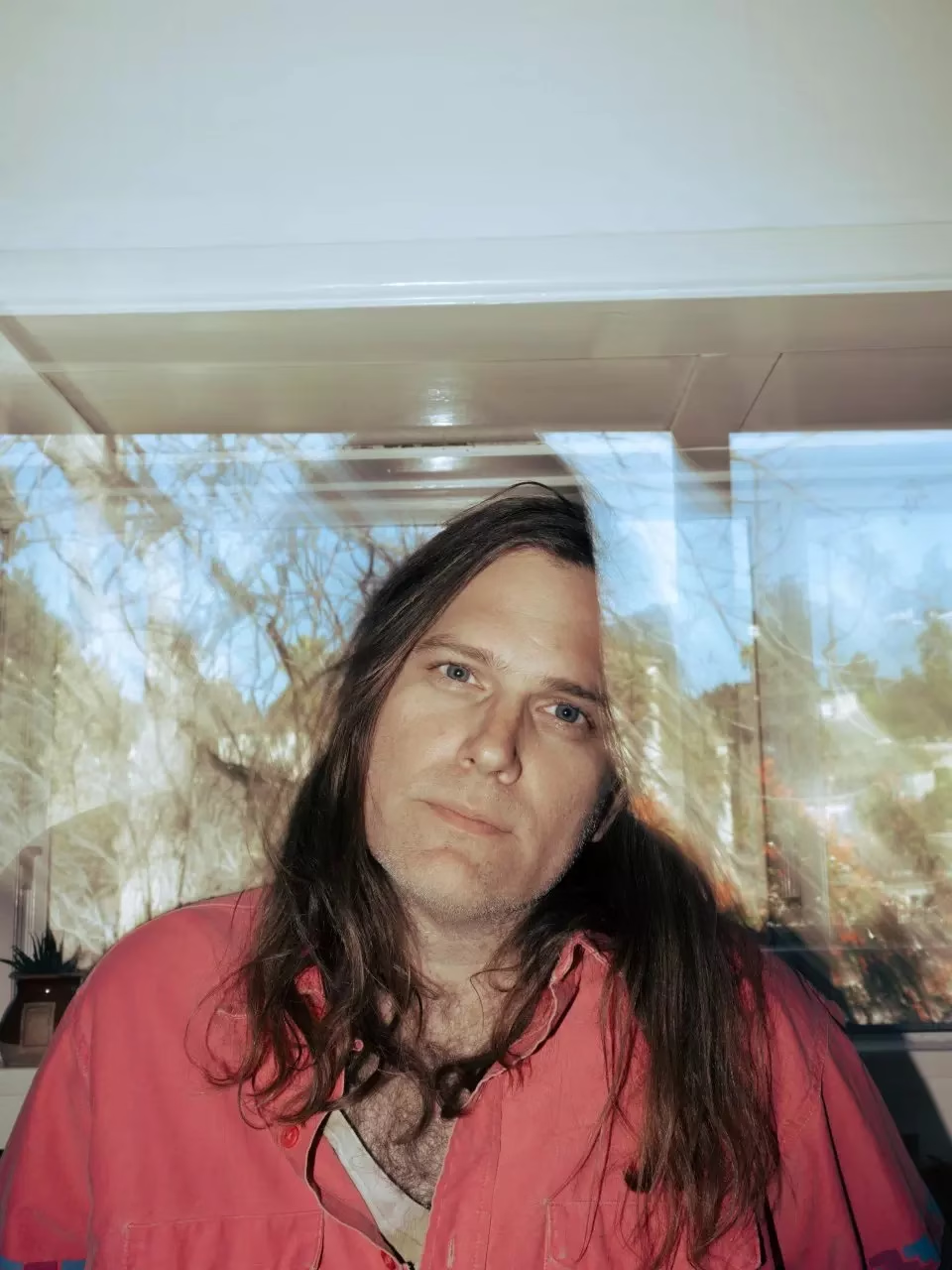
*Eric D. Johnson. Photo: Chantal Anderson*
In 2023, where does the onus for music-making lie? Is it making ear-catching records? Tightening up as a touring act? Just writing great songs?
In a way, it's like we're back to the '60s where you're going to top-load a record with the jams. I don't really know. I am personally always trying to make super-connective music, and I think that [had to do with] kind of getting out of lo-fi when I did go into a bigger studio.
I did realize I'm still a child of '80s radio, and I was actually interested in blasting out of your speakers. But I was coming from this lo-fi background, too, so you could kind of hear that on the first few Fruit Bats records. It's like this lo-fi attempt at making hi-fi music.
Then, later, I got better at hi-fi music in general. I think the [debut] Bonny Light Horseman record was super-connective, and obviously has great fidelity and everything, too. It's not a lo-fi record, but "Deep in Love," that was a single take at 1:00 in the morning. That's still one of my biggest songs I've ever been involved with.
So, I think there was an emotional chord of that song that somehow was connected. There's a little bit of fairy dust involved, too, or there's really good engineering. I've been revisiting INXS…
Underrated!
Underrated, and then you're like, "This sounds expensive," when you hear that, but you're also like, "It was worth every penny." Then, there's some cool lo-fi song that was just totally off the cuff, but has an emotional core.
I think there still isn't a rhyme or reason for it. If you hear music that's very cynically engineered to be as hard-hitting as possible, you can kind of hear that. It sounds corny, but it it's coming from the heart, then it means something to someone.
Will Sheff Swears Off Primary Colors, Reductive Narratives & Pernicious Self-Mythology On New Album Nothing Special