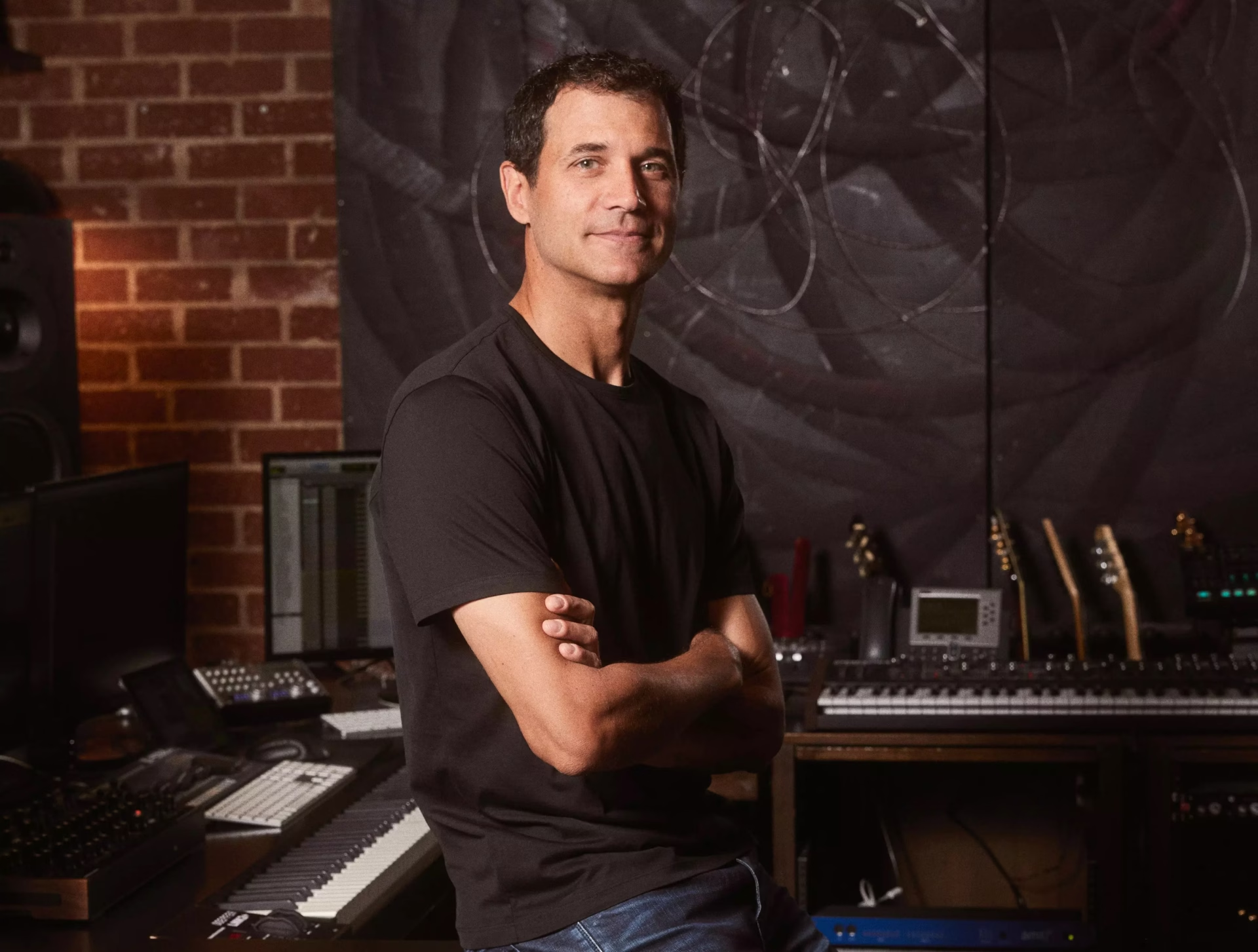
If you're a fan of prestige TV and blockbuster cinema, you've likely heard the works of music composer Ramin Djawadi. The two-time Emmy Award-winner and three-time GRAMMY nominee has crafted scores for "Westworld," "Iron Man," "Eternals," "Uncharted," and dozens of other celebrated shows and films, with more to come. But those who have journeyed to Westeros know Djawadi for his opus: that's right, he's the man behind the music of "Game of Thrones." .
Now, the sonic call to arms is experiencing a second life as the central theme for "House of the Dragon" — the latest installment in George R.R. Martin's "Game of Thrones" universe, set 200 years before the events of the original series.
A musical chameleon — who has collaborated with mega talents like Hans Zimmer, Wu Tang's RZA, and Rage Against the Machine guitarist Tom Morello — Djawadi has returned to compose music for the highly anticipated prequel series, which is wrapping its debut season this Sunday on HBO. Ahead of the finale, GRAMMY.com spoke with the composer about crafting musical cues and themes for the characters of Westeros, his love of '80s metal and the possibility of a "House of the Dragon" live concert experience. The discussion below contains mild spoilers.
This interview has been condensed and edited for clarity.
Earlier in your career, you collaborated with Hans Zimmer on "Pirates of the Caribbean: The Curse of the Black Pearl." Did your experience working on that score inform your later work? And what insights did you gain from him?
Working with Hans has been absolutely incredible. He has been such a good mentor and friend. Looking back on those times, I was fresh out of college and felt ready to become a composer. But I didn't realize how much more there was to the role than just writing, which is hard enough.
Working closely with Hans, I got to see his organizational process and how he works with collaborators and runs meetings. Obviously, there are a lot of pieces of music to write and keep track of, and you also have to stay on top of the recording sessions. Being able to see this on a massive project like "Pirates" was incredible.
You've spoken about the decision to use GoT's main theme for "House of the Dragon" to keep the shows connected. Are there any plans to compose an original HOTD theme for future seasons?
Honestly, at this point, there haven't been any discussions about season 2 yet, so it's too early to tell. For the first season [of HOTD], the decision was made to use the theme to tie the show to "Game of Thrones," which has been off the air for a while. It was meant to make a statement about connecting these shows and giving this overarching theme. That's how we always saw the original theme in the "Game of Thrones" episodes: It belongs to everyone. It summarizes the movement of the show, so that's why the decision was made to keep it for the new series.
Where do you find inspiration for the different musical ideas and motifs in the series? What are some of your reference points?
Number one, talking with the showrunners, Miguel [Sapochnik] and Ryan [Condal]. They've guided me through the show, as they understand where things are heading. So I've followed that very closely when I set up a theme. And then they'll tell me, "Look, later on, this needs to be able to do this. And can it be mysterious but also epic?" So I pay close attention to their guidance.
I'm also very inspired and influenced by visuals. When I get the episodes — even if I don't write to picture — I like having the episode running in the background. Seeing those amazing costumes and set design — all of that inspires me.
You recently revealed that you were a metalhead when you were younger. Has that genre influenced your work on this series or GoT?
[Laughs] Absolutely. I won't deny it. Rock and metal have always been a big part of my influence. As a teenager, I had long hair and was a shredder on the guitar. I was inspired by all those great '80s metal bands: Metallica, Anthrax, Slayer; I can go on and on. Metal had a great run during that whole time period. There was one amazing band after another.
The genre has really influenced my writing. In fact, when we did the second "Game of Thrones" tour, my wife suggested adding guitar to the mix. And I actually pushed back, but she said to put this cue on and play along with the guitar. And I did it and thought, Oh my god. And I realized how guitaristic the lines were and how well it fit on the guitar, so we made that part of the show. A lot of things that I write translate well on the guitar.
Though the genres seem disparate, I've heard there's a connection between classical music and metal.
You're absolutely correct. When I was a teenager playing all this rock stuff, there were all these neo-classical guitar players, like Yngwie Malmsteen, for example. He was crossing over from rock and metal into classical music. And I played that stuff all day long. I would take Paganini pieces and play them on the guitar. That type of crossover was popular during that time frame. Guitar players would play Bach pieces on the guitar. So there's definitely a connection.
Can you talk about the process of scoring a scene for the show? Is there a brief or a discussion beforehand?
It's called a spotting session. I sit down with the showrunners, Miguel and Ryan, and we watch the whole episode together. Then we decide where music should start and where it should stop. And then we talk about those moments. What theme could we use? What should the mood be?
Sometimes we get into great detail, and sometimes we don't. We have to figure out the right instrumentation when there's a turning point, so they'll give me more inspiration and direction. And then, I write all the music and create these digital demos, which I play for them. Then, we'll watch the picture with the music together and see what works and what doesn't. Do we need to tweak it more or not? Once we all agree on the music, I record it.
It's important to point out that it's a collaboration. I don't just write whatever I want. The showrunners have a clear vision. For example, they knew that we were going to use the piano again at the end of the first ["House of the Dragon"] episode. It has always been a big thing to use the piano in GoT, and we didn't do that until the sixth season.
So now that we've introduced that piano sound, we might as well drop it in the first episode [of this new series]. It's a crucial point in the plot, so we decided to use it. So I write the piece with the piano and then play it for the showrunners. They might have some thoughts, but they might not. Ultimately, it's a collaboration, and you want everyone to love it, so you have to explore this together.
How do you determine which characters get a theme or multiple themes?
That's a great question. It just kind of happens organically as we move through the episode. Some are more obvious than others. In one episode, Rhaenys, Alicent and Viserys may need themes.
Or Rhaenyra, for example, there are several themes for her that just kind of happened to come out of different scenes. Like there's one that is more of an emotional theme for her. Then there's the other one with the vocal in episode 3 when she returns to the camp. It's fun to combine them, depending on what the story does.
As a viewer, I love how the musical cues in both series are always deployed with such precision, at just the right emotional moment. And I've noticed how the absence of music in certain scenes can trigger deeper emotions. How do you and the creatives decide when a scene or moment can benefit from a cue and when to hold back?
I feel it's very hard to do. And again, this all happens in the spotting session, where you decide where music should and should not be. But we tweak right up until the very end when the show has to be finalized because most times when we discuss the music, the visuals are not finished. The visual effects, the sound effects. Everything happens in parallel. So sometimes you wind up doing what we call overscoring, where you put too much music in the show. When the visuals come together later, you realize, "Wow, now that the final sound effects are here, let's pull back on the music because the dragons are so loud. We don't need music here right now to compensate for them."
You make these decisions until the very end. And it's always a tricky thing to get the balance just right. I think it's really well done in "House of the Dragon" and "Game of Thrones." Like you said, sometimes, having no music can be more powerful than actually playing something because music always enhances things. Sometimes, not enhancing a scene can make it more awkward, more scary or more emotional.
When composing the music for a scene, do you prioritize syncing sounds to actions and movements or creating a mood?
For this particular show, we usually focus on capturing the mood rather than syncing to movement. It's more about storytelling with the thematic material. A lot of it is broader strokes. And that's always what has worked really well for the show.
Rhaenys' grand entrance during the coronation features one of my favorite musical moments of the show so far. You took us from celebration mode to pure chaos in an instant. Then the music syncs as Alicent's eyes close, and there's no doubt that everyone on that stage is toast — but our expectations are subverted. What went into creating that epic piece?
It's a big, big moment. And that's a good example of a time when we played with the balance of sound effects — where not to have music and where to introduce it and pull it when you think they are all gonna die now. I actually dropped a little bit of the "Main Title Theme" in there because, historically, that's always what we have done. Towards later episodes, we saw that this overarching main theme could stand for all.
The realm is on the cusp of civil war as the first season comes to an end. Can you talk about any of the themes or cues we'll hear in this Sunday's finale? Will the piano return?
[Laughs] I'm not sure how much I can say, but it's gonna be an epic finale. I think it's really, really great. I'm trying to think if there is any piano in it. I don't remember now, actually.
A few years ago, you created the "Game of Thrones" Live Concert Experience and toured the world playing the sounds of Westeros. Do you plan to develop a "House of the Dragon" live show?
Possibly, but it's a little bit too early to tell. On "Game of Thrones," we didn't do a tour until after season 6, actually. [HOTD] is still in its first season, but there's certainly plenty of material; it could definitely fill a concert. And I absolutely enjoyed those concerts.
If my schedule allows, I'm more than happy to tour again because it was very special to connect with the audience. I'm always in my studio by myself, and being out there and seeing the reactions from the crowd when you play those epic scenes along with the music was fantastic.
Meet Sherri Chung, The Score Composer Shaking Up The Television Academy