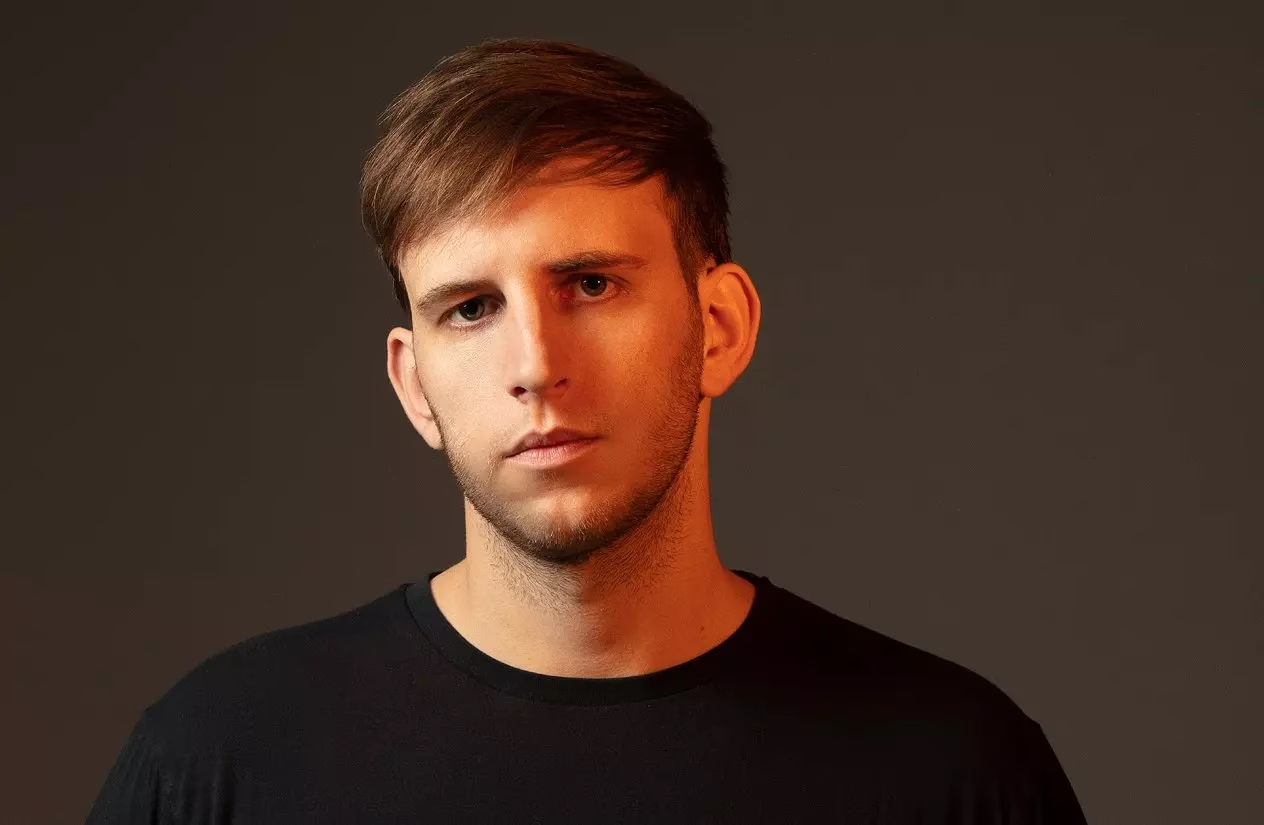
Growing up, Nick Miller never really listened to dance music. Now, he's one of the genre's most prolific stars, better known as Illenium — and is celebrating a GRAMMY nomination as a result.
Illenium's fourth album, 2021's Fallen Embers, is up for Best Dance/Electronic Music Album at the 2022 GRAMMY Awards. It's a pinnacle moment for Miller, who became "obsessed" with the electronic music world in 2009, launched his career with a self-released EP in 2013, then made his major-label debut in 2016.
Since then, Illenium has put out three more LPs and countless singles, teaming up with fellow dance titans like Gryffin and the Chainsmokers, as well as a variety of singers, from Georgia Ku to Jon Bellion. His versatility is perhaps most apparent on Fallen Embers, which features Tori Kelly, iann dior and Thirty Seconds to Mars, among others.
Though he's already teasing new music — which will debut during Illenium's set at Miami's Ultra Music Festival on March 26 — the producer/DJ feels the next chapter of his career truly began with Fallen Embers. With a GRAMMY nomination to validate his new direction, it may really just be the beginning.
GRAMMY.com sat down with Illenium to discuss the importance of Fallen Embers, how he transitioned from the crowd to the stage, and the role music played in changing — and saving — his life.
What initially made you realize that you were interested in producing — and that you were actually pretty good at it?
I started messing around in GarageBand in high school, and it introduced me to the idea of spending time creating something — even though that stuff back then was really bad. I moved to Colorado, and had some life-changing moments, and I started putting a lot of my time into it. A lot of the encouragement I got from friends, even though it was just mediocre music, was really exciting.
I was writing for music blogs, and I just loved the whole electronic music scene at that time. I would try to create what my idols were doing, and try to learn how they were doing it. I became obsessed, passionate and excited. I got addicted to trying to make songs. The feeling of doing it yourself, and being able to control every aspect of that, was really addicting.
I went to a Red Rocks show in 2012, and seeing that community, especially in Colorado — the Denver-based music scene is really tight-knit and communal, and it's really genuine. It was just really special. It was an experience that really drove me to want to succeed in it.
Was dance music your No. 1 genre growing up?
No, not at all. I didn't listen to much dance music until, like, 2009. I first got into it when I was living in San Francisco. I really liked a lot of the house stuff and trance, and then once I moved to Colorado, it turned into the bass music scene.
I grew up listening to a lot of pop-punk and rock, and my family listens to country a lot. A lot of hip-hop [too]. So I was all over the place in middle school and high school.
That's kind of all I listen to now. I listen to some pop, and a little bit of hip-hop, but it's almost all rock music and pop-punk.
Considering you were a teenager during the pop-punk explosion of the mid-2000s, that makes sense.
Totally. I feel like there's so much emotion and — it's not even aggression, but it's like, intensity, in that kind of music, where it can be really pretty melodically or lyrically, but the instrumental stuff behind it just like, hits. It hits me more than a lot of electronic music does nowadays. So I think that's why I'm transferring it into my type of thing.
Fallen Embers is the first album that doesn't start with "A," but its title still fits into the overall theme that Ashes, Awake and Ascend present. What's the story behind that?
My logo is a phoenix, [because] the imagery behind the phoenix really relates to me and the music that I make, and why I make music in the first place. So my first three albums were kind of this whole birth cycle of a phoenix. They all started with "A," it was a trilogy of that cycle. So Fallen Embers was kind of my take on what pieces were left — the embers fallen from the phoenix throughout that whole journey.
I made that album when I wasn't touring, and that's the first album I made in a long time [that] I wasn't touring, because I've been touring like crazy. It turned out much more calm and much more like a recharge album for me. Lyrically, it [details] the ebbs and flows of a relationship — it doesn't have to be a relationship, but just through finding yourself, and forgiving yourself for making mistakes and moving on.
Sonically, Fallen Embers has more rock elements. It's definitely calmer than Ascend. I love emotional music, so my music is always going to have an emotional aspect to it. That is not going to change. But I don't want to just keep repeating and chasing [the same sound], so now I'm moving very — like, totally — different, post-Fallen Embers. Fallen Embers, for me, was like a farewell, almost. I just wanted to be very clear that that was a trilogy, and now we're departed.
When you announced Fallen Embers, you said this is "the start of a new chapter." So is that kind of what you were talking about?
Yeah. I've been in LA five out of the past six months to start from scratch and write rock songs, and heavy aggressive s***, because I feel like I took a break and made music that's kind of calm. Now I'm [going] a little more aggressive and adding some metal aspects.
There's this middle ground of electronic, rock and metal that can be really cool. And I feel like there's a lot of people doing similar stuff, but the songs can be really authentic and healing to people — right now, especially.
You also said this album was "an incredibly personal journey for me." Since it was so personal for you, did you see an even more meaningful impact from these songs?
Yeah. I mean, these past two years have been really challenging for a lot of people, myself included. Especially since shows have come back, you can definitely see in people the excitement to get a release of some sort. And to [just] enjoy — it's hard after a long time of people just going through the motions.
Especially in the electronic music scene, a lot of these people use these shows and the music for their healing and their escape. And that's really important for 'em. So to be able to give them a show and also give them new music, and see how that music has been their kind of crutch this past year, has been really beautiful for me.
You had everyone from Tori Kelly to Angels and Airwaves on Fallen Embers. What goes into finding the right vocalist for a track?
It's a mix. A lot of it is availability-based. When I first am working on a song, especially if it's a demo, it'd be like, "Who would sound good on this?" The "Blame Myself" demo had Emily Warren, who has a really amazing voice, and a very unique tone. So it's hard to fill that.
You get this thing called "demoitis," where you're used to the demo so much, it's hard to separate. But you've got to just find the right vocalist that is gonna bring her own or his own whole attitude to it. And you just kind of have to sit with it for a second because you're so obsessed with the first version.
It's not about, necessarily, the skill of singing. It's a lot of tone. Sonically, how you make a whole song, and you have a vocal in there, you need someone that fits that exact same spot. And that can be really challenging.
For "Paper Thin" with Tom and Angels and Airwaves, that was just a bucket list [thing] for me, I've always wanted to work with him. When we sent it to him, we were like, "They're probably not going to do this." Same with Jared [Leto, Thirty Seconds to Mars' frontman]. I'm the biggest fan of all of the people I collaborated with, so it's really been special.
I feel like a lot of people who aren't as familiar with the dance music scene may assume that producers like you, who aren't on their tracks vocally, might not write them. But you, and people like Kygo and Zedd — all of these huge names in the producer world — have proven that wrong. Do you feel like that's a common misconception?
I think there's always gonna be a misconception of a DJ/producer type thing. I don't think there's any way to get around it, unfortunately. But at the end of the day, it's okay. People [who like] different music have a whole different perspective.
When people see "DJ," they're like, "Oh, like, Vegas DJ. Throw a party!" They have no idea the complexities that go behind that. There are some producers out there that can do insane stuff. It's hard to even start describing that. There's some songs where we start with a guitar, and we write from scratch. It's just about having an ear for what is going to be successful, and also just having an ear of what you enjoy.
In 2018, you shared a really personal story about how music changed your life. Was it a certain song, album or artist that did that for you? Or was it being able to use the music that you were creating as your outlet? Or a combination of both?
It's definitely a mixture of both. When I turned my life around from that time period, it was a mixture of getting so curious about music production, but I was also obsessed with music — I was like, "How do these producers create these things?"
That little thought sparked so much curiosity in me, and [I] wanted to figure out how to implement my love for music and love for different genres. For it to change my life, it had to have all of those aspects — being obsessed with music, loving other people's music, and wanting to create my own.
Doing an action in one of those phases every day is what got me going and got me into the scene, and into my career. But also [made me] confident with myself and feeling like I had some sort of purpose. It was a really healing process for me, because I was kind of a s***show before that. I needed something to put all of my energy into, and something that my family supported, and I had friends that supported me. So that was just really cool.
When I was so low, I had no faith in myself at all. You just have no confidence, and you're pretty broken. For you to even have an idea of "I might be good at something" or "I might get good at something if I work hard enough at it and I love it," then it's just full speed ahead.
What does 2012 Nick at Red Rocks think of 2022 Nick being a GRAMMY-nominated producer?
It's just mind-blowing. You know, I told myself when I saw the Red Rocks show in 2012, I was like, "Maybe in 10 years, I'll get to play at Red Rocks." I wasn't even saying headline or anything, just play at Red Rocks. I apparently set a very low goal for myself. [Laughs.]
Constantly having goals set and then reaching them throughout my whole career has been amazing, but it's crazy to think about being a GRAMMY-nominated artist. That is a whole different world that I never even thought — I just got into bass music and EDM, you know? To think of that transition, that's crazy.
We're Probably On An Irreversible Course Into The Metaverse. What Role Will Music Play In It?