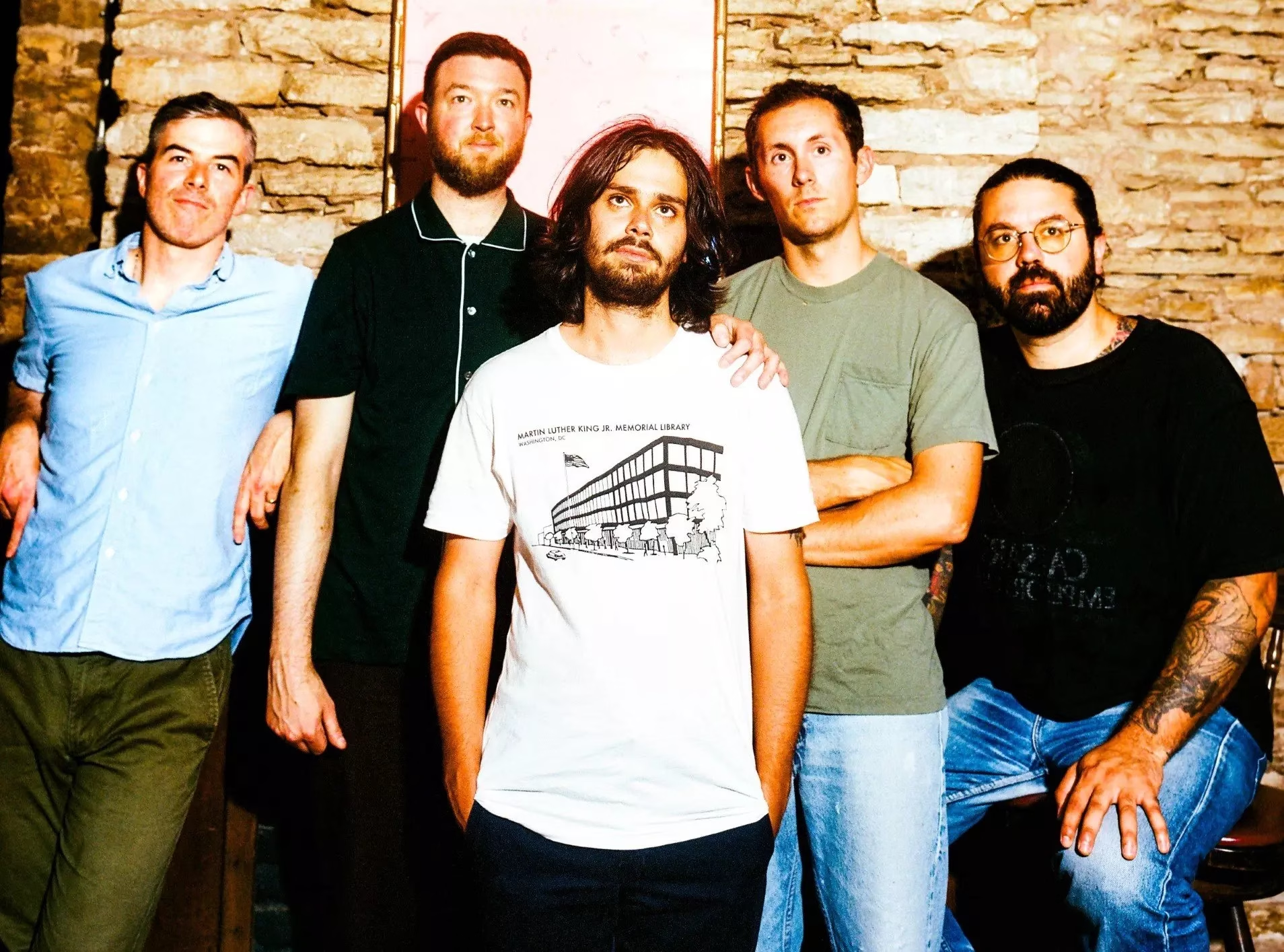
You don't see Fiddlehead crisscrossing the globe over and over; if you miss them in your area, chances are they won't be back in a few months. In fact, there's no assurance they'll return in the foreseeable future — or ever.
"There's no guarantee that it's going to happen again," says vocalist Pat Flynn, in an interview about their new album, Death is Nothing to Us. "Because the band is clearly not our life."
The rhythms of domesticity rumble around Flynn; because "my office was invaded by my children," he's Zooming from another room. (When he told them he was "talking to GRAMMY," the kids misunderstood it to mean Grandma.)
For the hardcore-adjacent supergroup — composed of members of Basement, Have Heart and more — life responsibilities have engendered a "scarcity effect."
But instead of rendering Fiddlehead lost in the shuffle, this has made their performances unforgettable — both for the audience and band.
"I've been in bands where we've toured for three to six weeks at a time, and I can barely remember one from the other," adds their guitarist, Alex Henery, from a parallel Zoom window.
But with Fiddlehead? "I can track down most shows in my brain when I think about it because there's not that many," Henery says. "It really does feel special, and I really never want to wish away that time."
Out Aug. 18, Death is Nothing to Us frequently evokes a feeling of holding onto the present. "Face it all/ Replace with love," Flynn repeatedly exhorts in the combustible "Sullenboy." In the aching "Fifteen to Infinity," he sings of heaven being attainable on the sofa, "in the nothingness of our night."
And the final line, from closer "Going to Die," seems to encapsulate the album's mortality-haunted essence: "See you on the other side/ I know I will/ But I don't wanna die."
Granted, Fiddlehead didn't become a "grief band" by some grand design. But from their first demo, that's been a major component of their emotional landscape.
"It just so happened that I was in a pretty thick stage of dealing with the loss of my father," Flynn says. "So, that first record [2018’s Springtime and Blind] really connected and I think a lot of people connected with it in sharing stories of profound losses in their lives. The positive response was motivating to continue the band."
This theme has seemingly crescendoed with Death is Nothing to Us, a 12-song, 27-minute volley of life-affirming, kinetic rock. Read on for an interview with Flynn and Henery about how Fiddlehead's third album came to be.
This interview has been edited for clarity.
Pat, you grew up Catholic; in "True Hardcore (II)," you sing about scenesters who are "pseudo and false to the core/ keeping the gates closed." What's the overlap between religious sanctimony and subcultural gatekeeping?
Pat Flynn: Growing up in a Catholic education, perhaps I've always been skeptical of those who are trying to draw too firm of a line.
But in just terms of gatekeeping, to me, it's more like that's how you kill art, that's just how you destroy it. When you start to codify too many things and you label the genre, you make it really intensively small.. .it becomes like you have to look a certain way to sound a certain way.
I'm skeptical of retrospective psychoanalysis, but, sure, I think that there's probably some type of overlap of there being too many strict codes — which is a lot of what a Catholic education has to be. And I've always really appreciated the power of the individual as opposed to the mediator.
[Catholicism is] a top-down structure. And when I was in high school, the top-down structure was definitely a motivator to find something like the hardcore scene really appealing; it was an equalizer.
I know why I felt compelled to write the lyrics for "True Hardcore (II)" more specifically, but the record in itself seems to really follow my own path with my struggles of hitting the low points.
I can't deny the fact that for the last 24 to 25 years, I've always found hardcore to be a place that's kind of uplifting and helped me bounce back. I just see it as totally precious and valuable.
And so the idea when some people try to make it too exclusive, or a selectively chosen community, it really agitated me. It's taken away the human appeal to thriving in life. I don't know if that sounds all corny, but it's an interesting song.
Has that individual-over-group ethos always been at the core of Fiddlehead's music?
Flynn: I specifically and explicitly remember saying, "Hey, let's just write as if we're never going to play out and play live," so that we can keep a pure sound.
And I think I was definitely burnt out with too much exposure to a community, and dealing with the noise of the community with my previous band [Have Heart]. And so I just wanted to get back to just writing for the sake of the enjoyment of creation.
However, when it began to connect with people in a really positive way, I was very quickly reminded of the value of sharing your art with a larger world around you. It very much went on to inspire writing the second record, and it continues to inspire the band to continue creating art.
Alex Henery: I was thinking back to early shows the other day, and it was awesome, honestly.
Back then, all you'd care about is just playing the show. There were no distractions; we weren't trying to win anyone over. It was purely just that we'd written these songs we liked and we wanted to play them.
We always talk about some of those early shows, as it doesn't get much more pure than that or us. Getting back to the core of it was definitely really important to me.
How would you guys characterize the period of time between Between the Richness and Death is Nothing to Us?
Flynn: It's been pretty positive. We actually started writing this record before Between the Richness came out. Between the Richness was recorded in February of 2020, and obviously, the world kind of stopped.
We didn't know if shows were ever coming back. There was actually no guarantee that we would ever play music live again. And yet we were still meeting up in our barn just putting music together because that just felt right.
We don't play too much, and so it really does create a nice scarcity effect, if you will. People feel like they really have to — and especially, very much so us — really soak up the live moment.
We all have different lives; we all have very different ambitions. It's not that we're always teetering on the brink of breaking up or anything like that. But it does make us savor the moment, and it makes the shows to be as sacred as you can make them — and as intense, in the moment, and cathartic, in many ways.
We're just playing and continuing to write, and allowing for the interactions with the people to inform our ideas about writing. And it's been a pretty great reciprocal relationship with the people who have been supporting us through the last few years.
I think the record has been a bit of a reflection of areas that we wanted to explore musically and lyrically that we had not before.
Henery: I was writing out of the really strong desire, after being cooped up in my room for so long, of getting to play loud — practicing and just turning the amps up loud and letting it out. It was awesome, and I think we all needed that at that point.
Fast forward all the way 'til now — where everything has changed again, and we do have shows and I feel like we appreciate it even more than we already did.
I'm very excited to be able to travel and play music. We're about to go to Southeast Asia. I'm excited to go to some places I've never been before and play in front of a bunch of different audiences, and play this new record for people.
It's crazy to think about it starting all the way back then, and coming to fruition now. I forgot how long this journey's been.
Flynn: [Regarding] the record — it's cool in a sense. We don't really tinker too much with the songs. It's a fairly organic process when we're writing it. Ideas just sort of pop out and we don't want to overdo it, overproduce it.
I think a lot of that has to do with trying to keep the magic of the writing moment. A lot of these songs that end up getting recorded in the studio are pretty raw, other than the fact that we're just recording them again. We didn't change too many things.
I like that. It's special. Nothing is perfect. In a day in which there's increasing motivation to try and make it and do the right thing that the masses want to hear, what's going to be digestible and yada, yada, yada… this has felt pretty pure.
Henery: We've never had the luxury of going in for a month, two months and being in the studio and really just musing over the song. One song is maybe three days, four days.
I don't even know if I believe in the perfect take. I think we all just, we go until we feel that it's good and then we keep it moving. And I think that you hear that in this record. It has a natural feel rather than OK, again, again, again.
I think we're more of a "feel band" and we go off that, so there are imperfections here and there. But I think that adds to the charm of it.
And we have an amazing engineer, Chris Teti. I'm glad that we're not with someone who's like, "No, let's just do it another 50 times; maybe there's something extra we could find in there." Let's just keep it moving and see what else we can come up with.
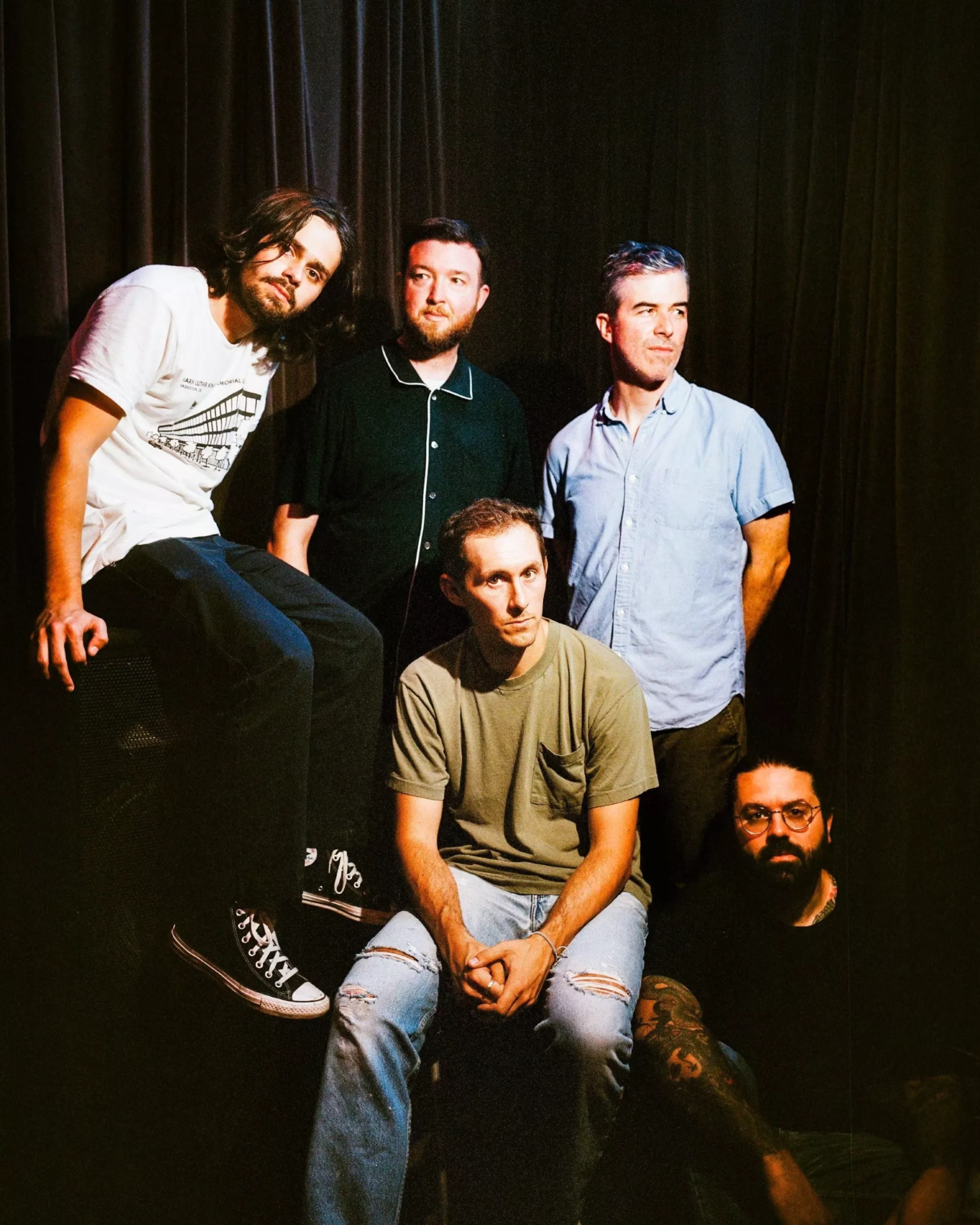
*Fiddlehead. Photo: Pooneh Ghana*
With that in mind, tell me how you wanted the album to grab people on an aural, visceral level.
Henery: [Alex] Dow, our guitarist, brought the riff for the opening record ["The Deathlife"]. He showed it to Pat, and the two of them instantly had the vision. I was the last person to gain that vision. It just wasn't clicking.
It wasn't until we fully hit the studio that, hearing the lyrics and the way that Pat performed the vocals, [I realized] it's just such a stark contrast to our last record, which is such a build and then a final release. This was just straight "bash over the head."
I love that it is such a different approach and I just couldn't see the vision straight away. But we got there in the end, and maybe it's just that I was hungry and tired or something. I think I'd flown in from a different tour to go practice — not a good combo for me.
It is kind of interesting how we work. I don't have any experience in musical theory, didn't go to music school. It's very feel-based, and Pat really has that too.
Pat, you have a good perception of what story you want this song to tell, or what journey we want to go on. I'm more just like: if this feels good, I'm going to play it. Then I'll go from there and the building blocks then begin to stack up.
Flynn: Yeah, the opening track is definitely a clamoring at the gates.
If you're interested in creating a collection of songs that work together to take a listener on a journey, the sequencing is so, so important. There's a desperation that I thought we didn't really explore on previous records, and I just thought that a really great way to create this [feeling]. We're not ringing the doorbell; we're slamming it, breaking it open.
And then it's followed by a very pleasant sounding song that is very bright, but somehow has some of the most dreadful, depressed lyrics on top of it. So if it's not this sonic bashing, it really is this tug and pull of a variety of emotions.
The record ends at the antithesis, lyrically, of where it began. And it's fun: if you put it on repeat, you're going through a variety of human emotions.
Henery: I definitely think this isn't an unbelievably massive hard left or right turn with this new record. But I think we've established that we're not going to try and recreate what we just did.
Hopefully, that's enjoyable from a listener standpoint: that there's a story here that can continue as opposed to being capped out.
On Militarie Gun's Life Under The Gun, Ian Shelton Invites You Inside His Hornet's Nest Of A Mind