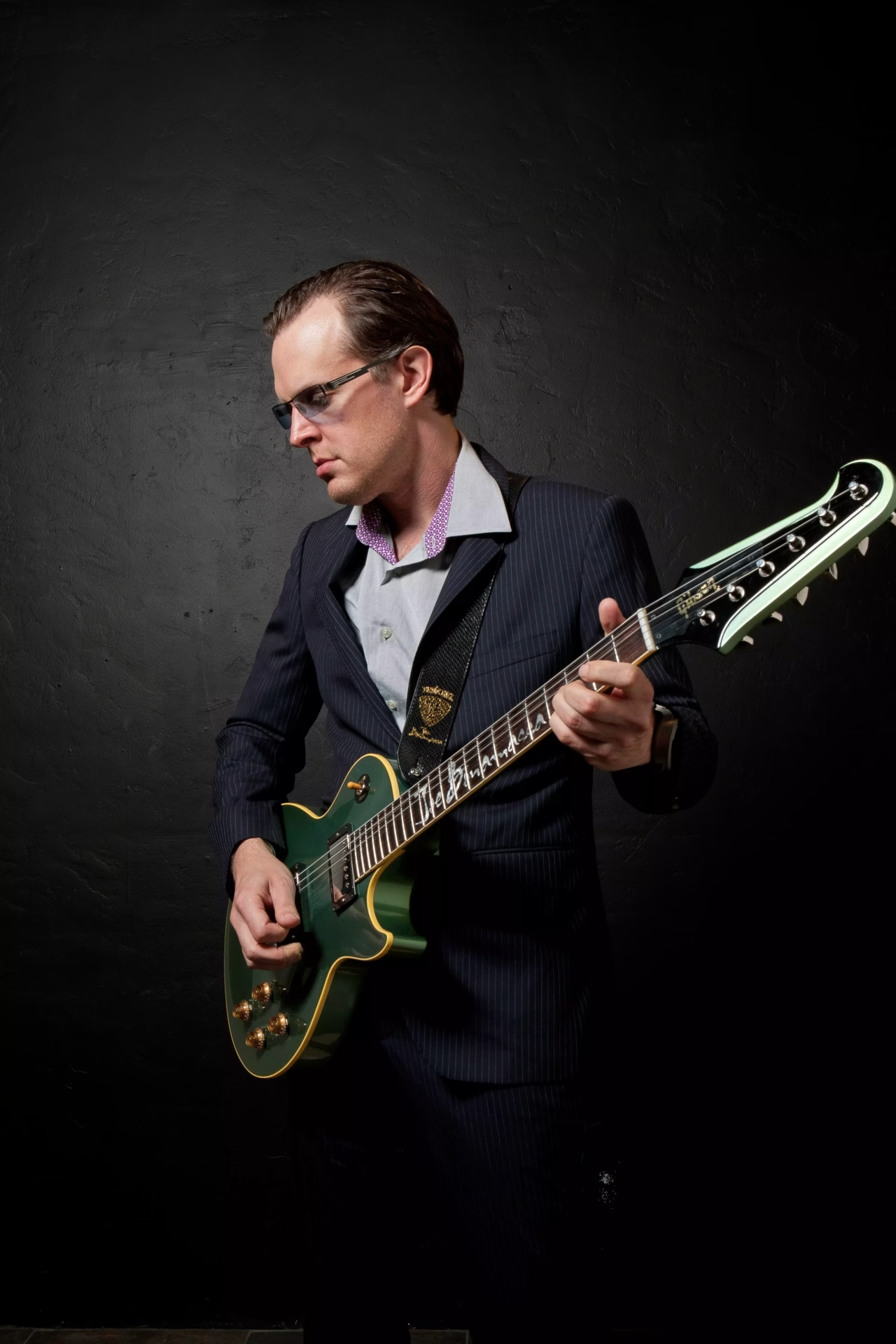
In the years since his '80s debut as a child prodigy opening for the likes of B.B. King, Joe Bonamassa has established himself as one of the 21st century's foremost axe slingers and rock-inflected interpreters of the venerable blues tradition. A relentless touring schedule and dense back catalog of albums and DVDs have placed him at the forefront of a field crowded with six-string contenders. In recent years, his stellar solo career has been complemented by a growing body of work with consummately soulful vocalist Beth Hart. Their sophomore album, Seesaw, earned a GRAMMY nomination for Best Blues Album for 2013.
For his new solo album, Different Shades Of Blue — which is scheduled for release Sept. 23 — Bonamassa decided to take a slightly different tack than he has on past projects. He spent time in Nashville, Tenn., co-writing the album's songs with several different tunesmiths, including Jerry Flowers, GRAMMY nominees Jonathan Cain (Journey), James House and Jeffrey Steele, and GRAMMY winner Gary Nicholson. The result is a hard-hitting set of tracks that showcase Bonamassa's blazing guitar work and plaintive vocal style to great advantage.
In an exclusive GRAMMY.com interview, Bonamassa reflected on his career, writing his new album, the nature of artistic collaboration, and why he's not worried about the future of blues.
What was your songwriting process with your co-writers on Different Shades Of Blue?
The attitude with co-writing is you have to start with something. You have to come in with a verse, a title, a lyric, or a riff. And the good songs come real quick. Generally within 20, 25 minutes, you're on your way to a finished song, which is great. There's some really talented cats in Nashville. Good lyricists. Really soulful. And I found I was welcomed with open arms because I wasn't there to write country hits. It wasn't like, "Hey, I need a hit because the record company is thinking about dropping me." I own my record company [J&R Adventures], so there's no chance of [them] dropping me. And Jonathan, James and Jerry were all kind of chuffed by the project. They said, "You wanna write some blues-based stuff? That's really cool!"
So it was the high level of song craft associated with Nashville that drew you to the town?
Yeah. The fact is these guys are lyric writin' dudes. And they're also good at song structure. I'm happy to do the Lightnin' Hopkins thing all night long — just play an E chord. But these guys go, "Hey you probably need a bridge here." Whoa. A bridge? So it was a really good experience and I made some great new friends.
In writing material for yourself, are you thinking of it partly as a vehicle for a guitar solo?
Not really. Some of the best songs I have shied away from the guitar solo. I found over the years that people come for the tunes more than they come for guitar solos. The solos — that's the polar bear riding the unicycle and juggling. In the P.T. Barnum school of spectacle, that's what it really is. But the draw is the circus — the event itself. I kind of learned that. My watershed moment with that was in 2006, when we went on after Steely Dan at the North Sea Jazz Festival outside of Amsterdam. Thirty seconds after we started, I realized, "Geez, 'Kid Charlemagne' is still ringing in the room, and we're on. I don't have any songs!" That was the beginning of an eight-or nine-year quest to amass material that really connects to people.
You first learned guitar from your father?
Yeah. Dad played guitar, collected guitars and ran a guitar shop. There was a lot of music in my house. My grandfather and great grandfather played trumpet. I'm the fourth generation in the family to make a living out of music. Music has been the Bonamassa family's business since one generation removed from Ellis Island. We've been gluttons for punishment for over a century. That's a nice slogan!
You've always known that music is what you were going to do in life.
Always. I had no B plan. I started playing guitar 33 years ago. I started playing professionally 25 years ago this November. And I've never had a B plan. I just always wanted to make a living playing music. And I say I'm one of the luckiest cats in the world because I get to do what I love for a living.
What was it like to receive a Best Blues Album GRAMMY nomination for Seesaw with Beth Hart?
I was very happy about the GRAMMY nomination. It was a real thrill. I first met Beth when she opened for us in 2010. I was looking at her going, "Wow, this is like watching Steve Marriott and Tina Turner at the same time! This is incredible." So I said, "What would happen if we took this situation, got a kick-a** band around it and did some classic material?" Didn't even have to write it. Just do an album of soul tunes and let her do her thing. And when we got in the studio it was very clear it was working. So we did a couple of albums, a tour last summer and a DVD.
What's special about your chemistry with Hart?
The reason why it's working is because there are no egos involved. Everybody knows what it should be and what it shouldn't be. When you do collaborations, it's important to be able to be a chameleon. It's not my job to go up there and front this. That's her job. I'm not dancing in front of her or trying to glom onto the spotlight. In fact, I'd prefer if the spotlight wasn't on me. When we did the tour, I stood in back with the band. The cats that come and hear Beth and me play are not gonna hear my catalog, and they're not gonna hear Beth Hart's catalog. They're going to hear our catalog. And Beth Hart's gonna front it, and that's the deal.
Do you think the blues is in a good place right now?
What's promising is that there are a lot of younger cats, like [15-year-old] Quinn Sullivan, playing the blues, and there's a lot of renewed interest in blues music. You also have your White Stripes and Black Keys. It's sad that there's enmity there, apparently, but that doesn't matter. Basically they package the blues in a way that kids love. They don't even realize they're listening to the blues, which is really clever. It's exactly what Cream, Led Zeppelin and my heroes did in the '60s. They were playing Sonny Boy Williamson and Howlin' Wolf songs and the kids were dancing to it. Most of those kids didn't have a clue where the music came from; it was just packaged in a way that appealed to them. To me, that seems like a fantastic way of doing it. So there seems to be a renewed interest in the blues, which is great.
In addition to your own blues-based music, you also head up the Keeping the Blues Alive Foundation.
Yes, it's our non-profit. A lot of times, schools' music budgets are the first thing to get cut. … If a school in Tuscaloosa says, "Hey, we're starting to convert Jell-O Pudding Pops into saxophone reeds. Can we get $500 for a new set of saxophones?" I'm inclined to say, "Sure, let's go." It doesn't matter if they're playing blues on them or not. I was successful in my career, and this is my way of giving back.
Your own work often takes you outside of the traditional I, IV, V, 12-bar blues format. How far can you go with that and still have it be the blues?
I have a very liberal view of what the blues is. But sometimes I can't even sit there with a straight face and tell you that some of my songs are blues songs. I believe that Sonny Boy Williamson is the blues. Robert Johnson is the blues. But I also believe that Robin Trower is the blues. Led Zeppelin [are] the blues. The Black Keys are the blues. 'Cause it's all from the same stone. It's just how you shape it. Admittedly, the great forefathers would not recognize this today [as] the blues. But I think they'd be proud that something they did has influenced generation after generation.
(Veteran music journalist Alan di Perna is a contributing editor for Guitar World and Guitar Aficionado. His liner notes credits include Santana Live At The Fillmore East, the deluxe reissue of AC/DC's The Razor's Edge and Rhino Records' Heavy Metal Hits Of The '80s [Vols. 1 and 3].)