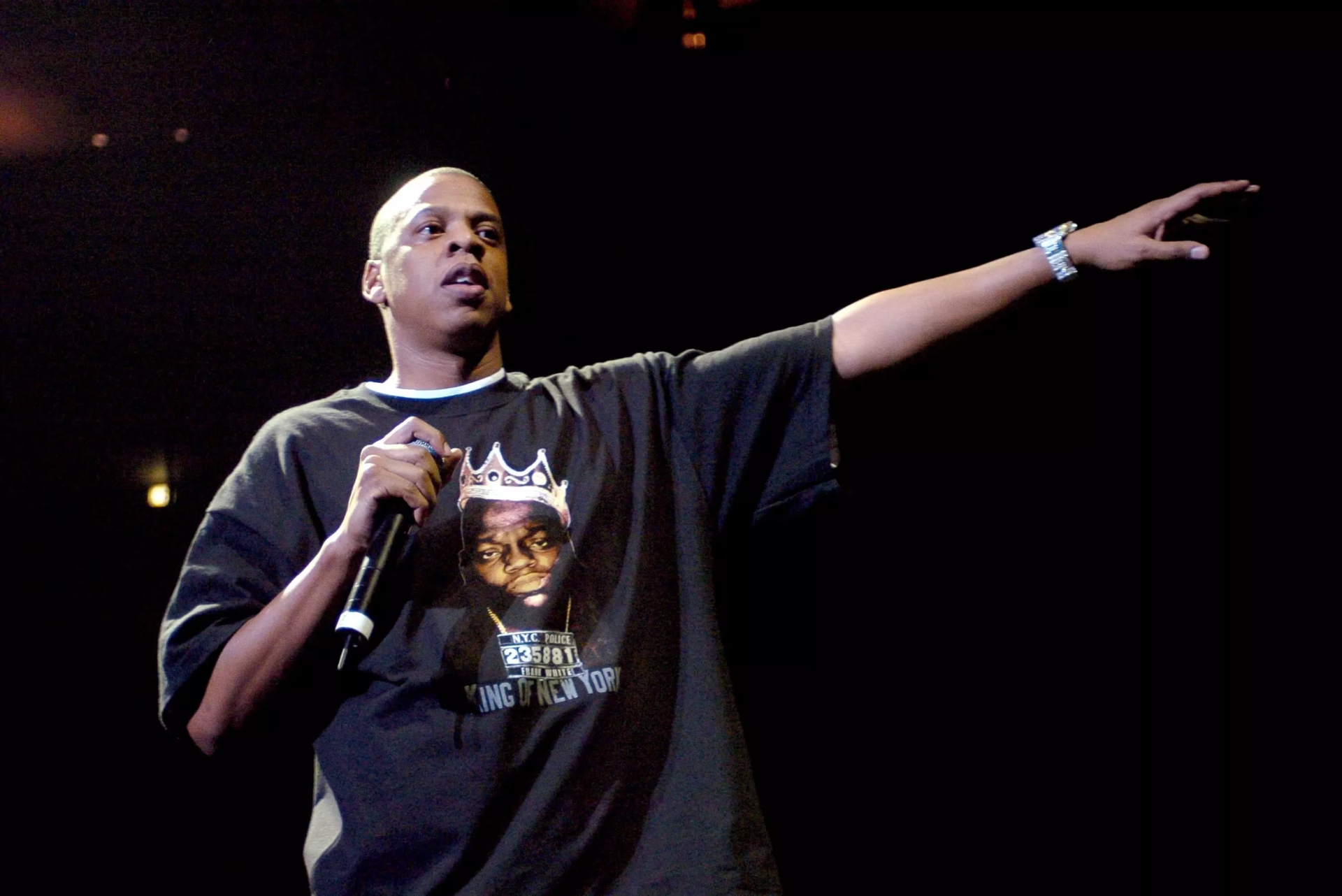
"From bricks to Billboards, from grams to Grammys," Jay-Z rhymes on "Dirt Off Your Shoulder," a prime example of how his eighth LP, The Black Album, is dominated by his rags-to-riches story. Released Nov. 14, 2003, The Black Album was, ironically, intended to be the rapper's final chapter. But the album's remarkable commercial and critical success — it sold 3.5 million copies in the States to become his sixth consecutive number one on the Billboard 200 — instead furthered his magnitude and influence, only continuing his legacy of one of rap's greats.
Boasting no fewer than 12 of the era's hottest producers (The Neptunes, Just Blaze, Timbaland, to name a few), The Black Album is a consistently strong, musically diverse, and remarkably honest listen, which firmly justifies all the self-lionizing. And not only does the album feature Jay-Z's signature tune, it also spawned arguably the most revered mash-up in music — and, among many other feats, inspired a generation of MCs with its slick lyrical flow and ground-breaking beats.
Twenty years on, take a look at eight ways in which Jay-Z's faux-farewell changed the hip-hop game.
It Spawned The Most Famous Mashup Album Ever
Jay-Z practically invited the DJ crowd to put their own spins on The Black Album toward the end of 2004 when he reissued the LP without any beats. Pete Rock, DJ Bazooka Joe, and original contributor 9th Wonder all accepted the challenge. But Danger Mouse, aka one half of soon-to-be chart-toppers Gnarls Barkley, had already taken it on, fusing the rapper's original rhymes with music from another colorful record, The Beatles' White Album.
Bringing two pop cultural behemoths together for the first time, The Grey Album (see what he did there) inevitably became a sensation, with EMI's efforts to withhold its release only adding to all the hype. Both Hova and Paul McCartney, however, gave their blessing, with the former telling NPR, "I think it was a really strong album. I champion any form of creativity, and that was a genius idea to do it. And it sparked so many others like it."
It Put Several Key Names On The Map
Jay-Z was no stranger to giving future hip-hop heavyweights their big breaks; both Swizz Beats and Kanye West were virtual unknowns when they contributed to Vol. 2... Hard Knock Life and The Blueprint, respectively. And The Black Album was no different.
Production team The Buchanans, who'd later work with Lupe Fiasco, Amerie, and Dr. Dre, gained their first official credit on "What More Can I Say." John Legend was still a year away from GRAMMY-winning breakthrough Get Lifted when he co-wrote "Encore." And "Threat" helped rap professor (yes, that's a real thing) 9th Wonder to establish himself as a genuine hip-hop authority.
It Produced His Defining Track
Jay-Z had scored, and would go on to score, much bigger hits than "99 Problems." In fact, 24 of his solo singles have charted higher than its No. 30 peak on the Billboard Hot 100. And it isn't always considered to be his best, either: "Big Pimpin'," "Dead Presidents II," and "Where I'm From" all kept the Rick Rubin production out of the top three in Rolling Stone's recent all-time Hova list. Even so, "99 Problems" still has the clout of an undeniably defining tune.
It's been referenced by everyone from Iggy Azalea to Barack Obama. It gave Jay-Z the first of his four Best Rap Solo Performance GRAMMYs (Mark Romanek's controversial monochrome video also picked up four MTV VMAs). Its themes of racial profiling, police aggression, and gentrification led Jack White to hail it as the modern "story of America." And although Ice Cube said it first, it was undoubtedly Jay-Z who put "I got 99 problems, but a b— ain't one" firmly into the hip-hop lexicon.
It Birthed Rap-Rock's Greatest Crossover
Jay-Z certainly wasn't the first hip-hop act to forge an unlikely rock connection. Run-D.M.C. broke down barriers (literally) in the video for their iconic 1986 Aerosmith collaboration "Walk This Way." The '90s saw collabs from KRS-One and Crazy Town ("B-Boy 2000"), Method Man and Limp Bizkit ("N 2 Gether Now"), and Public Enemy & Anthrax ("Bring The Noise"), all of which were met with mixed results. However, the Jigga Man's EP with nu-metalers Linkin Park, 2004's Collision Course, was a different story.
Notching another Billboard 200 No. 1 for both artists, Collision Course proved that rap-rock could be both credible and commercially successful — which eventually helped pave the way for everyone from Lil Uzi Vert to Machine Gun Kelly. And The Black Album was a key part of their success.
Not only did Jay-Z think to do the team-up after seeing the various mash-ups The Black Album spawned, but three of Collision Course's six tracks stem from the LP: "Points of Authority/99 Problems/One Step Closer," "Dirt Off Your Shoulder/Lying From You," and the Best Rap/Sung Collaboration GRAMMY-winning "Numb/Encore."
It's Been Sampled Countless Times
The Black Album is built on samples, from the emphatic big beats of Billy Squier to Russell Crowe's dialog from Gladiator. But such is the recyclable nature of hip-hop, it's also been heavily sampled since its 2003 release, too.
"99 Problems" alone has been borrowed from or covered at least a recorded 79 times, perhaps most famously on Iggy Azalea's verse in "Problem," her No. 1 hit with Ariana Grande. T.I. brought "What More Can I Say" into the top 10 of the Hot 100 after lifting its vocal hook for "Bring Em Out." Hip-hop sibling duo Clipse appear to have been The Black Album's biggest fans, though, having taken lines from "Public Service Announcement" and "Threat" on "Number One Supplier" and "Where You Been," respectively.
It Pioneered The Hip-Hop Concert Movie
Long before his other half Beyoncé unleashed Homecoming, Jay-Z proved that the concert movie didn't need to be the sole preserve of white guitar acts. Five years after his collaborative Hard Knock Life tour was captured for posterity on Backstage, the rapper invited another camera crew to document what was supposed to be his live swansong. "The undisputed heavyweight champion of the world in hip-hop," welcomes ring announcer Michael Buffer at the start of Fade to Black. And Jay-Z more than justifies such a billing in a dazzling, star-studded set that leaves the 19,000-strong Madison Square Garden crowd hanging on his every word.
Just as compelling is the behind-the-scenes footage of The Black Album's inception, particularly Timbaland and Pharrell Williams' excitement at conjuring the perfect beats. From J. Cole (Forest Hills Drive: Homecoming) to Chance the Rapper (Magnificent Coloring World), a whole host of rappers have since followed suit.
It Allowed Jay-Z To Guide Other Superstars
The Black Album might not have been the studio goodbye purported at the time. But before returning with Kingdom Come in 2006, Jay-Z did spend the following three years adhering to The Black Album's retirement theme. The self-imposed hiatus allowed the rapper to explore other creative avenues, expand his brand, and – perhaps most significantly for fans of a certain Barbadian superstar – take the reins of the legendary Def Jam Recordings.
Yes, after being appointed to the position of CEO in 2004 by L.A. Reid, Jay-Z signed a then-unknown Rihanna to the label, reportedly responding to her audition with "There's only two ways out. Out the door after you sign this deal. Or through this window." Ne-Yo and Rick Ross were both also plucked from obscurity by the Jigga Man and sent on their paths to stardom during his three years in charge (Jay-Z remained with Def Jam as an artist until May 2009, when he left to concentrate on his own Roc Nation label.)
It Made Retirement A Marketing Tactic
Although Too Short and Master P had both previously reneged on their plans to call it quits, Jay-Z was the first rapper to truly harness the power of an early retirement. Frequently alluding to the news (see "I supposed to be number one on everybody's list/ We'll see what happens when I no longer exist" on "What More Can I Say"), The Black Album was also accompanied by the aforementioned concert film, a memoir (The Black Book), and ever the entrepreneur, even tie-in sneaker and mobile phones.
Hova insists that he really did believe he was bidding farewell at the time, but there's no denying that the announcement helped to both boost his coffers (The Black Album was his biggest selling 2000s release) and add to his mythology. 50 Cent, Waka Flocka Flame, and Lupe Fiasco are just a few of the major hip-hop names who've since made similar claims before quickly walking them back.
Since his return, Jay-Z has added to his legacy in a multitude of ways. He's released collaborative projects with West and Beyoncé; scored a further five solo number one LPs on the Billboard 200 (including The Black Album's unexpected follow-up, Kingdom Come); and added more than a dozen GRAMMYs to his awards haul. And we've not even mentioned the record-breaking world tours, film production credits, and various business interests (TIDAL, Roc Nation Sports) which have helped him become the world's wealthiest rapper with a staggering net worth of $2.5 billion at press time. While The Black Album would've been a remarkable finale, Jay-Z's decision to unretire remains his smartest yet.