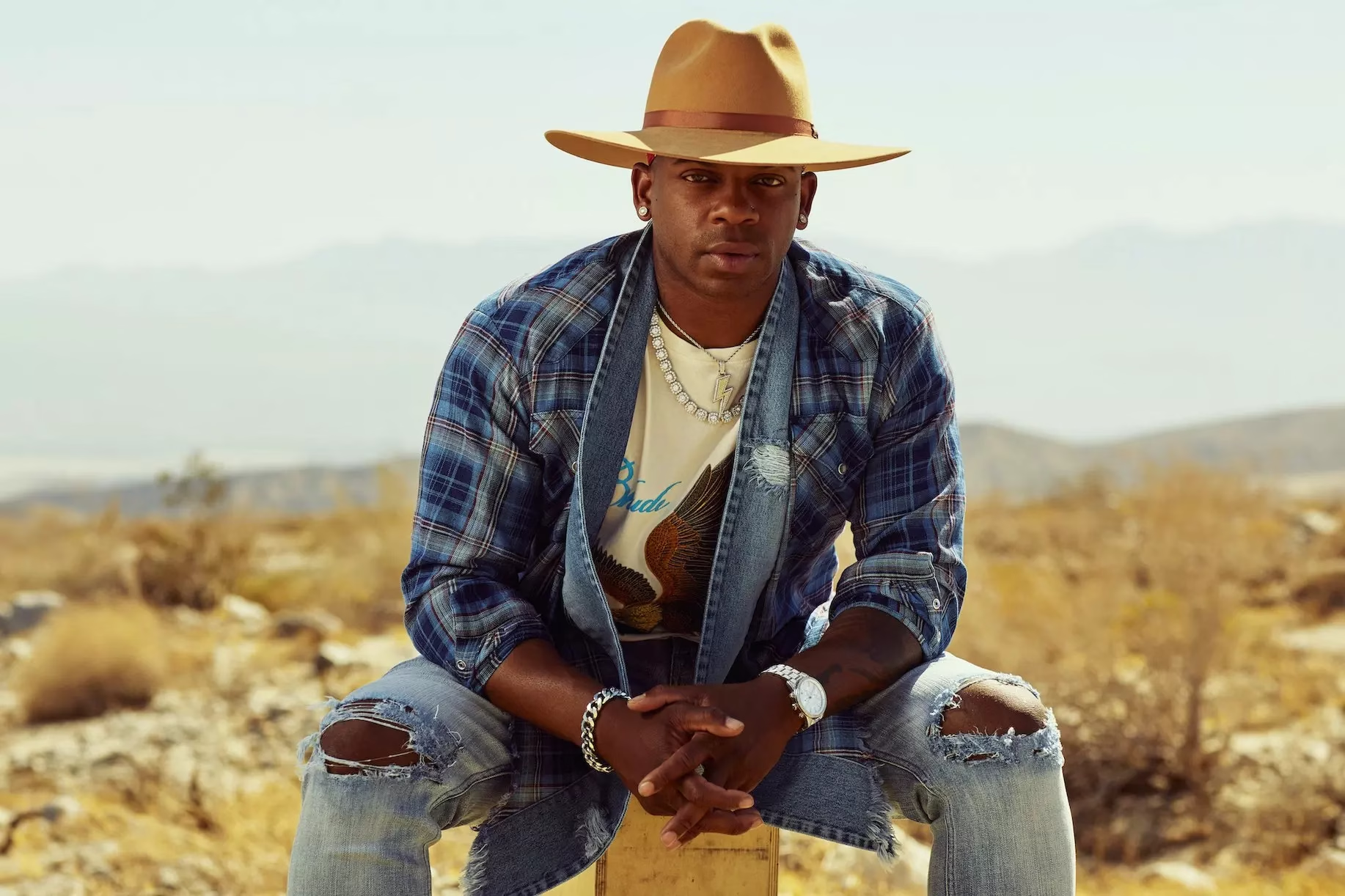
Jimmie Allen may just be the busiest man in country music. In the past six months alone, the singer/songwriter has competed on "Dancing With the Stars," welcomed his third child, toured with Nelly, won his first Country Music Association award, landed his third No. 1 on country radio, and co-hosted the ACM Awards with Dolly Parton and Gabby Barrett.
Though he's been officially releasing music since 2017, Allen is inarguably having the biggest moment of his career thus far. As a result, he's nominated for Best New Artist at the 2022 GRAMMY Awards — the only country artist to receive the honor this year.
"I was shocked. People would say all the time, 'Jimmie, why aren't you nominated for a GRAMMY for this? You're doing it different, and you're different-looking than most people in your genre of music,'" Allen says. "I'm not really worried about that. How I do my thing is, I just keep my head down, I work, and the people who are meant to know who I am will. I just focus on creating, expanding my brand and having fun."
One scroll through Allen's Instagram page will tell you that he's definitely having fun. And rightfully so: Allen has been working to make a career in music happen since 2007, initially struggling so much that he had to sleep in his car.
But while he's basking in the success he's made for himself, Allen is also aware of the work that still needs to be done. The "Down Home" singer has plenty more career aspirations, and as one of country's leading Black voices, he's looking forward to creating more opportunities for himself and the genre's rising stars. "It takes us having the courage to actually go out there and do it, and try to do it, to help open the door for someone else," he asserts.
GRAMMY.com sat down with Allen to discuss the importance of his GRAMMY nomination, how his small-town upbringing influenced his genre-spanning sound, and the long list of ventures that are still on his horizon (hint: get ready for some Jimmie Allen deodorant).
You're extremely passionate about expanding your reach to people who don't necessarily listen to country music. So what does it mean to be the only country artist in this year's Best New Artist category?
It means a lot. It means that not only did I get votes in the country category, I had to have gotten some votes outside of it. When you think of artists that could have been nominated this year, from Gabby Barrett to Hardy, there's so many artists that are just killing it right now. For it to be me, that means it was all the different outlets my publicists have gotten me on — "Family Feud," "American Idol," "Dancing With the Stars," hosting this TV show, doing that performance — it all kind of paid out.
My overall plan was, I'm never gonna change the style of music I do, but in order to reach people that don't listen to country music, you've kind of got to go where they are. It's been cool to see it executed and kind of see everything coming together.
What some people may not know about you is that you've been grinding to make this happen since 2007. What kept you motivated to make this work in the toughest moments over the past 15 years?
See, I get motivated from people telling me I can't do something. There's nothing better than someone saying, "You shouldn't do this, it's not gonna work." That fires me up. A lot of the time when there's no confrontation, I'll create it in my head to motivate myself [Laughs].
2007 was rough, I ain't gon' lie to you. From living in that trailer with no electric, to living in my car for a while, to being told I'm too country for pop, I'm too pop for country. It was a weird space. But listening to encouragement from my father, my mother, my grandmother, saying, "Look, you know what you want to do, you know who you are. Just keep creating the music you love and eventually you'll find the place."
That's what happened. 2018, the first single came out, got my first No. 1 in November that year. I got my second No. 1 in 2020 — 2020 was kind of a wash. The world was shut down, and it felt every artist was on an equal playing field. So [I was] like, "Okay, nobody's doing nothing. This gives me a chance to get a little head start and set myself up, so when things do open back up, I'll be a little bit ahead of the game and not playing catch up."
You've put out so many different styles of music within your own catalog, from doing R&B with Babyface to a Latin-inspired song with Pitbull. How have you seen that versatility expand the reach and impact that you were hoping for?
I've seen it grow a lot. I've had people that don't listen to country music start following me because they said they heard the song I did with Babyface, or the song I did with Nelly or the Noah Cyrus song. A lot of those songs are what got attention in places where people don't really listen to country.
Genres are languages. We're all saying the same thing: We talk about love, we talk about hurt, we talk about loss, about inspiration. But the way you deliver it is different. I spent my years in college understanding different types of people. I didn't care about the degree, I just wanted to meet different people and be around different types of people, so that when it [came] to creating music, I [could] learn how to speak the way they do — whether the drum pattern goes this way, or there's guitar or no guitar, the different phrasing and the cadence, stuff like that that kind of opens their ear to be receptive to the message that you're spilling through their speakers.
That's the big thing that I always wanted to be able to do — speak different languages, aka different genres, to where people are receptive to what you have to say.
You grew up listening to a lot of different music, from Matchbox Twenty to Motown to Christian music to your dad's favorite, Aaron Tippin. What ultimately made you decide that country was your genre?
It's who I am. I look at country music like I do Christian music — it's not about how many dogs died in the song, or how many banjos you got on it, it's about the person. And I grew up a country boy in Delaware. Country was the one place where I could completely be myself and still make the different types of music that I love.
Do you feel like where you grew up impacted the kind of artist you'd become and/or the music you're making?
It made a big difference. Milton is a small, little country town, but there's different types of people. You walk into a place and everybody's listening to country music — Black people, Mexican people, people wearing cowboy boots, people wearing Jordans. It don't matter.
How I was raised played a big part, because I was taught at a young age that everyone listens to country music, everyone listens to Christian, to hip-hop, to pop, to jazz. So for me, there were never really any color stereotypes associated with different genres of music. It was just people that liked music. That's it. That definitely goes out to where I was raised and how I was raised.
So Milton, Delaware is more musical than people may assume!
The crazy thing is, I know people from the inner city that have never heard of Jason Aldean, Garth Brooks, Luke Combs, Luke Bryan. But every country town you go to, everybody knows who Michael Jackson is, everybody's heard of JAY-Z.
It's like, "Why can't we somehow take this approach with country, and expand the brand of country to where we're on the main stage just like hip-hop or pop?" And we kind of have our voice.
That's kind of how I look at this GRAMMY nomination. I'm privileged to be the face of country music in this Best New Artist category, and my job is to show people, "Look, anybody can listen to country. And country music has made huge steps." I'm a Black guy nominated for a GRAMMY because of my success in country. It says a lot. We're not where we want to be, but we're getting there.
You won the CMA for New Artist Of The Year two weeks before receiving your GRAMMY nomination. In your social media posts about each of them, you talked about how these awards and nominations mean acceptance for those who "color outside the lines," which I thought was a cool, big-picture way to think about it.
The biggest thing I tell artists all the time — I know a few Mexican country artists that want to get into it. I said, "You've got to do it. In order to see change, it takes someone willing to put themselves out there, and force the change."
If we didn't have Charley Pride, [who] had the courage to be a country artist in the '60s and '70s, there wouldn't be Darius Rucker. There wouldn't be me. There wouldn't be Kane [Brown], there wouldn't be Mickey Guyton.
In order to change the narrative, it takes people that have the courage to put themselves in a situation and careers where there's not a lot of people to look like them. And people say, "Well, it's harder." Yeah, it's harder. Sometimes I do have to work twice as hard to get half the reward that a white artist would get in country music. But it is what it is. You can't change the obstacles. We can only control our work ethic and the quality of music that we put out.
I was going to ask how being Black — especially in a genre that's predominantly white — informs the music that you create and the career music moves that you make, but it sounds like you might not even think about it. You just make the music that inspires you, and you do you.
Yeah, I just do me. This year was the first time my managers really got to see kind of what I go through as a Black artist in country music. There was a time [an outlet] posted me — I'll always read comments, because when people troll me, I love trolling them. I have the mentality of a hip-hop artist.
Every time [this outlet] posted [a picture of] me, this one guy was like, "Look at this thug from Compton. There's no way he's a country [artist]. Play real country artists." And he started naming people whose music sounds more pop than mine [Laughs]. I told him, "Man, you're a genius. Hands down the smartest person I've ever written to in my life. How did you get this smart?"
And then people just started going after my manager, Lauren — she said, "So this happens every time?" I say, "Oh yeah, you just get used to it." I don't let those comments affect me. That's why I call it self esteem. It's how you feel about yourself. Other people's opinions don't bother me at all. I lose zero sleep over it. And I feel like that's how it should be.
I'm sure Charley Pride would be proud of you for taking that stance.
Me and Charley talked a lot. We talked on the phone every other Sunday from the time we met to the day he died. He's a funny dude. I learned a lot from him, too — just how to handle yourself. Like, there's a way to be upset, but yet still word what you want to say in a way to where people are willing to listen.
What does it mean to you to be able to carry on his legacy, since he meant so much to you?
It's an honor. I have parents of Black children email me and say, "My son or my daughter listens to country music because of you being part of it. You inspired them to get into country music. You let them know that they're not weird for liking something different." If I could be a fraction of what Charley Pride was to me to someone, I feel like I'll be making a difference.
Along with collaborating with your hero, you've landed three No. 1 singles, launched a publishing and management company, published a book — the list goes on. Are there any career moves you're still looking to make?
I want to be on Broadway. I want to play Aaron Burr in "Hamilton" really badly. I want to host a couple shows on TV, have my own TV show, whether it's reality TV or a sitcom. I want to do movies. I want to have my own sneaker and my own boot, my own line of men's deodorant and facial products. I want to create kid's shoes.
My ultimate goal is to raise money to create a music school within my old high school in Delaware, and name it after my grandma. My buddy was like, "You don't want it to be named after you?" And I said, "Nah. I do want a statue though." And I want a statue while I'm alive. I want to see it. I don't want no memorial statue when I'm dead. That don't do me no good!
Would it just be your face or your whole body?
Oh, whole body. I want this thing like, 200 feet tall.
I feel like it needs to be the picture of you in the all-leather outfit that you posted with the caption "currently eating popcorn waiting for the 'this ain't country' comments."
Exactly. Even when I die, it'll say, "Jimmie Allen: Still waiting for the 'This ain't country' comments.’"
So you're really just trying to do literally everything you can with your platform.
Oh yeah. You got one life. I'd rather spend my life trying to do it than sit back wishing I would have done it.
Thinking back to the days when you were living in your car and trying to make this dream happen, how does where you saw things going compared to where you're at now?
It's right on track. My plan was always to get one No. 1, then start slowly try to venture outside of music, then get two No. 1s, and slowly get into TV and host [shows]. I never wanted to rush anything. I wanted to wait until my fourth single was out before I did my first headlining tour.
For me, it's all about executing, but also being patient and not rushing, and not competing with other artists. As artists, we're not in competition with anyone but ourselves, because there's no one who can do what we do but us. So as long as I keep that in mind, I can stay on my own path.