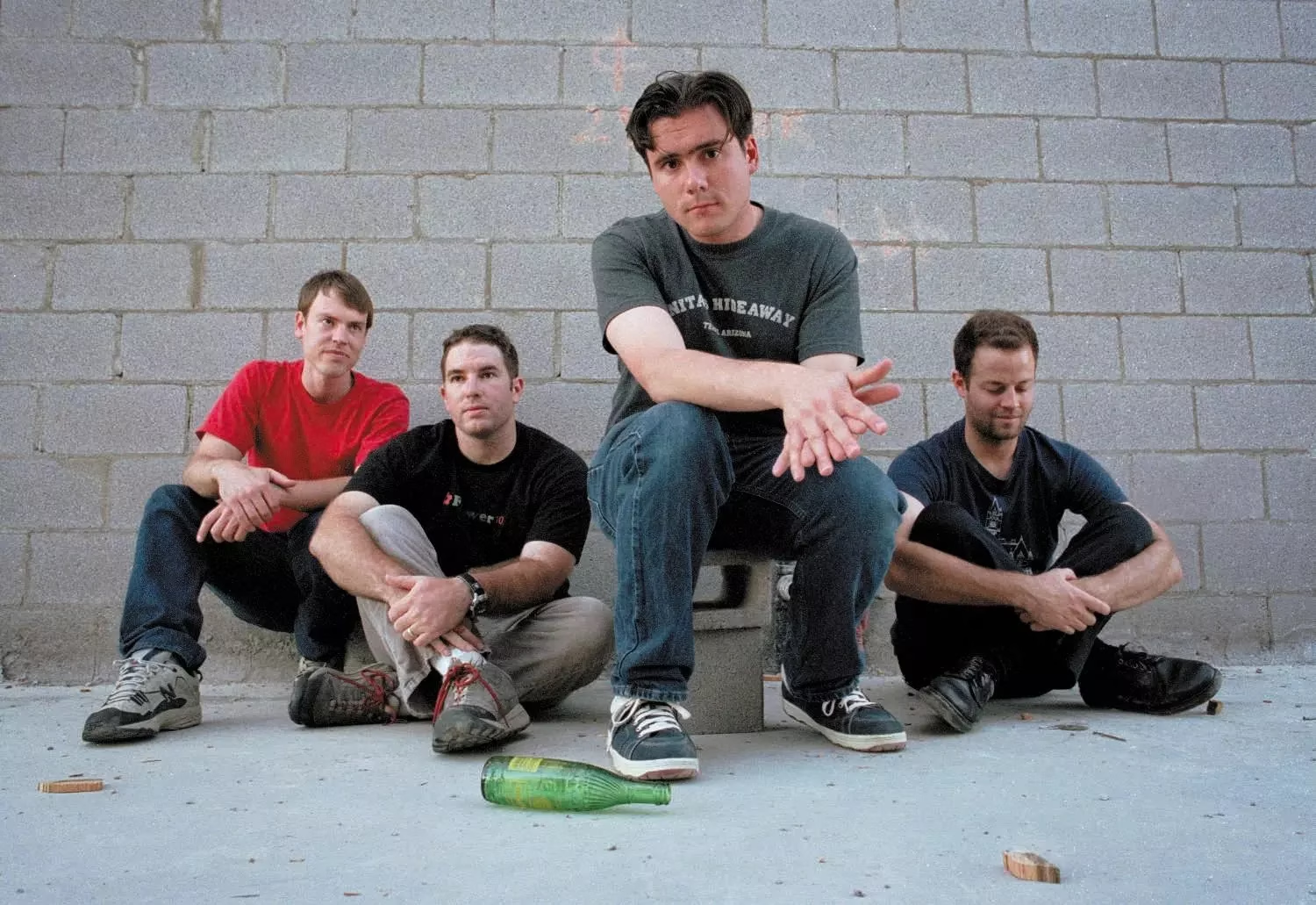
Second chances are hard to come by in the music business, and the 1990s alt-rock gold rush was no different. For every Pearl Jam and Stone Temple Pilots success story, there were bands like Fig Dish and For Love Not Lisa, whose albums failed to launch.
And yet there was Jimmy Eat World, an emo-punk band scooped by Capitol Records right out of high school in '95 only to be dropped after two albums in. Fast-forward to 2002, and the band is performing their breakout hit, "The Middle," on "Late Night with Conan O'Brien." Then "The Tonight Show with Jay Leno." Then "Saturday Night Live." The song's uplifting lyrics—"Don't write yourself off yet ... It doesn't matter if it's good enough / For someone else"—sound almost like a masterclass in self-motivational life lessons.
"The Middle," from Jimmy Eat World's fourth album, Bleed American, which celebrates its 20-year anniversary this month, shot to the Top 5 on the Billboard Hot 100 all-genre chart and made the four then-twentysomethings from Mesa, Arizona, darlings of late-night TV and MTV. While it's easy to read into the lyrics two decades later, the song wasn't written as a kiss-off to their former label. But it was the ultimate about-face, the "phoenix-like rising from the ashes of being dropped," as Steve Martin of Nasty Little Man, who orchestrated the publicity campaign for Bleed American, puts it.
"Where they had gotten in their development, and the musical zeitgeist of the time, were just so aligned," Martin tells GRAMMY.com. "Even if they hadn't been [aligned], it was such an undeniable collection of songs."
<style>.embed-container { position: relative; padding-bottom: 56.25%; height: 0; overflow: hidden; max-width: 100%; } .embed-container iframe, .embed-container object, .embed-container embed { position: absolute; top: 0; left: 0; width: 100%; height: 100%; }</style><div class='embed-container'><iframe src='https://www.youtube.com/embed/Nl3vGClF_hA' frameborder='0' allowfullscreen></iframe></div>
For Bleed American, the band went for simplicity. While the album peppered elements from their previous releases—the barbed post-punk guitar riffs from the band's 1996 album, Static Prevails, giving the title track its teeth, the jangly atmospherics from Clarity (1999) chiming in the background of "Hear You Me" and "Cautioners"—the scaled-back approach marked a significant change to their sound. Still, the songs on Bleed American are also front-loaded with hooks that get straight to business: The band reaches both the bludgeoning chorus of "Bleed American" and the bouncy singalong of "The Middle" in 35 seconds flat.
"I think I started finally getting Bruce Springsteen and the Everly Brothers after we made Clarity," lead vocalist and guitarist Jim Adkins says. "I started recognizing that simpler construction, simpler arrangements, [the] everything-you-need/nothing-you-don't type of songwriting is actually really, really challenging and worth pursuing."
Before they made Bleed American, though, they had to get out of their contract with Capitol. Adkins estimates the band sold maybe (his emphasis) 10,000 copies combined of Static Prevails and Clarity. The pairing was a mismatch, according to the band. The label treated Jimmy Eat World like a development project, while Adkins says Capitol was set up to "drop the hammer on the thing that's moving 15,000 to 30,000 [records] a week." So, when the label dropped them in 1999, it was a relief. It was also a chance to rebuild.
In reality, the band simply continued with business as usual. They were already operating as their own European distributor, buying copies of Clarity at wholesale prices from the college department at Capitol and shipping them to Germany; the move paid off when 400 people showed up to their first gig in the country, as Jimmy Eat World were touring to save up money to record Bleed American. Toward that end, they also released Singles, a compilation of their seven-inch singles and one-offs, on the now-defunct independent label Big Wheel Recreation in 2000.
With demos of new songs like "Sweetness" circulating online and in industry channels, the band settled in at Cherokee Studios in Los Angeles with producer Mark Trombino, whose confidence in the band was so high, he waived his fee until the group worked out a new label deal. And sure enough, representatives from major labels began showing up at their recording sessions to see what the buzz was all about.
"It was a very welcomed change," drummer Zach Lind says. "You go from feeling kind of like the red-headed stepchild to being in a position where you have a little bit of leverage, whereas before, we didn't really have any leverage."
<style>.embed-container { position: relative; padding-bottom: 56.25%; height: 0; overflow: hidden; max-width: 100%; } .embed-container iframe, .embed-container object, .embed-container embed { position: absolute; top: 0; left: 0; width: 100%; height: 100%; }</style><div class='embed-container'><iframe src='https://www.youtube.com/embed/PPtFp1qRFcE' frameborder='0' allowfullscreen></iframe></div>
Jimmy Eat World 2.0 signed with DreamWorks, an artists-first label created by music industry veteran David Geffen with filmmakers Steven Spielberg and Jeffrey Katzenberg, whose roster also included Elliott Smith, Morphine and Eels. Retooled with a new label, new management, and their new album's title track as the first single, the band hit the promotion circuit hard in the summer of 2001, playing dates on the Warped Tour as well as headlining club shows.
"When 'Bleed American' started happening, things changed quickly," bassist Rick Burch tells GRAMMY.com. "The venues got bigger. We weren't driving ourselves in the van anymore; we had a bus driver and a bus, so we could do far more gigs for a longer stretch, and we were playing in front of more people than we ever had before."
The terrorist attacks of September 11, 2001, changed all that. Although the song was doing well on alternative radio, "Bleed American" "just fell off the face of the Earth" after 9/11 happened, according to Lind.
<style>.embed-container { position: relative; padding-bottom: 56.25%; height: 0; overflow: hidden; max-width: 100%; } .embed-container iframe, .embed-container object, .embed-container embed { position: absolute; top: 0; left: 0; width: 100%; height: 100%; }</style><div class='embed-container'><iframe src='https://www.youtube.com/embed/oKsxPW6i3pM' frameborder='0' allowfullscreen></iframe></div>
As Americans regrouped in the aftermath of the world-changing event, so, too, did Jimmy Eat World. They rechristened the album as Jimmy Eat World and transitioned to pushing "The Middle," which was on deck as the second single.
Written in response to a fan email sent to the band's Aol. account in the '90s, "The Middle" addresses themes like alienation and low self-confidence. Its perspective outlines a position of rallying and understanding how someone's teenage years are only a small part, e.g. "the middle," of a person's journey. Radio embraced "The Middle," but what really put the song over the top was the video and its subsequent spins on MTV's "Total Request Live" countdown show.
Paul Fedor, who directed the music video for "The Middle," pitched the theme: A classic dream sequence where you show up to school, work—or in this case, a house party—naked. But in this instance, the roles are reversed. The protagonist shows up to a party fully clothed, while his peers dance and cavort in their underwear. Just as he succumbs to peer pressure, he meets someone just like him. It was a simple concept, but it could have easily gone wrong.
"I think we just decided, 'Let's lean into this and do it and make sure it's done right,' make sure it's not overly gratuitous or inappropriate in a way that feels creepy," drummer Lind says. "So, we tried to thread that needle. I think there was a little bit of apprehension, but once we decided to go down that road, and once we were done with it, we felt really good about it."
As their popularity rose, Jimmy Eat World's touring schedule broadened. They played the main stage at several European festivals to a "sea of humanity," according to Burch, and recorded a sold-out performance at the 9:30 Club in Washington, D.C., for the Believe in What You Want DVD. The touring bubble insulated them from seeing just how big things had gotten.
"We were just touring, and it all felt like kind of the same way it felt working with Capitol," frontman Adkins says, "[like] we were totally getting away with something. 'This isn't real. We're just taking the ride for the funny stories while we have the chance.' It didn't sink in that, 'Oh, wait, this is actually connecting with people. This is something that is really getting out there.' It wasn't until maybe a record later or two records later we realized actually how big it was."
<style>.embed-container { position: relative; padding-bottom: 56.25%; height: 0; overflow: hidden; max-width: 100%; } .embed-container iframe, .embed-container object, .embed-container embed { position: absolute; top: 0; left: 0; width: 100%; height: 100%; }</style><div class='embed-container'><iframe src='https://www.youtube.com/embed/ROatPGGMvXg' frameborder='0' allowfullscreen></iframe></div>
In summer 2002, as the album's third single, the fan-favorite "Sweetness," peaked at No. 2 on Billboard's Alternative Airplay chart, Jimmy Eat World signed on to open the Pop Disaster Tour co-headlined by Green Day and Blink-182. The two-month jaunt grossed $20 million at amphitheaters and arenas, according to Billboard, and the bands wasted no time in hazing each other.
"We hired some male strippers to storm [Blink-182's] stage during their song 'All the Small Things,'" bassist Burch remembers, with a laugh. "The audience just loved it. They thought it was part of Blink's act, and the Blink guys loved it, too. We actually ended up helping them, giving them a cool element to their set that everyone was stoked with. It wasn't distracting to them at all."
Green Day, however, flexed their "vast resources" mercilessly. "When they came out on stage, the first thing they did was shoot super soakers," Burch recalls. "The next layer was boxes of dehydrated mashed potatoes. [When you] combine that with the water, it turns into glue." Then their crew deployed Ping-Pong balls and glitter bombs from the overhead lighting trusses.
"That starts raining down," Burch adds, "and when the glitter meets the mashed potato glue, it's a very strong bond. Even to this day, there's bits of glitter adhered to the guitar I was playing."
When the dust, and some of the glitter, settled on their nearly two-year campaign for Bleed American, the members of Jimmy Eat World had come home to platinum plaques and an album that continues to rank high on "best of" lists; readers of Rolling Stone voted the album one of the 10 Best Pop-Punk Albums of All Time. Bands tagged with the "emo" label in the years that followed, like Panic At the Disco, All Time Low and Fall Out Boy, owe a big debt to Jimmy Eat World for crashing the gate to mainstream acceptance.
"The way that Bleed American just opened doors for us was maybe one of the most satisfying experiences of my life," Lind reflects. "In the wake of all the frustration and banging our head against the wall at Capitol, it just felt like everything aligned perfectly, and I think we were lucky to be able to experience that in that way, because I don't think a lot of people get that moment in their life."
Saves The Day's Chris Conley Talks 20 Years Of Through Being Cool