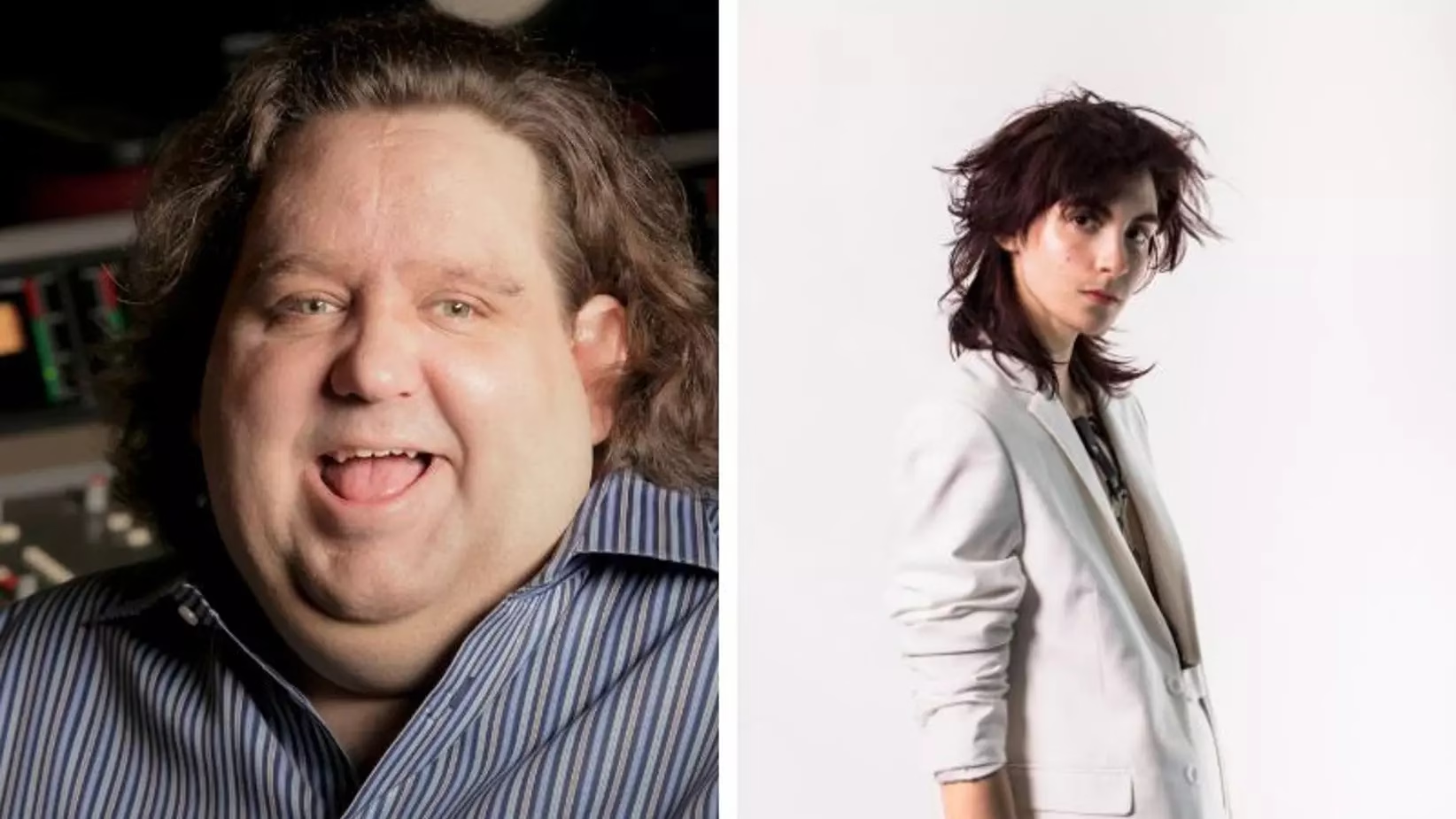
October marks LGBT History Month and National Disability Employment Awareness Month (NDEAM), and while the month is drawing to an end, supporting the disabled and queer musical communities is something we must continue to do year-round.
GRAMMY.com spoke with musicians Joey Stuckey and Medusa about their personal experiences with accessibility, and how to better support those within underrepresented communities.
Joey Stuckey, a renowned blues guitarist who is blind, is a Recording Academy Atlanta Chapter member, AES member and educator.
Medusa, who is nonbinary, intersex and neurodiverse, is a pop/EDM artist, activist and member of RAMPD.
Joey Stuckey
You decided to pursue sound production after becoming a fan of public radio. What about the content or accessibility of those broadcasts inspired you?
It truly was a watershed moment for me! Before TV, radio was king and besides the obvious idea to transmit music and the news, they did radio plays. These stories were told using dialog, sound effects and music to tell amazing stories that were fully accessible to a blind person. For a blind kid, it was just an entire new world of possibilities.
Later, I realized that I could also record bands and artists and capture their performance. I started doing that when I was around 15 years old and by the time I was 19 I had a pro recording studio in downtown Macon, Georgia — where I also serve as the official music ambassador — and have been working as a recording engineer and producer ever since!
In addition to being a musician, you're a professor of Music Technology at Mercer University and a mentor for the Recording Connections School in Los Angeles. How do you approach music education?
Whether I am teaching at a university as adjunct faculty or leading masterclasses in music theory, music technology, music branding or the art of improvisation or educating the industry about the need for accessibility, I speak in a way that is clear and concise and simple.
I use words very strategically and rarely use visual aids. I do use lots of audio examples, and, after all, the recording sciences and music composition and performing are all auditory. I really drill down on critical listening! In fact, the first thing I get my students to do is to close their eyes and tell me what they hear — not what they see.
Can you talk about your experiences as an artist with accessibility needs?
I have always been determined to do what I want and to be as independent as possible, but also to recognize what I can and can’t do. I started my career in the analog world. As a blind person, I could memorize all the buttons and knobs. In our digital screen driven universe, most controls are "soft" meaning that their function changes depending upon what screen/menu you are on. If you can’t see the screen, that is a big problem.
When I was first starting, computers weren’t an integral part of our world let alone the recording sciences…I didn’t touch a computer again until 2003.
The big problem with accessibility with programs that read the screen to the blind is that they don’t work all the time. When I went to college the first time, the ADA was not in existence and right around the time I was approaching the end of my college days it was new and mostly untested. So I just had to constantly think outside the box to get any kind of accessibility I could and I was mostly successful.
Today, there is more attention being paid to accessibility needs for folks with disabilities, but we still are nowhere near fully being able to have the same accessibility as our sighted counterparts. While there are some wonderful music companies out there that make accessibility a priority, they are still few. However, I believe the biggest obstacle to greater accessibility is talking about it, so I sincerely thank you for the opportunity to do so here!
In which ways do we still have a long way to go in providing accessibility to artists?
Accessibility is more than just providing access to the hardware and software that we use in the music industry. We also must provide accessible stages and performance venues.
I spent some time in a wheelchair due to a latent issue form the brain tumor when I was in my late twenties. I remember being hired to do a performance with my band and when we got to the venue, the only way onto the stage was a steep flight of stairs. Two of my band mates had to take me out of the wheel chair and carry me up those stairs while another band member had to get the wheelchair up the stairs. It is not only important for disabled performers to have access to our performance spaces, but also for disabled patrons as well.
How can we better interface with and support the blind musical community?
I would recommend that folks get involved with organizations likes RAMPD [an accessibility organization within which Stuckey is a pro member], Half Access and the 1IN4 Coalition to educate yourself about these challenges and how you might be part of the solution.
Also, making sure that while we work for greater diversity, equity and inclusion, we remember that our disabled artists are part of that community of folks that can become disenfranchised. I have served on a lot of D&I committees, and none of them had a disabled person listed on their diversity wheel, which is a tool used to make sure that different diversity needs were represented. It took me asking to be included before it happened.
Again, it is mostly a case of needing to talk about being disabled and sharing what we need to make these changes happen. It requires honest discourse and people willing and excited to offer spaces where this discourse can take place.
Medusa
How did your 2020 LP Boy of the Year help you understand or shape your identity?
Writing Boy of the Year helped me document a crucial period of my personal development. I jokingly refer to it as my "coming of gender LP." And although the title is tongue-in-cheek, it is a coming out album in the truest sense. Back then, I started most mornings by plucking dozens of hairs from my chin to help hide my masculinity. Paradoxically, I ended most evenings curled around an empty stomach, trying to starve away the parts of me that were feminine. I’d spent most of my life sprinting full-speed away from myself. Of course, everywhere I went, there I was.
Facing down a decade-long eating disorder is difficult enough for a cis person. For someone who doesn’t realize they’re transgender, instructions to "love and accept the body you’re in" can feel like a death sentence. So you can imagine how learning you’re trans can save your life. Seeing other non-binary people gave me the context I needed to self actualize. Then, I realized I could help be that representation for someone else.
Each song helped me explore a different aspect of transition. I transformed my unbridled joy and relief into beats. I took on transphobes' voices and mocked myself, then mocked me back. I sang directly to those who mourned everything I "could have" been, including myself. When I was done, I had an album. And, I’ve been recovered ever since.
Tell us about Allegory of the G/Rave, your queer retelling of the story of Medusa, and how the story resonates with you.
In the original Greek myth, Medusa was a Gorgon from birth. Later, a poet called Ovid rewrote the story; in his telling, Athena cursed Medusa to become a monster as punishment for being violated by Poseidon. Because of this version, survivors of assault see Medusa as a symbol of power. I started making music as Medusa after I was attacked, then called a liar, and ostracized. Realizing I’m queer added another layer of relatability; a lot of transphobic rhetoric centers around the idea that trans people become grotesque, or "ruined."
But to me, the most interesting thing about Medusa isn’t Poseidon attacking her, or her transformation. It’s what happens after that. We’re not just victims of transphobia, or of assault. It doesn’t subsume our identity until we head to our graves. So, with Allegory of the G/Rave, I wanted to explore what happens to Medusa after she’s exiled. After trauma and transformation, how do we live in our new bodies and minds? How do we defend ourselves? Which threats are real, and which are just shadows on the wall of the cave? I thought a nice way to play on the theme of ostracization would be to keep the whole album really upbeat — alt-pop and dance tracks, with bite, and good for group catharsis. Hence, "rave.”
My fantasy was to also turn this concept album into a short film, and Audiofemme has helped make that a reality. They chose me as one of the recipients for their 2022 Agenda Grant, so this year, I’ve been producing the album and film simultaneously. I am profoundly excited — and so, so lucky — to get to share another version of this story for generations to come.
Can you talk about your experiences as an artist with accessibility needs?
Imagine your job is to put rocks into a box. The rocks are to your right, and the box is on the left. You’re left handed, making reaching across awkward, so you move the box to the right. Now, you can use your left hand to pick up the rocks and toss them into the box. Your setup is ergonomic and efficient.
Then, your boss comes around. You think he’s going to commend your productivity, but instead he yells at you to change things back. "Everybody else does it the normal way," he says. "Why can’t you? Fix it, or you’re fired." So you revert to the awkward posture and develop bursitis in your shoulder. Now you can’t do your job at all.
This is the autistic experience. This is the ADHD experience. People love to hear from an eccentric artist about their synesthesia, and rely on their coworker’s attention to detail and innovative solutions. Those same people refuse to change the office’s fluorescent bulbs, chastise their employees for fidgeting, and deny others opportunities for being ‘too weird.’ They see us as strange, childish, or incompetent.
A lot of people don’t realize neurodivergent accessibility needs are deeply physiological. Masking behaviors take a toll on the body, and when modifications aren’t possible, it’s a safety issue. This is why we ask for a quiet place to sneak away to, or for emails over video calls, or for walking meetings, or to collaborate remotely. We know what we need. We know how we operate. So, let us.
In which ways do we still have a long way to go in providing accessibility to artists?
So many people in the music industry want to improve access…they just don’t know how. It’s difficult to intuit others’ needs. In the case of neurodivergence, I think of the double-empathy problem: neurotypical people often think it’s sad that we don’t seem to understand them, not realizing they themselves don’t seem to understand us. And of course your venue or team or event isn’t meeting accessibility standards. How could it, when there are no disabled people on the team?
I’m a pro member of RAMPD, or Recording Artists and Music Professionals with Disabilities. We’re an intersectional coalition fighting to amplify disability culture, promote inclusion, and advocate for accessibility across all facets of the music industry. For example, RAMPD introduced everyone at the 2021 Wavy Awards to self-description, to aid Blind and low-vision audiences. Before each speech or performance, we relayed information about our appearance and identity verbally.
For every triumph, there are a dozen more issues to address. But this isn’t a never ending mountain of responsibilities to trudge through. They’re opportunities. Each choice made to further accessibility is a chance to create beautiful new experiences we’re all better for.
We need people to understand that we aren’t great artists, or managers, or entrepreneurs even though we’re autistic, or deaf, or anything else. We’re great because of who we are. So, put us in the room, because we will make things better. Not just for us, but for everyone.
How can we better interface with and support the queer musical community?
Sometimes when people want to support the queer community, they’ll make the mistake of simply adding a handful of us to a bill. Sure, our presence can enrich and educate others. But that education actually needs to happen before we are invited. Your venue needs to have bathrooms trans people can safely use, your bandmates need to use our real names and pronouns, and your studio needs to be safe for lesbians and gay men to record without harassment. To truly include us, and not just tokenize us, you need to make it safe for both queer artists and our audiences to be there.
An easy way to do this is to expose yourself and your community to more queer art. Listen to our music. Share our stories and discuss them with others. Attend queer concerts and experience things firsthand. Meet with the organizers for advice on how to create safer spaces. Educate your staff, your bandmates, and your friends. Institute a zero-tolerance policy for transphobic and homophobic behavior– and enforce it.
And, above all, amplify the voices of the queer artists around you. When you make your support known in a public way, you become our megaphone. And we are grateful for that.