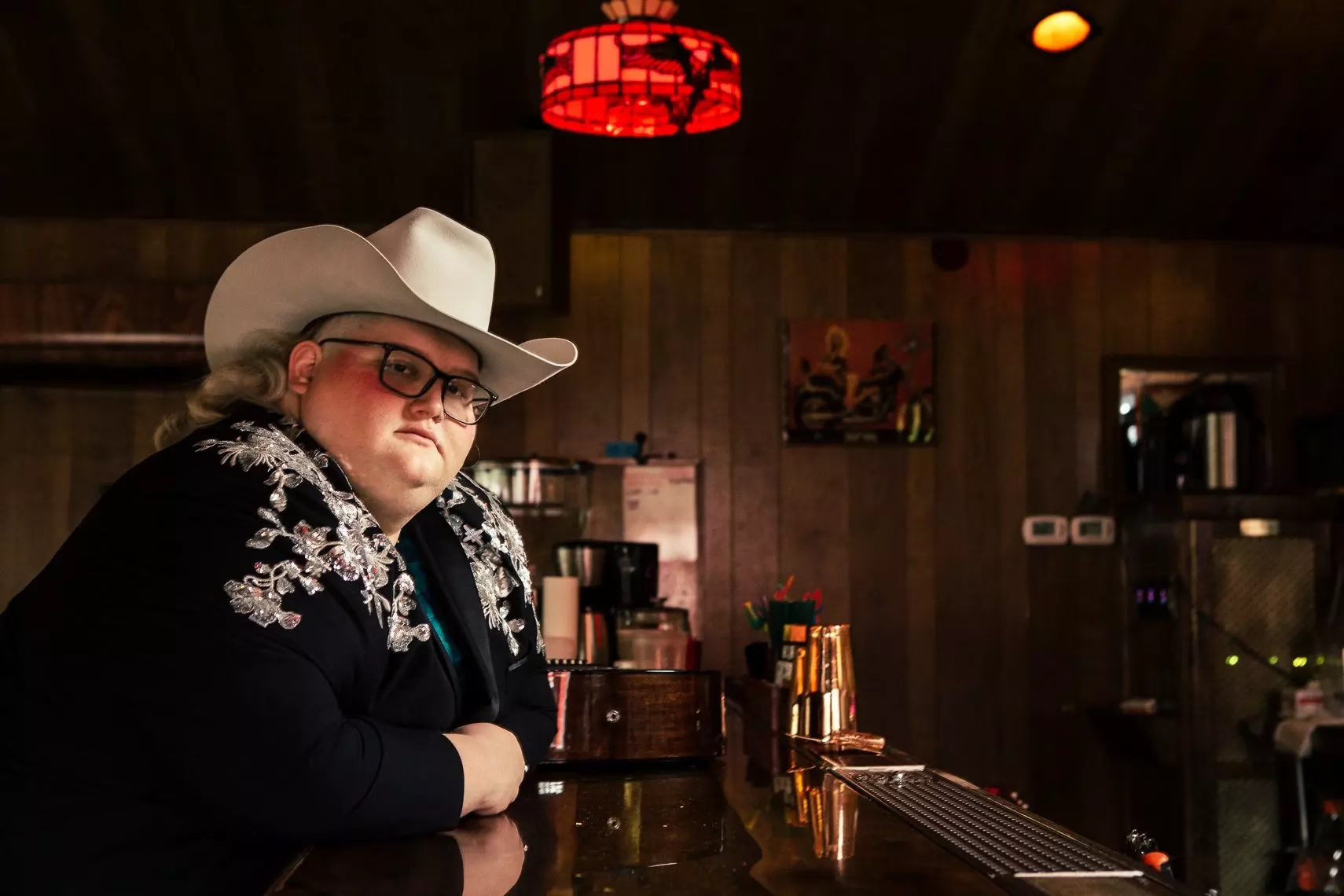
In April, country singer/songwriter Joshua Ray Walker made his Grand Ole Opry debut with "Sexy After Dark," a rollicking anthem celebrating the giddy freedom of anonymity, alcohol and proximity of a packed bar late at night. Switching tone, he followed his first song with “Voices,” a dulcet, brooding first-person reflection on a moment of acute mental pain.
While the playful energy of "Sexy After Dark" is instantly accessible, "Voices" asks the audience to slow down and listen. The Opry audience did just that, but couldn't help erupting into cheers when Walker held the long, haunting falsetto note that concludes the song's chorus.
Appearing on the Opry's stage remains a quintessential stop in any country musician's career, and the Nashville institution holds a singular power to anoint stardom. And although 31-year-old Walker received a standing ovation at the prestigious venue, he isn't your typical country musician.
A Dallas, Texas native, Walker's music picks up where some of his state's singer/songwriter greats like Guy Clark, Townes Van Zandt and Billy Joe Shaver left off. He grew up in a musical tradition that celebrated Willie Nelson andWaylon Jennings for rejecting rigid Nashville country norms and carving out the outlaw country genre away from Music City's neon lights.
Walker's music often elicits comments of "I don't like country music, but I like this," from new fans. That's because it doesn't sound like the mainstream country music of the past few decades. You won't find big-truck worship or rote breakup tales in his music; Walker writes meticulously-worded songs about human foibles and working-class characters that thrive on the stories they tell, narrated by his sweet, husky tenor.
"Pop country and what Josh is doing are two different leagues," says Walker's producer and alternate guitar player, John Pedigo. "His brevity and lyrics…there's real weight in the words, and every word matters."
Walker enjoys songs that strike an emotional chord, and he tries to write songs that do the same for his audiences. He finds that happens best with sincere lyrics and a story: “Whether it be an emotional response that they want to party, or it makes them want to cry, or it makes them want to call their dad, or it makes them happy…If you can write a song that paints a vivid picture in someone’s mind, I think that’s the goal,” he tells GRAMMY.com.
Although Walker’s songs tell stories, the outlaw label doesn't quite fit, either. He toes a delicate line, incurring praise from the de facto country music tastemakers in Nashville while maintaining a musical and artistic freedom granted by the Texas country music scene.
As musician and producer Rodney Crowell (a friend and contemporary of Clark and Van Zandt) wrote, Clark was a regional artist with global appeal whose literary sensibilities drove that relatability. The same is true of Walker, garnering him respect and fandom within country music as well as from a broader, varied fan base.
Walker, who is 31, grew up sharing a duplex with his parents and maternal grandparents. His grandfather introduced him to a varied musical regimen including flamenco and merengue records, ballroom and salsa dance soundtracks, and bluegrass and Opry live albums. Walker's grandfather also taught him to play musical instruments, selecting a tenor banjo from his extensive collection to teach a 4-year-old Walker to strum. Soon after, Walker picked up the guitar; by the time he was a teenager, he practiced for hours on end.
When Walker was 19, his grandfather died two days before Christmas. Sitting in the hospital parking lot in the early hours of Christmas Eve, he wrote the first song lyrics in his head: an homage of sorts to his grandfather.
He carried the words and melody in his head for nearly 10 years, honing and retooling it until it became “Fondly” — a cut on his debut album, 2019's Wish You Were Here."The coat and the hat you wore all the time/ Are still on that rack where you left them that night,” he sings in the second verse. “Clothes on the line hung out to dry/ You did not return but you put up a fight."
Walker is part of a resurgence of storytelling country music, which he traces back to Chris Stapleton's 2015 cover of the classic outlaw country song "Tennessee Whiskey.” The track topped the Hot Country Song chart and went platinum, opening the door for alternative country artists like Sturgill Simpson and Tyler Childers to unfetter the genre. They arrived on the heels of acts like Iron & Wine and Fleet Foxes — which, in Walker’s opinion, re-tuned the public’s ear to acoustic songwriters and primed them to love his music.
Many of Walker's songs were inspired by characters he's known or seen during hours spent on the road, both with his long-haul trucker father and as a touring musician. As an only child, he learned early to entertain himself by studying the people around him to figure out their relationships.
While on the road, Walker honed his knack for observing strangers, crafting their caricatures into songs. Whether they’re real or imagined, he gravitates towards flawed, complicated characters whose lives and livelihoods make them easy to overlook: recurring dive bar characters, oil rig workers, truck drivers, drifters, and people working themselves too hard just to get by.
Highlighting these characters came naturally to Walker. He’s celebrating and mythologizing the working class heroes and down on their luck road characters he knows best, and values getting to know. “Everybody wants all these things they feel entitled to, but people rarely think about the people that actually make all of that possible,” he says.
One of Walker's best-known songs, "Lot Lizard," originated with a conversation between a trucker and a woman — who appeared to be a prostitute — who he watched planning their next meeting while he sat at a Kansas truck stop. The care with which they treated each other struck him as so romantic that he wrote the song’s first lines on a napkin there at the counter.
In “Boat Show Girl,” off his second album, Walker chronicles and embellishes the backstories of the bikini-clad women he saw at motorsports shows when he tagged along with his mom, who was a promoter for the events. The women’s job was to make men buy into the fantasy of a beautiful woman and the life implied by owning a boat. “Those five-inch heels ain’t nothing/ Compared to what you left back home/ Yeah, you ain’t even chilly/ Though you’re wearing skin and bone,” he croons in the first verses. “You stand there on your altar/ AstroTurf beneath your feet / Like a redneck Statue of Liberty/ This phrase rings out as you greet.”
Walker includes a piece of himself in every character he writes. Stuck at home early in the pandemic and missing the joy of connecting with new people on the road, he wrote “Sexy After Dark,” about someone who is at his best in those moments. In “Cowboy” — a track off his third album, in which he pokes fun at hipster cowboys — Walker acknowledges that he himself wears western-style clothes without doing the work they're designed for. When he sings about hard work and hardship, he's experienced those, too.
A handful of his songs are overtly autobiographical — like his first single, "Canyon," a raw introspection on his relationship with his father that he wrote shortly after his father's terminal cancer diagnosis. In the similarly meditative "Flash Paper" (from See You Next Time), Walker ponders the box of odd mementos his father passed on to him near the end of his life.
Walker’s music not only sounds different than what many of his country peers are producing, but his aesthetic pushes the boundaries of the genre’s longtime — and often polarizing — stereotypes, too. For years, nearly all male country musicians dressed in a svelte, Hollywood-cowboy-inspired aesthetic. Although Walker often wears boots and a hat on stage, he also dons flamboyant outfits (complete with brightly printed shirts and embellished jackets) and boasts 10 tattoos, as well as a long mullet that he sometimes dyes blond, green or blue.
Walker's body is also bigger than country music's traditional visual rules dictate. He was prepared to hear negative comments about it, but was surprised to find that the way he dresses caught attention too — and that some people assume he’s gay or trans (he's cisgender and straight). His outfits are an expression of increasing confidence in himself rather than sexual identity. But if his style can help change cultural perceptions, Walker is all for it.
“If other people think that I am an ally for them because I am dressed that way, because I have unicorns on my denim vest or whatever, then that’s awesome,” Walker says. “I want everybody to feel safe and included and totally welcome at my shows to feel supported by me as a person, as an artist.”
Two and a half years ago, Walker played the opening day of the Texas State Fair, on the eve of his first European tour. Three shows into a four-show day, sunburned and sweaty, he took a break on the Cotton Bowl Stadium steps overlooking the fair and the joyful crowds below. As the sun set, a gentle breeze calmed the heat of the day. Looking out at carnival lights in the twilight, Walker seemed poised on the edge of something.
At the time, his career goals were to headline shows outside his hometown, to play Colorado's Red Rocks Amphitheater, to appear on late night TV, and, someday, to perform at the Opry. Less than three years later, only Red Rocks remains.
Walker's performance roster helps prove his growing appeal. The singer scored headlining gigs at storied venues like Texas’ Gruene Hall and New York’s Mercury Lounge, and a slot at Austin City Limits this year; he's been invited on tour with Paul Cauthen and Sarah Shook & The Disarmers; he’s made his late night TV debut on the "Tonight Show Starring Jimmy Fallon"; and he’s sung the National Anthem at a Formula 1 race in his native Texas. Walker even performed at the legendary Ryman Auditorium and Grand Ole Opry back to back.
Riding the career momentum that picked up after his first European tour — and accelerated after the release of his third album, 2021’s See You Next Time, which stayed in the Americana Top 40 charts for 26 weeks — Walker has now reached most of the goals he envisioned for his entire career and then some. With another set of North American and European tour dates on the horizon, he has his eye on bigger tours, stadium shows, and maybe even a GRAMMY.
Walker recently posted a heartfelt story on Instagram, asserting that the scope of his success hits him in the more humble moments. “It’s not on the Opry stage, or when I see myself on late night TV…it’s when I’m on a 4am airport shuttle, all so I can go home for a three day turnaround and do it all again,” he wrote.
Walker’s talent and knack for character, both his own and others, clearly resonates with audiences. Will the momentum make him one of the genre’s biggest stars? In Pedigo’s eyes, it's certainly possible: "It's like lightning in a bottle, how do you capture that? But if there's anybody that can do it, I think Josh is the dude right now."