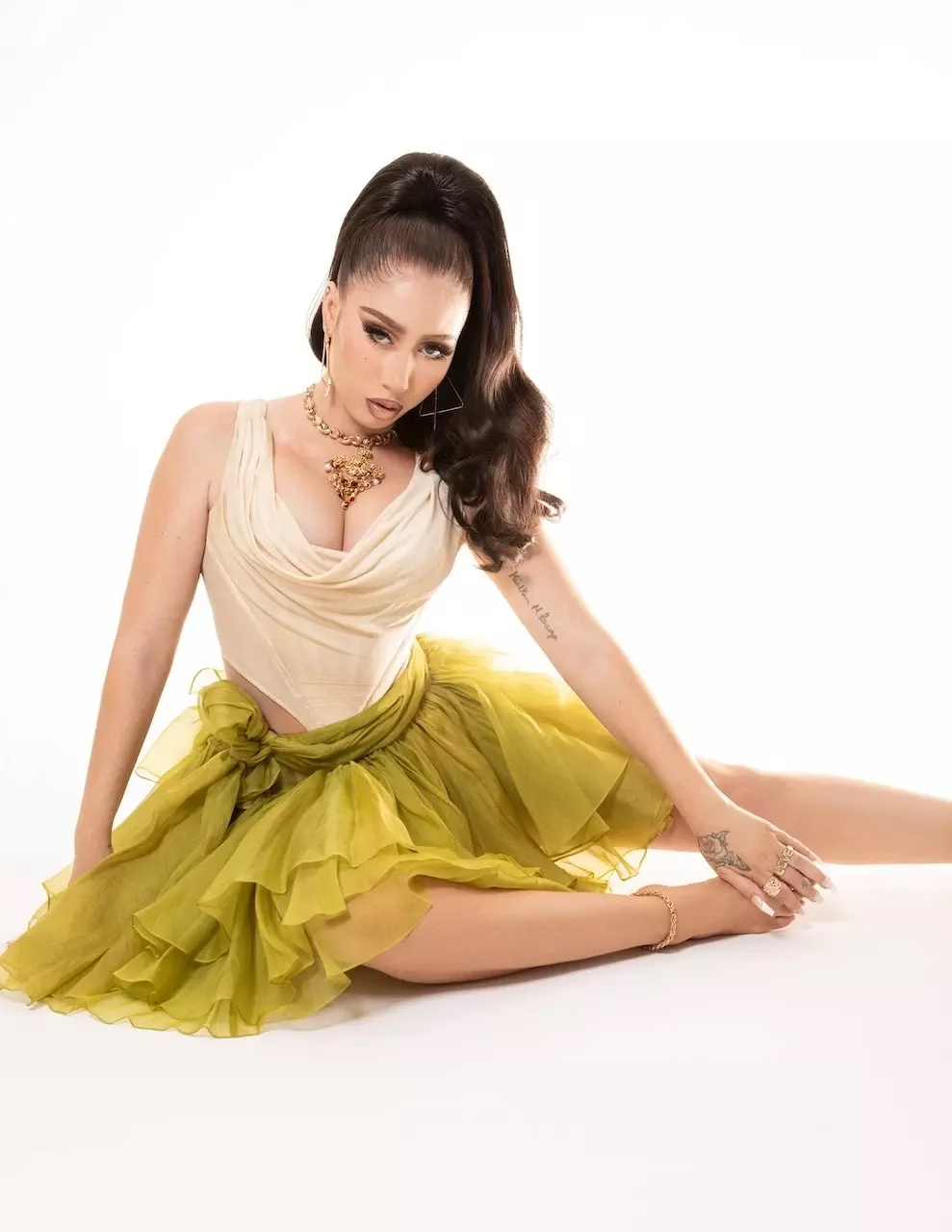
Kali Uchis still remembers the reactions she would get when she was crafting her first Spanish-language record, Sin Miedo (del Amor y Otros Demonios), which was released late last year amid the COVID-19 pandemic. "You're going backward in your career doing this. This isn't going to get supported," she would hear. “Well, this is what I want to do,” the Colombian-American singer would answer. That album, a body of work that captures her isolation and is a cross-pollination between haunting boleros, downtempo trip-hop, and a splash of reggaeton, ended up landing on the Billboard 200 and received glowing reviews around the web. "I really just make music for the love of it, not for the same reasons that others would," Uchis tells GRAMMY.com over the phone as she’s about to board a boat in Miami. “A lot of people just look at it as a business.”
<style>.embed-container { position: relative; padding-bottom: 56.25%; height: 0; overflow: hidden; max-width: 100%; } .embed-container iframe, .embed-container object, .embed-container embed { position: absolute; top: 0; left: 0; width: 100%; height: 100%; }</style><div class='embed-container'><iframe src='https://www.youtube.com/embed/bn_p95HbHoQ' frameborder='0' allowfullscreen></iframe></div>
Going against the grain is exactly what Karly-Marina Loaiza has always done. (At one point, her unwavering determination to her art, and self, led her to live in her car during her teens.) Sticking to her guns is finally reaping the rewards, especially now that Latin music is consumed on a global scale and continues to become one of the fastest-rising genres in the U.S. Yet, while Latin music has been increasingly dominating mainstream airwaves worldwide—most notably since reggaeton's second explosion in the mid-'10s—Uchis is among the few successful crossover stars who didn't have to conform to the demanding and dominating rhythms of reggaeton. She's been helping forge her path, leading a new rising Latin R&B scene alongside other bilingual luminaries like Omar Apollo and Paloma Mami.
Recently, she achieved a major accomplishment in the music industry: her first GRAMMY for her song "10%" with Kaytranada. From here, Uchis can only go higher. Her latest music video "Telepatía" has already garnered nearly 20 million views in just two weeks since its release. The R&B singer is planning to hit the road again this fall and also has a collaboration with SZA underway: "I really admire her as a woman, as a creator and as a writer, so I was honored to help segue her into her first song singing in Spanish," she says.
Just as her songs can easily tap into the depths of human emotion, with equal parts soul and grit, the 26-year-old star candidly reflects on her career with a social and critical lens. Chill yet assertive, Kali Uchis taps into racial and gender politics, all while redefining what it means to be a Latin "crossover" star in the 21st Century.
Hi Kali! First of all, congratulations on your first GRAMMY win. When your name was announced, what went through your head?
I was in Mexico filming a commercial, and Jenn Nkiru who was directing it also won a GRAMMY for directing the Beyoncé video ["Brown Skin Girl."] We both found out that we won a short time between each other, and we were both freaking out. She went to the other room to go do a thank you speech, and I didn't really take it in because I had to be on camera. But I so couldn't focus while on set because I was like, "Oh my god, we won a GRAMMY." I need to get on my phone, make a post and thank everybody.
<style>.embed-container { position: relative; padding-bottom: 56.25%; height: 0; overflow: hidden; max-width: 100%; } .embed-container iframe, .embed-container object, .embed-container embed { position: absolute; top: 0; left: 0; width: 100%; height: 100%; }</style><div class='embed-container'><iframe src='https://www.youtube.com/embed/5KJDlLvjoHQ' frameborder='0' allowfullscreen></iframe></div>
On your video for "Telepatía," viewers see you in Pereida, Colombia. What would you like your fans to see or know about the place of your heritage?
Since the first day that I came up with the name Kali Uchis, I was in Colombia. I have a home there, too. My first years of education were in Pereida. I spent a lot of time there going back and forth. I left to be able to have both worlds, and that's how I've lived my whole life. For me, it was always really important to represent. That's why a lot of my first videos take place there, in the streets that I played in when I was a little kid. It’s really about never forgetting where you come from.
Everybody there [in Colombia] is so proud of me and the kids are always so happy that I'm there. At the end of the day, I feel so loved and supported by my community. That's what my dream has always been. Anybody who knows me knows I'm so proud of both of my homes [the U.S. and Colombia], and growing up that way is what contributed to a lot of who I am as a person and as an artist, the way that I see the world, and the way that I listen to music. No matter where you come from and who you are, as long as you keep working and stay true to yourself, you'll get where you want to go.
Your parents are Colombian, you were born in Virginia and are an L.A. resident. Describe your personal connection with these places.
There’s just so much that comes with being multicultural. I feel love for the DMV area because that's where I'm from, northern [Virginia.] When I lived there, I never really felt embraced. I always felt like people were always like, "Oh, you're not from here. You don't dress like you're from here. Your music doesn't sound like you're from here." When I was really little, we lived in an area called Chirilagua, where there’s a large Latin community. It's pretty much all Salvadorians. I love Salvadorians, and I love the Latin community there. At the end of the day, all I ever really wanted was to show love to my community and receive that love in return. It's a beautiful thing to be accepted by people in general.
Moving to L.A., I felt very accepted and loved. L.A. is also my home. When I go to Colombia, I feel the same thing. And when it came to VA, I never fully felt that way, like I didn't belong there as much. I think that was what made it difficult to grow as an artist there and the main reason why I left. Aside from the fact that I really don't have many family members there either. My parents live in Colombia. I think it's a situation of "go where you're loved, go where you're supported." That's what I always tell everybody, no matter where you come from or who you are, just go where you're loved and supported, and try to represent where you come from the best you can. It's really complicated, and it's really interesting.
<style>.embed-container { position: relative; padding-bottom: 56.25%; height: 0; overflow: hidden; max-width: 100%; } .embed-container iframe, .embed-container object, .embed-container embed { position: absolute; top: 0; left: 0; width: 100%; height: 100%; }</style><div class='embed-container'><iframe src='https://www.youtube.com/embed/RQqJeIyyQBs' frameborder='0' allowfullscreen></iframe></div>
How has that transmigrational experience played a role in your musical development?
I feel like it’s what contributed to people looking at me as a niche artist, or even me looking at myself as a niche artist. I’m okay with that. I feel like part of being a niche artist is that you can't be categorized from one place, yet somehow that makes it harder to market artists. In my case, it was like, "Where is she from? She's from here, but she's also from there." It’s just more things that contribute to you not being able to be boxed into one category. Even some people now will be like, "Colombian-American, what does that even mean?" A lot of people still don't even understand what it means to be a dual citizen. For some reason, they just can't grasp how someone could have two homes, or two cultures, or more than two [nationalities]. I think that has been a blessing and a curse for me. It goes both ways, but I also wouldn't have it any other way.
It certainly brings some challenging layers, especially when one’s developing their identity, but I believe it makes creative growth more enriching.
Yeah, not just as artists, but as human beings. I think the most important thing is to figure out and know who you are, and not let society [determine that]. Just the idea of borders and of people obsessing with one's nationality is a very strange societal norm. Don't ever limit yourself based on those things.
In your last video, we also see you portrayed as a retro Hollywood chanteuse and then a little more Latin-styled with a sultry edgy. Who are your fashion and style icons?
Most of my life I have been inspired by not being able to be defined or confined to only one style. For me, being versatile, experimenting with genres, with style and never identifying as one [singular] look or anything. That's what really helped me make my life of creation fun and worthwhile—experimenting. Otherwise, you end up limiting yourself when you do one thing. In general, I'm a very nostalgic person. I love to mix futuristic things sometimes. I love the ‘90s, and I also love the ‘60s and ‘70s. Women being expressive with their sexuality, women being tomboys.
I think gender identity and gender norms are another way that people try to restrict and confine us. I definitely had my own personal experiences with coming into my femininity and understanding what femininity was for me. Even now as an adult, I'm still realizing like, okay, I don't always have to be so glam in order to feel like me. Or, I don't have to have my identity attached to this certain brand to make me more comfortable. I'm trying to wear less makeup and just play with different styles and stuff. Just experimenting.
Thinking now as an adult, I realize that certain things in the ‘90s were actually appropriation. For instance, I never realized a certain hairstyle was called bantu knots, and that it came from an African tribe. Growing up in the ‘90s, you just saw No Doubt’s [Gwen Stefani] and Björk wearing these hairstyles and later realized that they were taking it from Black women. I think that's something that you have to be careful about, when you look at some of these older ‘90s styles, a lot of it is appropriation. Become more aware of that, and learn more about where things actually come from. That’s the most important thing to do when it comes to style. Educate yourself about what you're wearing.
On Sin Miedo (del Amor y Otros Demonios)—meaning Without Fear (of Love and Other Demons)—what does the title represent to you?
Sin Mideo was a phrase that pushed me to never [live life without fear]. I feel like everybody should live life without fear. We only have one life. You shouldn't live it for anybody else. You should do what makes you happy. As long as you're not hurting anybody else, you should do what feels good for you and be who you want to be, whatever that is. Sin Miedo also captured the essence of isolation. All of my songs come from my own personal experiences. So when I made the album, I was thinking, "What type of state of mind was I in when I made all this music?" Isolated. I was literally not talking to anybody. I didn't have any friends around me. I was living by myself in this L.A. apartment, very lonely and separate. It's something my aunt used to always say to me growing up, "Sin Miedo, sin miedo." My first tattoo was also "Sin Miedo. Sin Miedo is really a state of mind. I think the most important thing as an artist is to never lose your mind and vision, and as a human, to never lose your soul.
Paloma Mami Is Putting Chile On The Map With Debut Album ‘Sueños de Dalí’