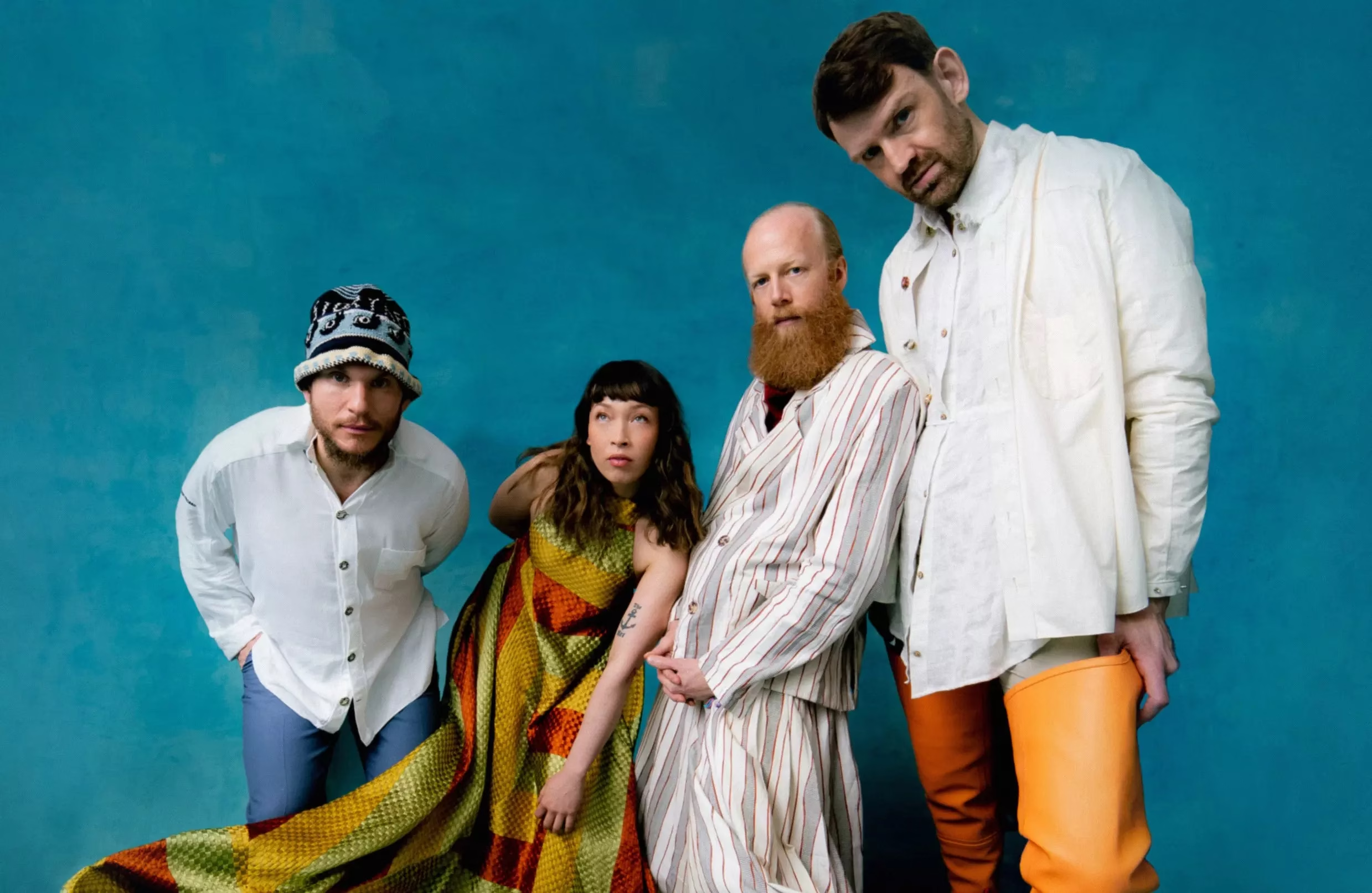
There's a special synergy and magic that comes from music made by people that love and really know each other. Little Dragon has manifested and expanded on that feeling since they were teenagers.
The spirit-lifting Swedish dance-pop quartet — drummer Erik Bodin, bassist Fredrik Wallin, keyboardist Håkan Wirenstarnd and singer Yukimi Nagano — met at their local music high school, and formed Little Dragon back in 1996. Now, they're back with their seventh album, Slugs of Love, and they're simply having fun.
The LP follows 2020's New Me, Same Us, which saw the band at their most collaborative, working together on all elements of the music-making progress to shake things up. Slugs of Love furthers their ultra-collaborative and experimental impulse, exemplified by the exuberant, silly title track, a playful meditation on the essence of humanity.
Their creative freedom radiates throughout the rest of Slugs of Love, like the sun-soaked "Disco Dangerous," whose funky instrumentals provide a dreamy backdrop for Nagano to coyly exclaim "never ever!" to falling in love. The subsequent track, "Lily's Call," shows another side of Little Dragon, a dark and driving number whose instrumental could fit in a Blade Runner soundtrack. Slugs of Love also sees them reconnecting with Damon Albarn — who they first worked with in 2010 on the Gorillaz's Plastic Beach — on the trippy, shimmery "Glow."
"We feel really grateful that we don't have to compromise ourselves at all," Nagano tells GRAMMY.com. "We do what we love and there are people who are into it."
GRAMMY.com caught up with the Little Dragon frontwoman to chat about the group's lively new album, their longevity as a band, reuniting with Damon Albarn and more.
When I first heard "Slugs of Love," I was obsessed and listened to it on repeat. I love how euphoric and absurd it is. What inspired it and how did the track come together?
The track was first written as just a demo beat and it had that infectious energy from the very start, without any vocals and melodies on it, and it just really grabbed me. The guys always write very random titles for demo tracks because you have to name it something, but I loved that title. And sometimes you get inspired by an odd angle, and the demo title together with the music gave me this image to write to. I painted this picture in my mind of humans being like slugs that are crawling on the wall, and everyone's becoming more obsessed and lazier, but ultimately kind of all needing and wanting the same thing — just wanting to be loved and safe.
It took a few turns production-wise. We tried to play it live and then we kind of returned back to the demo vibe. That sometimes feels like you're going backwards because you're trying too much stuff and nothing's working, but then you realize that the vibe was in the original ideas.
Since you chose "Slugs of Love" as the title track of the album, in what ways do you feel like it speaks to or sets the tone for the rest of the album?
It is just a fun image, so we're playing with that. Our first idea was that we wanted to make a trilogy [of] albums. We were gonna make one that was just romantic songs, one of dance songs and one with trippy forest music. In the end, we decided just to make an old-fashioned album because it was becoming very complicated.
"Slugs of Love" stood out as a track and as a title, and it felt sort of representative to the whole process and that time of making music. It felt like it also represented something a little bit new for us. [Our music] is very intuitive when we write it, whatever feels good in our guts, and then we let journalists and the people describe what it means.
You've said that your last album New Me, Same Us was your most collaborative and saw you working together in a new way. How did your approach to making Slugs of Love compare or differ, or build upon that?
Well, it's all just one long, linear story in a way for us, so [we gain] more experience with and understanding of each other. Sometimes you gotta throw away ideas that you have of each other as well – like you do with a family, with someone always being the little sister.
Sometimes we just have to try to have a blank slate and not get too stuck in the characters we've created. So it keeps evolving and everyone really wants to collaborate. I think we all feel like it's a meaningful process, even though sometimes it's really hard. Everyone is pretty strong-willed in different areas of the creative process so it can get complicated.
When you're on stage, you're so in the moment and your feelings are so big, but when you're watching the show, you're so relaxed and you're just there ready to take it in. And I think that kind of feeling [exists] with the process of making your music, and with the relationship with ourselves. Sometimes it's so serious, it's like the center of the universe — but at the end of the day, it's just music. We can get really caught up in one little detail, but really, we just want to be friends and have fun.
Being in a band, you have each other's different perspectives. I think it'd be different if it was just one artist in your own head, being your own neurotic self. We're four neurotic egos bumping heads with each other, so we get a little perspective.
I love the combination of the funky, fuzzy, sparkly instrumentals on "Disco Dangerous" with the sort of anti-love love song lyrics and the "never ever!" refrains. What was the spark for that track?
That track was just fun. [We were just] being silly and having fun and enjoying writing music. We love music that has that vibe of playfulness, and I think that kind of translated on that track. But most of all, we just had a good time making it, so I'm happy that came through.
And how did the instrumentals evolve on that one, from the demo to where it is now?
It started as a pretty basic layer of bass and drums. Then I wrote a little part and then more things got added, and I wrote a little more. We weren't sure about this song. Sometimes you want to write a good song, and sometimes you just want to have fun.
It's fun to know that you can release that stuff as well and not care too much. I think we can all get too stuck in the sickness of wanting to create something special and get caught up in thoughts that actually don't really help the process very much.
You reunited with Damon Albarn on the shimmering "Glow"— how did working with him on it inspire or shift the track?
We just chanced it to see if he was into the song, and he was. What we really loved about Damon's contribution was that he was very careless in a way that we found really inspiring.
When we collaborate with people, we're a little bit tip-toeing, like, "Okay, does this work for you? Is this okay?" And he came in and chopped it up, and added a bunch of new harmonies and a whole new part. I think it fits really well.
When I listened to the song, the visuals I got were very psychedelic; you're in the desert and then you're in the water. And when his part came in, I started seeing these big statues. The music, vocals and everything else he added felt like a whole new scenery which I found really refreshing. It was inspiring [to realize] you don't have to be so careful.
What did you learn from touring with him back in 2010 on the Gorillaz's Escape to Plastic Beach Tour?
The whole experience was a really big impression because there was such a mix of artists on the tour. Fred and I shared a tour bus with Bobby Womack. De La Sol was also on the tour, along with a whole horn band and a Syrian orchestra. There were maybe eight or nine tour buses — it was crazy, like a festival on tour. It was such a good time and a lot of fun memories.
We traveled the States and the UK and Australia, so it was a good three months. The inspiring part was seeing Damon deliver on stage — he gave everything — and the way that he brought all those different artists together. It created a lot of friendships that still exist.
Speaking of performing, you all bring so much energy and joy to live shows. What does it feel like for you and the band when you're on stage?
That's probably the main reason why we gravitated towards each other, because we admired each other as musicians. It feels like we're all in our element together and it feels natural because we've done it for so long. We know each other's language musically, and we know how to communicate with each other. That's such a special thing.
You don't really realize that until you play with people that you don't know their musical language in the same way. It's something that we cherish. Of course, you have good shows and bad shows, but the guys still impress me on stage with the way they play because we improvise a lot and we try to take it somewhere. Every show is different.
Is it important to you to change things up on stage to not get bored yourself, or to entertain the audience, or a bit of both?
I think it's some kind of musician's pride. We also love the jazz philosophy of music. I guess it bores us if we see bands and they have a backing track. I think that's where it shows that we're musicians first, and then we became a band. We were all session musicians, and we had these vibrations between us when we were playing and that's what made us write music together. It started there. It reminds us of the core of what we are on stage together.
What do you get out of sharing your music in person? I'm sure it's one thing to get sweet comments from people online, but it must be something to feel people freaking out to your songs.
It's the best feeling. I mean, we don't always get [an engaged crowd]. Any band will know that doing support shows strengthens your backbone because you have to play almost for yourself. So we have shows that are great, and shows that are less good. Every show has its twists, but when the stars are aligned, it's pretty amazing.
You can have moments where you lose track of yourself, and you feel like the communication between the band is just flowing so nicely — you almost feel like it's flowing back and forth with the audience too. It's a bit addictive, actually, to get that feeling, that energy, from a crowd. Sometimes you have a few people that are going off so hard and dancing and giving so much energy that it just fuels us.
"Ritual Union" was such a big track when it came out in 2011. What did the success and buzz you experienced then feel like to the band at the time?
I don't think it necessarily felt like a peak or anything to us because we've always felt like we were on some kind of a verge. But now we're appreciative of it. Just this last summer when we did shows in San Francisco, I recognized hardcore fans from 10 years back, who still come to the front.
At the time, we were touring so much that we almost exhausted ourselves after Ritual Union. We needed a proper break. As a band, when you feel that you're up-and-coming, it's the feeling that you've got to grab this thing right in front of you, but it keeps moving forward — you're just running after nothing.
We had to stop and be like, "Okay, you can prioritize other things and you can say no to shows." We had to learn stuff like that because you can get this FOMO feeling like if you don't grab it, someone else is going to take it and you're gonna miss it.
There's this feeling in industry that there's so much competition, so if you don't take it now, it's never gonna come back. There's so much fear and pressure in the industry that can push a band too hard. It was a very intense time after Ritual Union. But we were getting a lot of love and touring hard.
What came after that pause? What was the thing that was like "this is why we're a band" or "this is what we're actually focused on"?
We still have our studio and we go there pretty much every day. People rent studios for tons of money, and we have a nice homemade one that's an apartment that we made into a studio. That allows us to be able to make a song like "Disco Dangerous" and to be silly in the studio. It's such a blessing to be able to release that and know that people actually want to hear it and dance to it.
We feel really grateful that we don't have to compromise ourselves at all. We do what we love and there are people who are into it. That's what every artist wants to do, not have to sell out.
Do you feel connected to or inspired by the music scene in Gothenburg?
We have our bubble in the studio. The setup is four studios in one space, so we're definitely bouncing off of each other in that collective space. In a dream world, it'd be a whole building and tons of bands, that would be pretty awesome.
I read that it actually took some time for the band to catch on in Sweden, after the U.K. and U.S. When did that home country recognition finally happen?
I feel like it's still pretty slow here. We're gonna do a show in Gothenburg and Stockholm this fall, it's definitely been growing. We did a few things here during COVID; we were a house band for a really big Swedish TV show. That probably made some people aware, but I feel like it's still growing.
We haven't really invested that much time, either, in playing here. Some bands tour all over Sweden and play all the small towns, but we haven't really done that. You can't really complain if you haven't really toured and promoted that much here. We probably need to play more shows in Sweden. Our first record label [Peacefrog] was in the U.K. I don't know if that has anything to do with it, but they were definitely not really focusing on Sweden.
As a band, how do you make sure that you're still having fun making music together and meshing creatively, since you have been doing it for so long?
Most of the time, it's pretty easy. I mean, it's not always gonna be a vibe, but since we go to the studio pretty much every single day, you're going to flow at some point, even though it can take some time. After the summer, you're going to need a little bit of time to warm up before, and you're not necessarily gonna write your favorite song the first day you get in. You just have to just flow with it.
I think just showing up in the studio every day, being with each other, makes things happen. But how do you make it fun? I think we just have fun together, we don't even have to try most of the time.
Love Thundercat? Check Out These 5 Contemporary Bassists Keeping The Flame