Presented by GRAMMY.com, Living Legends is an editorial series that honors icons in music and celebrates their inimitable legacies and ongoing impact on culture. GRAMMY.com caught up with Judy Collins, the venerated, GRAMMY-winning singer, songwriter and interpreter whose career spans seven decades — and whose album Spellbound is nominated for Best Folk Album at the 2023 GRAMMYs.
Judy Collins never went away, but in 2019, she landed back in the public consciousness — largely for cat-related reasons.
That came by way of an illuminating New York Times profile conducted at her ritzy Upper West Side apartment where she's resided for more than 50 years. Therein, the legendary musician — among other things — hopped on a trampoline, displayed her wig collection and gleefully dug out a pink sequined jacket that Joan Baez bought her.
Then, yes, there were the three Persian cats: Rachmaninoff, Coco Chanel and Tom Wolfe, two of which were captured in an unforgettable photo.
But anyone serious about music would be remiss to sum up Collins as per her quirks and idiosyncrasies. After she planted a flag with her 1961 debut album, A Maid of Constant Sorrow, she rose the ranks to become one of the great singers, songwriters and interpreters of the 20th century. She recorded "Both Sides, Now" before Joni Mitchell did; ditto Randy Newman’s "I Think It's Going to Rain Today." The astonishing bona fides roll on and on.
These days, Collins is on the road promoting 2022's Spellbound, her first album of all original material, which is nominated for Best Folk Album at the 2023 GRAMMYs. Previously, Collins had sprinkled originals into her albums: "sometimes quite a few, sometimes half a dozen, sometimes three or four."
Why did she never release anything like this in seven decades? If one is tempted to think the industry pigeonholed her as an interpreter, they'd be wrong. "It wasn't ever a matter of marketing in any way," Collins tells GRAMMY.com while on tour in Salem, Oregon. "I've done what I want to do, and that's been my own desire of working in a way I want to work: not having anything imposed on me."
This self-determination has been the throughline of Collins' career, and dictates the parameters of Spellbound's concepts and expressions. There's a song about nearly crashing a car ("Hell on Wheels"), a Trappist monk who died under suspicious circumstances ("Thomas Merton"), and, in general terms, Collins' misspent youth ("Arizona").
But that's hardly the extent of the 83-year-old's ambitions. Never one to rest on her laurels, Collins cites a variety of other projects set for the rest of the year and beyond: a Broadway show; a documentary film; more albums; an orchestrated version of her 1967 album Wildflowers.
This living legend spoke to GRAMMY.com about her old associates Joni Mitchell, Leonard Cohen, and Jacques Brel; her still-developing artistry, and the road ahead in 2023. (And, yes, the kitties.)
This interview has been edited for clarity.
I'm going to lead with the most pertinent question: how are Rachmaninoff, Coco Chanel and Tom Wolfe doing?
[Laughs] Well, they're fine. They're 12 years old now and thriving. Coco is a lounger, and Rachmaninoff is an eager beaver for everything. And Tom Wolfe is just interested in writing a book.
I've never heard a cat described that way. Anyway, I'm sure you've been asked many, many questions about why you chose to produce an album of original material at this point. I'm more interested in what you chose to write about — how you landed on certain components of your 83-year life that you want to translate into song.
Well, I have the luxury of writing about my life a lot. Writing poetry and songs has been something I've done since 1966 when Leonard Cohen said to me, "I don't know why you're not writing your own songs."
I started by writing "Since You've Asked" [from Wildflowers] and have continued to write probably 60 to 70 songs that have been produced on various albums of mine.So, it was time for me to face up to writing a whole album. Actually, I wrote many more songs than a dozen. I am still in the process of refining a number of those songs and writing more, because the songwriting thing sort of hooked in, in 2016 when I started writing songs with Ari Hest.
He and I wrote a few songs on an album called Silver Skies Blue, which got us a GRAMMY nomination [for Best Folk Album at the 2017 GRAMMYs]. It was his first, and it was my first in 40 years. Not many people can say that. In fact, I hold the record in time between GRAMMY nominations. It's a funny, odd distinction to have, but I'm the only one who has it.
They should give out a GRAMMY for the biggest gap between GRAMMYs.
Exactly. Either that or a Guinness record.
Back to the particular themes on Spellbound.
Well, a lot of things came up. I mean, it's all very personal.
I was reading Thomas Merton a lot during the pandemic, and there's a song about [him]. Primarily based on the fact that he did not die of accidental causes. They think there's pretty good proof that he was murdered, probably by the CIA. So, that song is particularly important to me.
"Hell on Wheels," which is going into a whole new rock and roll dimension in my concerts, is about an incident that happened to me in Colorado. I've been working on that song for a long time. It's a story of getting my learner's license, driving on a dirt road in the mountains, and having a near-catastrophe.
"Spellbound" is something I wrote about my experiences in Hawaii. I started going there in 1966. I went on my first tour in Japan with Mimi Fariña, Bruce Langhorne and Arlo Guthrie, and we came back through Honolulu and stopped for a few days. I've been to Hawaii a lot since then, but it was very much a memory of what it was like then and what it's like now.
"Arizona" is a song about my misspent youth. I think it's a very strong song. We recorded it in 2019. So, my subject matter ranges over lots of things.
You've been a strong songwriter this whole time. Was there a measure of pigeonholing in the '60s and '70s? Like, You're mostly an interpreter; let's market you that way?
No, no, no. It wasn't ever a matter of marketing in any way. I've done what I want to do, and that's been my own desire of working in a way I want to work: not having anything imposed on me.
Regarding the not-so-distant future, what's creatively churning for you?
I'm working, of course, on the new songs. But at the same time, I have a wonderful band set up for the moment. We're not only working on the songs for Spellbound, but we're learning a recent song by Ari Hest, which I think is a great hit. He's a great writer, and he has miles to go before he's done.
We're working on a Broadway show; we're working on a documentary film; we're working on other albums. We're going to do the orchestrated version of all the songs on my 1967 album Wildflowers, because a whole bunch of orchestras, including the Boston Pops, want to do it with me.
So, one of the things I have to do is keep listening to those songs and learning the French and Italian again. It'll be very exciting. It'll happen starting [this month].
What do you remember early on in your life regarding finding your voice — whether that be your physical voice or artistic voice?
It was so easy because my dad was an entertainer: a singer, a wonderful pianist, a wonderful performer. So, I was around the whole process from the time I was born. He had already started his radio show in Seattle in 1937, and I was born in '39.
So, I was raised with all the Phi Gamma and the Fiji Brothers gathering in the house to sing quartets and old English and Irish and Scottish folk songs, and my dad singing all of the Great American Songbook. I just took to it naturally. It was a natural part of everything in my life. Music was the essential part of it.
What do you remember about making Wildflowers?
Well, first of all, "Both Sides, Now" is on that album, and my first three songs: "Albatross," "Since You've Asked" and a song called "Sky Fell." I had sort of buried it with no ceremony, but it's a good song. I like it.
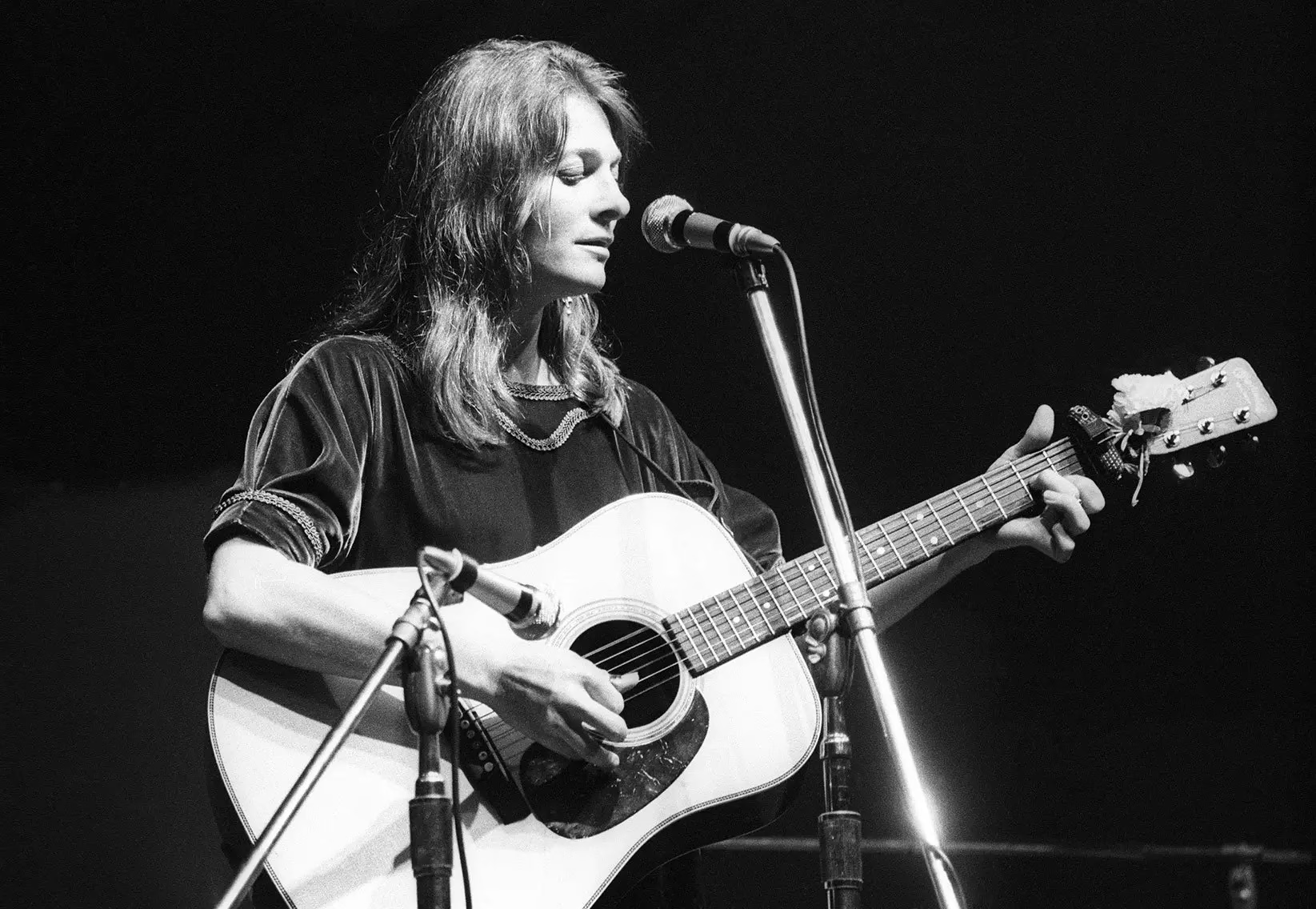
*Judy Collins performing at Newport Folk Festival in 1967. Photo: Tom Copi/Michael Ochs Archives/Getty Images*
This album can act as a portal to some of the great artists you interpreted and associated with back then. What was your first impression of Mr. Cohen?
Oh, dazzling. But thank goodness I never got involved with him romantically. That was a great gift.
The night before last, we were at Freight & Salvage, a club in Berkeley just on the other side of the bridge in San Francisco. The producers and directors of the [Leonard Cohen documentary] Hallelujah were there. They're become friends of mine because I'm in that movie talking a lot about Leonard, and he was an amazing man.
Did you stay close to him through the rest of his life?
Oh, yes. All through.
He seemed to die as he lived: hilarious, dark, philosophical.
Very dark, very funny. Very serious. Lighthearted, but with a dark edge.
You covered "Michael From Mountains" and "Both Sides, Now" on Wildflowers. What do you remember about your early association with Joni?
Oh my goodness. Such a wealth of beautiful songs. She is just amazing to me. An astonishing artist, an astonishing person. Very courageous and very blessed.
And then we have Jacques Brel.
He was an amazing writer. My first introduction to Brel came because [music businessman] Jack Holzman came to see me in the hospital in Denver — recovering from tuberculosis, actually. It was 1962, and he brought me an album of Jacques Brel. I was there in the hospital, but I had a record player, and I put that on the turntable and was just blown away.
Boy, oh boy, I met him. I heard both of the concerts that he did at Carnegie Hall in New York in 1966 and 1968. And then, of course, I got to know him because my manager, Harold Leventhal, presented him at Carnegie Hall. Also, I got to hang out with him in Paris and get to know his wife in Brussels.
So now, on Wildflowers, of course, I recorded "The Song of Old Lovers." I had to relearn that, which is fine.
For those who haven't seen you live, what can they expect from the tour you're currently on?
Well, I do some of the hits — "Both Sides, Now"; "Someday Soon"; "Send in the Clowns" — but I do a whole handful of the new songs: "Spellbound," "Girl in Colorado," "Thomas Merton." So, I sort of give them a review, plus some brand-new things to worry about.
You're looking back on your career, but you're still constantly developing as an artist. What accomplishments are you most proud of?
Getting up this morning, having breakfast, getting ready to work. Gee whiz.