It's fair to say that we're in a golden age of music biopics. In the last few months alone, Angelina Jolie has portrayed legendary opera singer Maria Callas, (Maria), cult indie favorites Pavement have blurred the boundaries between documentary and fiction (Pavements), and Pharrell Williams' rise to fame has been told in animated Lego form (Brick by Brick). And let's not forget British chart-topper Robbie Williams depicted as a CGI monkey (Better Man).
Hollywood's thirst for musical life stories shows little sign of being quenched, either. In 2025, the late King of Pop Michael Jackson (Michael) and New Jersey's finest Bruce Springsteen (Deliver Me From Nowhere) are both getting the big-screen treatment, with the latter starring man-of-the-moment Jeremy Allen White. Fast forwarding to 2027, The Beatles fanboy Sam Mendes is giving each and every member of the Fab Four their very own standalone dramatization. And there are also films in the pipeline centering on Linda Ronstadt, Bee Gees, and Frank Sinatra, just to name a few.
And even before 2024 comes to a close, one more biopic arrived: A Complete Unknown, where baby-faced thespian Timothée Chalamet depicts Bob Dylan's controversial switch to the electric guitar. Tipped for success at the Oscars, James Mangold's film follows 2007's monochromatic I'm Not There, in which the likes of Cate Blanchett, Ben Whishaw, and in his final film role, Heath Ledger, all portrayed different aspects of the bard's character to esoteric effect.
If the more conventional of the two appeals to your sensibilities, then there's plenty more where that came from. From stadium rockers and soul legends to gangster rappers and gospel greats, here's a look at 14 other music biopics from the past quarter-century that have hit all the right notes.
Made with the approval of Amy Winehouse's estate, Back to Black pays a sympathetic and respectful tribute to the singer who tragically became a member of music's 27 Club in 2011.
Sam Taylor-Johnson's film doesn't shy away from the issues that plagued her all-too-brief time in the spotlight. But it also ensures that her immeasurable talents remain a focal point, too. Industry's Marisa Abela – performing her own convincing Winehouse sound-alike vocals – effortlessly captures the essence of the beehived star on a journey that takes her from the Camden Town pub circuit all the way to the GRAMMYs (her visible astonishment at winning Album Of The Year provides the film's most uplifting moment).
Lesley Manville and Jack O'Connell also shine as Winehouse's beloved grandmother Cynthia and equally troubled on/off partner Blake, respectively, in a rounded portrait which deftly swerved any concerns of sensationalism.
'Bob Marley: One Love' (2024)
Bob Marley biopic One Love only covers two years of the reggae legend's life. But it's an eventful two years: Beginning with the Smile Jamaica gig during which he was nearly assassinated, the film later explores the recording of his seminal album Exodus, his fractious relationship with wife Rita, and the bizarre toenail infection that led to his untimely death.
Hot on the heels of playing one of Barbie's many Kens, Kingsley Ben-Adir is charm personified as the "buffalo soldier, dreadlock rasta," embodying exactly why Marley became such a beacon of positivity both in his Caribbean homeland and across the world. And he's just as convincing when, armed with an acoustic guitar, he tackles sun-kissed hits like "Turn Your Lights Down Low" and "Redemption Song," too.
Unsurprisingly, One Love broke all kinds of box-office records on its Jamaican release (and kept much-maligned blockbuster Madame Web off the top spot in the States), with audiences responding to a largely celebratory picture that further added to Marley's legend.
'Whitney Houston: I Wanna Dance with Somebody' (2022)
After honoring abolitionist Harriet Tubman (Harriet) and early 20th century millionaire Madam C.J. Walker (Self Made), director Kasi Lemmons switched her attention to a more recent Black icon with a highly watchable biopic of Whitney Houston.
Named after her most exuberant hit, I Wanna Dance with Somebody doesn't stray far beyond the diva's Wikipedia page, presenting her remarkable life in a linear, conventional fashion. However, perhaps surprisingly, it doesn't skimp on the personal life section, addressing her turbulent relationships with both secret lover Robyn Crawford and husband Bobby Brown, as well as the substance abuse issues that regularly threatened to derail her career.
Leading lady Naomi Ackie relies on lip-syncing in the musical moments – including several entertainingly faithful video recreations and, of course, the chart-topping rendition of "The Star-Spangled Banner." But that doesn't take away from her compelling performance, one that channels Houston's natural charisma and sheer force-of-nature personality, in a balanced depiction of a complex superstar.
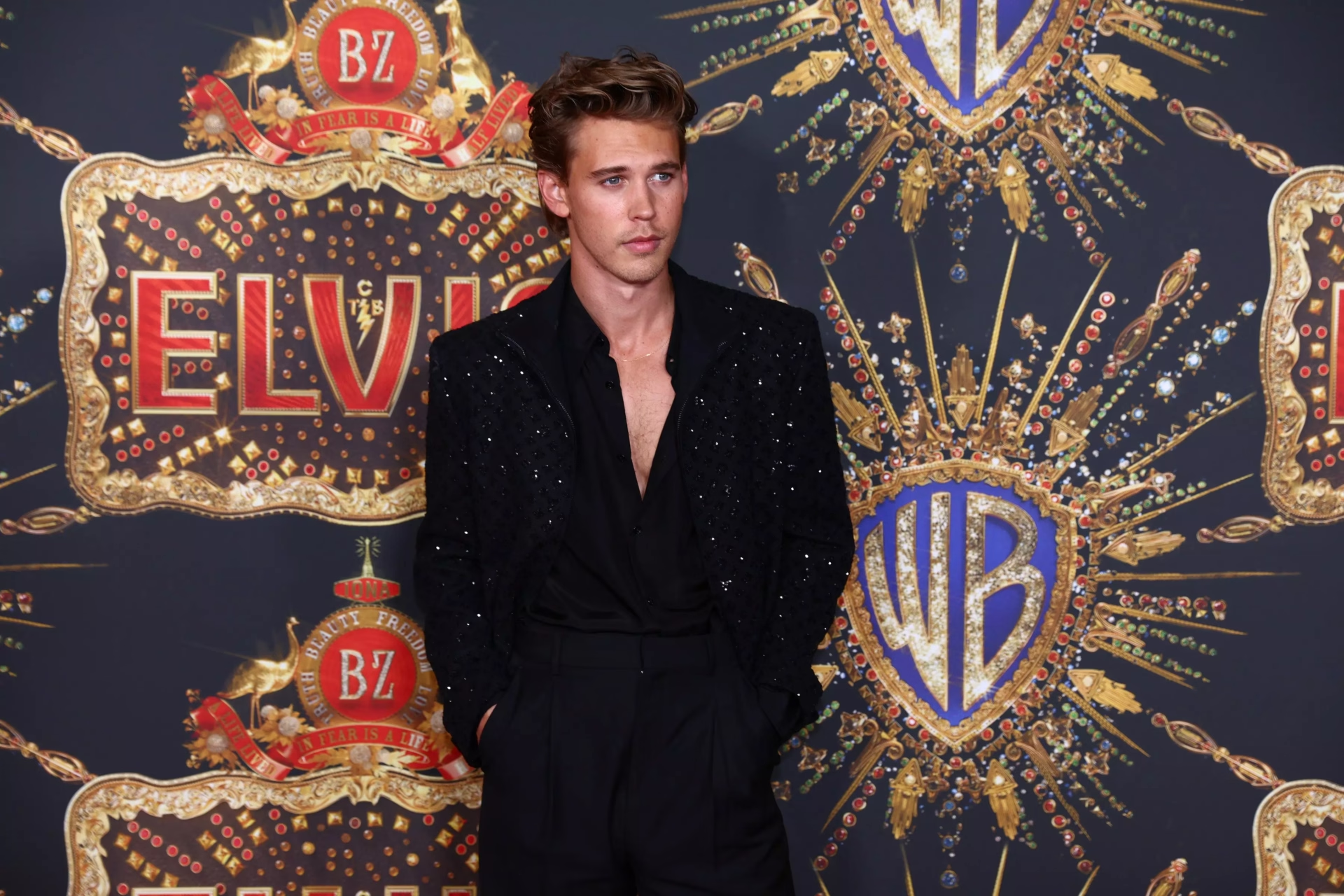
The man behind Romeo and Juliet, Moulin Rouge and The Great Gatsby was never going to make a straightforward Elvis Presley biopic. And lo and behold, Baz Luhrmann's love letter to the King of Rock and Roll was a daring, often dizzying spectacle filled with dream sequences, historical revisionism and pop-cultural anachronisms (see the mashup with Britney Spears and Backstreet Boys).
However, the organized chaos is grounded by a truly mesmerizing lead performance from Austin Butler, an actor previously best-known for various Nickelodeon sitcoms, but who committed so hard to the role that he adopted a near-permanent Elvis twang.
Butler, who beat Harry Styles for the part, gets to play the icon in all stages of his career, from the hip-swiveling pin-up that got middle America all worked up to the fallen idol destroyed by alcohol, drugs and fame, not to mention the toxic partnership with unscrupulous manager Colonel Parker. A closing real-deal performance of "Unchained Melody" only proves just how authentic his portrayal is.
'Respect' (2021)
Aretha Franklin personally invited Jennifer Hudson to play her in a big-screen biopic following Dreamgirls' Oscar-winning success. Sadly, having passed away three years before Respect made it to cinemas, the Queen of Soul never got to see how her casting choice paid off.
Stepping into shoes that most would consider far too iconic to fill, the "American Idol" graduate effortlessly mimics Franklin on classics such as "(You Make Me Feel Like) A Natural Woman" and, of course, the revolutionary title track. And she also skillfully inhabits the character behind that wonderfully gutsy voice, navigating the various trials and tribulations that dogged her path to greatness along the way.
Covering the first three decades of Franklin's life — from her traumatic childhood and church beginnings to her pivotal role in the civil rights movement, abusive marriage and recording of seminal live album Amazing Grace — Liesl Tommy's directorial debut delves deep into the opening chapters of a woman who commanded, and ultimately earned, everyone's R-E-S-P-E-C-T.
Sir Elton John can consider himself unlucky that his remarkable life story was dramatized just a year after Bohemian Rhapsody cleaned up at the box office. Had cinemagoers not already embraced a biopic of a flamboyant British rock act who rose to fame in the '70s (and one also directed by Dexter Fletcher), then Rocketman may well have enjoyed more than its modest success.
It's certainly bolder than Queen's money-spinner, tackling John's sexuality head-on while also presenting his body of work in a far more fantastical manner (see the gravity-defying performance of "Crocodile Rock"). Taron Egerton, who replaced Tom Hardy in the lead role, was also robbed of an Oscar nod, delivering a multi-layered performance that didn't rely solely on mere impersonation.
Rocketman still ticked off all the major career milestones, too, though — from John's iconic performance at Los Angeles' Dodger Stadium to the perfect recreation of the "I'm Still Standing" video that brings the film to a suitably colorful close.
Bohemian Rhapsody's big-screen journey was even more of a rollercoaster than its titular song: its original Freddie Mercury, Sacha Baron Cohen, left due to creative differences as the project languished in development, while Bryan Singer's poor time management and questionable people skills saw him forced to vacate the director's chair halfway through shooting.
But despite all the backstage drama, the Queen biopic proved to be just as all-conquering as the stadium rock giants themselves, grossing more than $900 million at the worldwide box office and winning four Oscars, including Best Actor for its mustachioed leading man Rami Malek.
Neither audiences nor the Academy also appeared to care that the film — finished with the help of Dexter Fletcher — often played fast and loose with the real versions of events. But what it lacked in historical accuracies, it made up for in much-loved tunes, undeniable charisma, and sheer spectacle, as evident by the epic finale that recreated the band's triumphant Live Aid set to truly magnetic effect.
N.W.A.'s controversial rise from the streets of Compton to the cop-baiting dons of the hip-hop scene always seemed worthy of the Hollywood treatment. Still, few could have predicted the no-holds-barred result would strike such a chord: it briefly became the highest-grossing music biopic in box office history.
Straight Outta Compton certainly boasted a relevant pedigree. Director F. Gary Gray had previously worked with Dr. Dre in Set It Off and Ice Cube in Friday, while the latter was portrayed by O'Shea Jackson Jr, aka his very own son! And the inspired casting continued with fellow gangster rapper Snoop Dogg played by Lakeith Stanfield and the band's fast-talking manager Jerry Heller by Paul Giamatti.
The 2015 film, which charts Ice Cube's shocking departure, the appointment of Suge Knight, and the tragic death of Eazy-E, didn't just impact the world of cinema, either. Dr. Dre was so inspired by the finished product that he headed back into the studio to record his first album in 16 years.
As its title suggests, Tate Taylor's James Brown biopic practically implored cinemagoers to start dancing in the aisles, with leading man Chadwick Boseman aping the Godfather of Funk – both in sound and style – on anthems like "Get Up, (I Feel Like Being A) Sex Machine" and "I Got You (I Feel Good)."
Of course, Get On Up had more to offer than moving and shaking; it painted an in-depth, if occasionally fabricated, picture of the man behind all the strutting. Boseman may have received posthumous awards attention for Black Panther, but his ability to switch from dazzling showman to volatile monster in the flick of a quiff, this is arguably his most versatile display.
Get On Up is no hagiography, though. Brown's early prison stint, troubles with the IRS, and bizarre incident in which he was chased by police after a gun-toting dispute about a restroom — they're all laid bare in a non-chronological affair that proves that rock star fact can often be stranger than fiction.
'Love and Mercy' (2014)
After a string of much-maligned TV movies (An American Family, Summer Dreams), Beach Boys, and their troubled genius leader in particular, finally got a screen adaptation worthy of their creative talents.
A biopic of two halves, Love and Mercy first focuses on the recording of the band's seminal 1966 album, Pet Sounds, and the unfinished follow-up Smile that was plagued by Brian Wilson's mental health issues and quest for complete perfection. Then, John Cusack took over from the Golden Globe-nominated Paul Dano to depict the musical maestro in the 1980s, a heavily medicated period defined by his relationships with future wife Melinda and exploitative therapist Dr. Eugene Landy.
Wilson was so convinced by Paul Giamatti's portrayal of the latter that he was left in fear for 10 minutes on first watch. But every performance is equally believable in a sensitively handled tale that embodies the idea that "from great suffering comes great art."
Jimi Hendrix character study All Is By My Side might not have received permission to use any of the guitar hero's recorded compositions. But by focusing solely leading up to his American breakthrough — it begins with his 1966 arrival in London and concludes with his star-making performance at the 1967 Monterey Pop Festival — this alternative biopic certainly doesn't suffer from the lack of hits.
OutKast's André 3000 also proved to be a casting masterstroke, the rapper and flutist once again showcasing his versatility with a performance as electrifying as Hendrix's solos.
Imogen Poots and Hayley Atwell also impress as the model who discovered the six-string wizard and the girlfriend who served as his muse, respectively. While 12 Years A Slave director John Ridley's impressionistic approach is befitting of a man who thrived on freedom and instinct.
Not to be confused with the same-named Hitchcock noir, this 2009 biopic charts the rise and fall of the hip-hop superstar born Christopher George Latore Wallace, aka Biggie Smalls and, of course, The Notorious B.I.G. Selected for the lead role over fellow rappers Beanie Sigel and Nissim Black, relative unknown Jamal Woolard recaptures both the natural swagger and lyrical flow of the larger-than-life icon in a debut performance that deserved to send him stratospheric.
Angela Bassett's powerful turn as Wallace's mother and the hypnotizing soundtrack are equally impressive. Its all-encompassing narrative — which delves into the MC's Brooklyn school years, turbulent relationships with Lil' Kim and Faith Evans, and involvement in the East Coast/West Coast rivalry that left both of their most dominant figures dead — also helps make Notorious a far superior effort to the 2Pac-focused All Eyez On Me.
'Walk the Line' (2005)
Two decades before making A Complete Unknown, director James Mangold shone the spotlight on Dylan's longtime friend Johnny Cash, with Joaquin Phoenix stepping into the Man in Black's formidable country boots for a film based on two of his revealing memoirs.
Brilliantly parodied by Walk Hard: The Dewey Cox Story, Walk the Line essentially set the blueprint for the modern music biopic. There's the traumatic backstory (Cash lost his younger brother in a sawmill accident), the lengthy battle with drink and drugs, and then the triumphant comeback (the film is bookended by his legendary performance at Folsom State Prison).
But Walk the Line isn't just a one-man show. Reese Witherspoon deservedly picked up a Best Actress Oscar for her feisty portrayal ofJune Carter Cash, the singer's partner in both life and on stage (she also co-wrote his signature hit "Ring of Fire") who repeatedly helped bring Johnny back from the brink.
Ray Charles sadly passed away just four months before his rags-to-riches journey was depicted on the big screen (he had, however, approved a Braille reading of the script). But the general consensus is that Jamie Foxx did the man proud.
In fact, then best-known for his comedic talents, the actor is a revelation as the pianist who overcomes his poverty-stricken upbringing and loss of sight to become "The Genius of Soul." And while Foxx may have been forced to lip-sync (his contribution to Kanye West's "Gold Digger" proved he would have made a great mimic), his mannerisms, technique (drawn from his own classical piano background), and general charisma were almost indistinguishable from the real thing.
Fully meriting his Best Actor Oscar win, Foxx was complemented by a strong performance from Kerry Washington as long-suffering wife Della; a multi-layered screenplay that recognized Charles' flaws; and Craig Armstrong's score — which, along with the official soundtrack, added to the film's trophy cabinet by winning at the 2006 GRAMMYs.
There had been big-time music biopics before, of course. But Ray's unprecedented success, both creatively and commercially, essentially kickstarted a trend of artist-inspired films that has only continued to grow — and shows no signs of stopping.