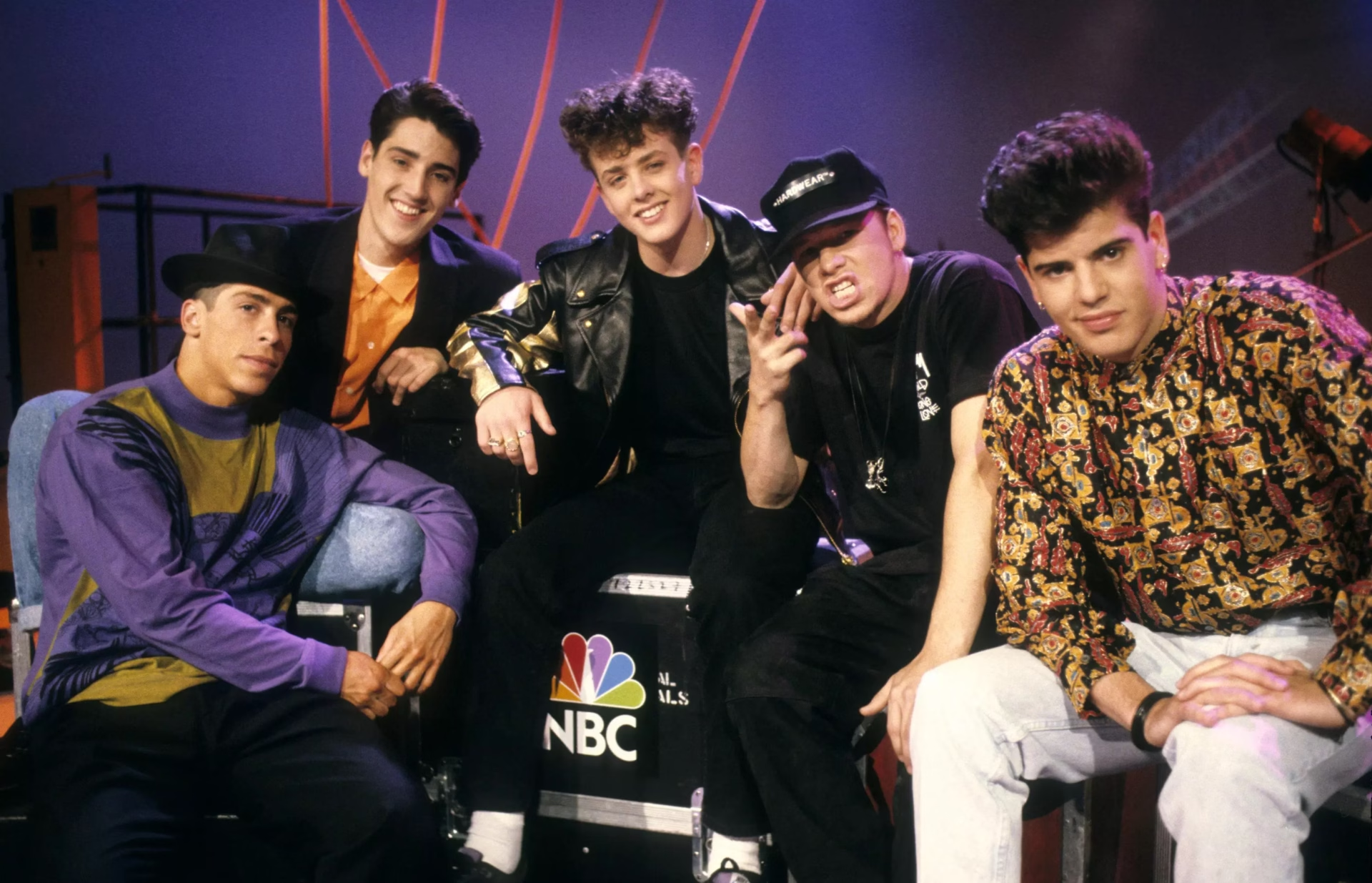
It's unlikely you'll ever see New Kids On The Block's Hangin' Tough mentioned in the same influential breath as Pixies' Surfer Rosa, Public Enemy's It Takes A Nation of Millions and Tracy Chapman's self-titled debut. Yet like 1988's other game-changers, the Boston quintet's sophomore album was pivotal in shaping the musical landscape for the following decade and beyond.
Indeed, without its mix of gloopy ballads and slightly unconvincing attempts to establish street cred, the "Total Request Live" era would have looked and sounded very different. In fact, there maybe wouldn't have been a "TRL" era at all. And instead of having flowers thrown at him, Harry Styles may have ended up selling them.
Of course, New Kids On The Block — or NKOTB, as most of their adoring fans know them — weren't the first boy band.The Monkees for example, were specifically designed to replicate the teen-pop hysteriathe Beatles had whipped up organically. Family outfits the Osmonds andthe Jackson 5 might not have been manufactured, yet they relied just as much on their charming lead singer as their musical skills. And who can forgetMenudo, the Latin phenomenon who continually replaced members as soon as they hit 16 to retain their fresh-faced appeal?
But the New Kids were the first to set the template that would be applied to every group of all-singing, all-dancing guys who ever adorned the pages of Tiger Beat. There was the heartthrob (Jordan Knight), the cute one (Joey McIntyre, who was only 12 when he first joined), the older brother figure (Danny Wood), the bad boy (Donnie Wahlberg) and the sensitive one (Jonathan Knight). The tightly-choreographed routines, the air grabs, the willingness to pose without a shirt, the sharing of lead vocals (well, apart from poor Jonathan), the aversion to playing any instruments — pretty much every trope of the modern boy band stems from the Hangin' Tough era. Even so, the gang can't take all the credit.
NKOTB was the brainchild of Maurice Starr, a failed R&B singer who first realized the power of five in 1982 when he discovered another Boston outfit, New Edition. However, after producing and co-writing New Edition's self-titled debut, including U.K. No. 1 "Candy Girl," he was sacked, and not unreasonably, either. Returning home from a punishing tour, the youngsters learned their earnings amounted to little more than a measly $2 each. They subsequently, and successfully, sued their mentor for damages.
Undeterred, Starr simply set his sights on creating a rival group, and one that would dwarf his former's multi-platinum sales. This time around, though, he and business partner Mary Alford looked specifically for five Caucasian males: "I honestly believe that if they'd been white, [New Edition] would have been 20 times as big," Starr once toldEntertainment Weekly, perhaps explaining his new approach.
Initially, the American record-buying public appeared to be on Team New Edition. In the same year the R&B group's 1986 fourth album Under the Blue Moon and first taster "Earth Angel" both made the Top 50, New Kids' eponymous debut and its three singles failed to chart at all. In fact, NKOTB were on the verge of getting dropped by Columbia Records after "Please Don't Go Girl," the lead track from 1988 follow-up Hangin' Tough, was also met with a resounding shrug.
Luckily for the five-piece, a Florida pop station started championing the song in the nick of time — and thanks to a hastily reshot promo which better showed their poster appeal, other stations soon followed suit. Within a few weeks, New Kids had scored their first entry on the Hot 100 in October 1988, and Columbia — now sensing a new pop phenomenon on the horizon — started gearing up to release their second album.
Hangin' Tough entered theBillboard 200 at a lowly No. 157 in August later that year. But after appearances on"Soul Train" and "Showtime at the Apollo," a support slot on Tiffany's U.S. tour (much to the "I Think We're Alone Now" singer's embarrassment, they were eventually bumped up to headliner) and growing word-of-mouth among the tween and teen crowd, it had climbed inside the Top 50 by the time its second single was sent to radio in November.
With its emphatic beats, chunky keyboards and woah-oh chants, "You Got It (The Right Stuff)" showcased a much harder edge than the bubblegum ballads NKOTB had initially tried to entice America's youth with. Its accompanying video — which combined footage of the band horsing around their hometown with belt-grabbing, leg-shuffling dance routines — further helped establish them as a crew rather than mere industry puppets, too.
As Donnie later told Variety, it was a change in direction informed by the group's school journeys to Roxbury from Dorchester: a court-mandated bussing system designed to desegregate Boston's black and white populations had helped expose them to new, cooler sounds. And second time around, they wanted to incorporate elements of funk, R&B and hip-hop into their own music.
Yet, Starr was still very much in the studio driving seat. Not only did he once again write and produce all 10 tracks, he'd repeatedly keep the youngsters on their toes by switching lead vocalists at the drop of a hat. "If a guy sounded 80 percent right for the part, then he was probably going to be replaced by someone who sounded 100 percent right," added Donnie, whose Calvin Kleins-wearing brother Mark was briefly part of the set-up. "Fortunately, we didn't take it personally."
However, the Svengali did at least allow his proteges a little more creative control. Danny enjoyed a crash course in engineering, mixing and programming, and, like Donnie and Jordan, was also given an associate producer title. This trio also helped pen one of the album's highlights, the lovestruck freestyle of "My Favorite Girl."
But it was with a retro love song that they scored their first chart-topper. Written with Motown legend Smokey Robinson in mind (hence Jordan's slightly pained falsetto),"I'll Be Loving You (Forever)" also practically invented the modern-day boy band ballad. Indeed, the gushy declaration of love, the close-knit harmonies, the overly sincere facial expressions, the sitting on bar stools. It's all here alongside the kind of piercing high note only dogs can hear. While most boy bands would replicate this formula at least once — usually around the Christmas period — the likes of All-4-One, 98 Degrees and Westlife would base their entire careers around it.
The New Kids' schoolboy influences are far more apparent, however, in "What'cha Gonna Do (About It)," an electro-funk number with shades of Janet Jackson's "What Have You Done for Me Lately," and the similarly punchy closer "Hold On." And then there's the title track, of course. Bridging the gaps between Run-D.M.C., the hair metal scene and the NBA anthem — it was actually intended to honor the group's basketball team of choice, the Boston Celtics — "Hangin' Tough" is essentially year 0 for boy bands going rebellious.
You can hear its echoes in everything from One Direction's Midnight Memories LP to the more blockbuster moments ofBackstreet Boys' oeuvre ("Larger Than Life," "Backstreet's Back"). "When the Lights Go Out" hitmakers Five, meanwhile, recorded three albums' worth of similarly bullish PG-13 pop. "Hangin' Tough" gave NKOTB their second U.S. No. 1 in the July of 1989, solidifying the band as a genuine pop sensation.
Its parent album, which eventually sold a colossal 14 million copies, was the year's second-best seller — ironically finishing behind Bobby Brown's Don't Be Cruel. Their same-named documentary, a mix of music promos and behind-the-scenes footage helmed by regular collaborator Doug Nichol, picked up a Best Music Video, Long Form nomination at the 1990 GRAMMYs (it lost to Janet Jackson's Rhythm Nation 1814).
Even their flop debut had gained a new lease of life, with a re-release of its Delfonics cover "Didn't I (Blow Your Mind This Time)" giving them a sixth top 10 hit in the span of just 10 months. A seventh arrived soon after, too, thanks to "This One's for the Children," the only single from their hastily assembled holiday album, Merry, Merry Christmas.
The latter exemplified fans' determination to get their hands on anything NKOTB and the industry's determination to capitalize on this; the cynic would argue Hangin' Tough's most significant impact was the merchandise empire it spawned. You couldn't do your weekly shopping without seeing the boys' idolized faces staring back at you, whether on a magazine front cover, official doll or Coca-Cola ad campaign. The money-making potential certainly had industry leaders taking notes — particularly one future impresario.
It was while leasing a plane to the New Kids that the since-disgraced Lou Pearlman hit upon the brainwave of forming his own squeaky-clean, scream-worthy, all-male vocal group. The aviation entrepreneur had been flabbergasted to learn his young customers had raked in a billion dollars through record sales, merchandise and tours, and subsequently used their business model for his first proteges, even hiring their road manager Johnny Wright to look after day-to-day duties. By the turn of the millennium, Backstreet Boys and another Pearlman project, *NSYNC, had taken the boy band concept to new supernova heights.
Of course, not everyone was as enamored by NKOTB's success. Perhaps unimpressed with Hangin' Tough's synthetic production and the overuse of the word "girl," Rolling Stone readers crowned them Worst Band of 1989; while referring to their younger demographic, the Los Angeles Times remarked, "There's no law, written, natural or otherwise, that says kids can't have taste, too."
Over the past 30 years, though, the stuffy critical response appears to have softened. In 2016, the record even earned its own prestigious 33 ⅓ (the literary series celebrating seminal albums) by author Rebecca Wallwork, a longtime fan who argued people's kneejerk reactions to her idols clouded their judgement of the music. And a 30th anniversary reissue — which featured "80s Baby," a new, aptly titled collaboration with old touring buddy Tiffany and fellow '80s survivors Debbie Gibson, Naughty by Nature and Salt-N-Pepa — returned Hangin' Tough to the Top 20 of the Billboard 200.
While promoting the re-release with a special show at Harlem's Apollo Theater, Donnie told Rolling Stone that although New Kids On The Block believe they have since eclipsed Hangin' Tough, they're still immensely proud of how it changed pop music forever: "We don't get to decide how we're remembered. But if it's with that album, and those special times, then how lucky are we?"