Nick Waterhouse holds an affection for a certain version of San Francisco — one that is reminiscent of Beat culture, but decidedly contemporary. His is a North Beach life filled with drunken, late-night trips to the famed City Lights bookstore, DJ gigs at clubs that no longer exist, hours spent behind the counter at one of the city’s most revered record stores, and long, stoney car rides with its most lauded music critics.
And yet, in a refrain familiar to many denizens of the cool grey city of love, Waterhouse’s San Francisco has slipped away with time, gentrification and disease. On his sixth album, The Fooler, the singer/songwriter, guitarist and producer earnestly attempts to recapture the essence of his city lost. Waterhouse doesn’t indulge in nostalgia, instead using it to frame a universal story about what happens when your "heart and your memories can betray you in really nice ways."
"It's a record about human connection and memory, and places and the disappearance of places," Waterhouse tells GRAMMY.com. "The life that we've all led the last few years — everything is radically changing. [But] I don't posit mourning in remembering these things or these lost places."
An evocative, cerebral portrait of time, place and space, The Fooler’s 12 tracks meld R&B, garage and soul — the primordial aural ooze seeping from jukeboxes in San Francisco institutions like Tosca, Specs and Café Trieste during Waterhouse's salad days. He channels the sonic boom of Phil Spector and the voice of Lee Hazelwood on lead single "Hide And Seek," evokes Dylan and the surf-rock of the Allah-Las (whom he produced) on "Late In The Garden," while literary greats like Virginia Woolf inform the narrative.
While Waterhouse has achieved what he calls a "new creative impetus" and newfound narrative songwriting skills, he has kept busy outside the confines of memory. In recent years he left his native Los Angeles for Europe, co-produced and played guitar on Lana Del Rey’s latest album, and collaborated with Jon Batiste on 2021’s GRAMMY-winning We Are. He’s revived efforts on his label, Pres, and will embark on a small tour of the U.S. and European this spring.
But for all the physical and sonic terrain traversed, Waterhouse is pulled back to the place where he first found creative success — beginning with his 2012 revival soul-leaning debut, Time’s All Gone — and found his voice. "This is the total distillation of all the spirit of what my time in San Francisco was. And what I was, in my heart, thinking and feeling too — but with some good distance and perspective," he says of The Fooler.
You needn’t haunt the bars along Columbus and Vallejo streets in San Francisco, have found love on Muni, or know the difference between the Lower and Upper Haight to enjoy The Fooler, but you’ll certainly find yourself enraptured by the dreamy figures in Waterhouse’s nuanced, yet capacious city of memory.
This interview has been edited for length and clarity.
The press release for this album is one of the headiest I’ve read recently, with a lot of literary references and existential questions. Was this always more of a conceptual album for you?
Completely. Then this record is like the skeleton key to decode earlier works. But with this record, I also had a breakthrough in writing. And I had a sudden knowledge of how I could use perspective as a songwriter; there were traces of it in earlier works, but this is finally what I think was a holistic expression.
That feeling of discovery was a big part of what drove this, and the themes in it. It's a record about human connection and memory, and places and the disappearance of places. I was listening to an interview with John Vanderslice this morning and he talked about how radically changed in such a short period of time [San Francisco] was, but even now, it's a major metropolitan area with the most vacancies of any first world nation.
With your previous work, were you mostly writing from your own perspective, asserting yourself as the character?
In a way, yes. I always was very careful not to write selfishly — the editor in my head was like, there has to be a reason that the song makes it to being done.
This record exists in the same city that Time’s All Gone was happening in, but that record was from the street level. It was like from the bus, from only where I was sitting. I was working two jobs and anxious; it was paycheck to paycheck, going through a relationship that was fragmenting; going through an apocalyptic breakup with somebody that ended up being very meaningful in my life, but I'm not with them anymore.
Now it's like 10 to 12 years later, I can see all of that floating above it. It's like this big dialogue between the characters and the world around it. And it's looking in the windows of all these places in the city, looking into other people's lives, and almost looking into people's spirits.
I thought a lot about Virginia Woolf and consciousness. The thesis is like, what does it mean to be in a space and have human connection? How do people change your life, and who changes?
The genesis of The Fooler occurred during a trip to San Francisco earlier in the pandemic. In addition to that cataclysmic change, I read that you had a number of really big changes happen in your life — you moved out of the country, you ended a relationship. How has that impacted the sound and spirit of this record?
Some of the things you're describing happened after this record, some of them were happening during, some of them were happening, maybe unconsciously before. A lot of the topics in the record are also me touching those things. And taking from them the meaningful collagen, the bone marrow, and using it to tell a story that isn't a literalized, confessional story. That was a huge breakthrough for me writing.
Is there one tune that you feel is a high watermark of this newfound ability to write in this narrative style?
"The Fooler" to me is that song, because lyrically it's so tight and it tells this story. It’s about space and memory and it's obscure enough for people to hang their own meanings on, but to me it still has meaning. "Was It You" is more of a literal storytelling, but it's also a city song. "The Fooler" and "Late In The Garden" are epiphany songs.
I wanted to write a musical novel. I wanted to write something that made me feel like James Salter’s Light Years, one of my favorite books, Goodbye to Berlin by Christopher Isherwood, or Mrs. Dalloway. They're going inside and outside, and perspectives change, but it's hitting at the same core human element.
I'd love to hear more of your history about you in San Francisco. Do you see this record as a sort of tribute to that time in your life?
When I was 19, I moved on to Vallejo Street with my then closest friend from Southern California. It was hanging out at [bars like] Specs and Tosca and going to City Lights drunk at 11 o'clock to buy a book, and hang out and write, and talk to people that have ideas, and talk about all the stuff that needs doing and will be done. I also studied literature at San Francisco State and the University of East Anglia.
On my last day of university, I lived in the Upper Haight at the time — I was in exile from North Beach — and I had gone through a massive tragedy that completely disrupted and ruptured my world. I was in a really bizarre state of mind, and I was comforting myself. I was just surviving.
I was listening to a lot of Them and Van Morrison, and I was working at the record shop that brought me joy, which was Rookys in the Lower Haight. And a lot of the sound that went into the sonics of this record are these specific types of New York City records made by people like Bert Berns, and Bob Crewe, and Ellie Greenwich. Dick Vivian, who ran Rookys, was playing those records a lot.
There was this girl who I thought was the most mysterious and beautiful person I'd ever seen. We took the train twice a week to San Francisco State and we never spoke. The very last day of this course we were in, I realized she was sitting in the back of that class. She came up and sat in front of me, and she turned around and she's like, "So where are we gonna go get a drink right now?"
And I fell in love with this person. We ended up living together. Her father was the piano player for Van Morrison. All these confluences of strange things started happening. I'm not a mystical person, but it was this feeling. The way that she lived, and her humor, and her mind — she was so literary and intelligent and wry and funny, and stylish. Our life was this life that I had dreamed of.
We [once] went to a book signing at Tosca in North Beach, and the journalist Joel Selvin turned to us and he goes, "I'm writing a book on Bert Berns right now." Then Selvin started inviting me over on weekends, where he'd smoked dope and take me for a drive in his Shelby Cobra and play me all this Bert Burns stuff, and tell me all the stories that I've been dying to hear.
That sound became North Beach for me. That sound became like my salad days, because it was always on in the background and everywhere I went. I was DJing a lot — we would be at Edinburgh Castle, or at the Knockout or at Casanova, or the Elbo Room, or Koko in the Tenderloin and all the music in that period of time was like girl groups and ‘60s soul and the R&B I liked.
I orbited in similar circles, and went to many of those bars and soul DJ nights. I remember seeing you perform your first album at Bimbo’s in North Beach.
When I had my career from my first record, I went out on tour and I basically left the city and never came back fully, and the city never came back to me too.
I struggled for a long time. I had a really hard couple years trying to enter another part of my life like, Do I make records now? I tour? I don't like this. I want to go back to North Beach. I want to listen to Bert Berns records in Tosca and have my girlfriend and have my life back and have my network of friends.
Then I realized everybody else's life was getting totally disrupted, and everybody was leaving or moving. That ex, when we split up, she went to New York and I went to L.A. All our friends went off to New York or to L.A. or to Austin or to Chicago or to Berlin. And those were the people who could tell the wind was changing then.
So much of what you're saying resonates really deeply with me as a Bay Arean who no longer lives there — you want to revisit that life, but realize that it's not there anymore.
Goodbye to all that, really. The cheap thing is for it to be nostalgia, right? But it gets to a deeper thing about what is memory, what is desire, what is unrequited love? What is society doing to people?
It's about release, surrender. But also why everything's worth doing even if it's gone, or you're tricked. "Unreal" and "No Commitment" are songs about the outside world to show what these characters are rebelling against or living among. And then like other songs like "Looking For A Place" or "Was It You" or "Was The Style" those are like, what is worth living for?
"Hide and Seek" is about adult relationships; they're not about visceral stuff that could be mistaken as youthful. All these songs, too, are love songs with no love in the choruses. "Hide And Seek" is not a toxic relationship, but it's about the uncertainty of what love feels like, and when people are glancing off each other instead of connecting all the way.
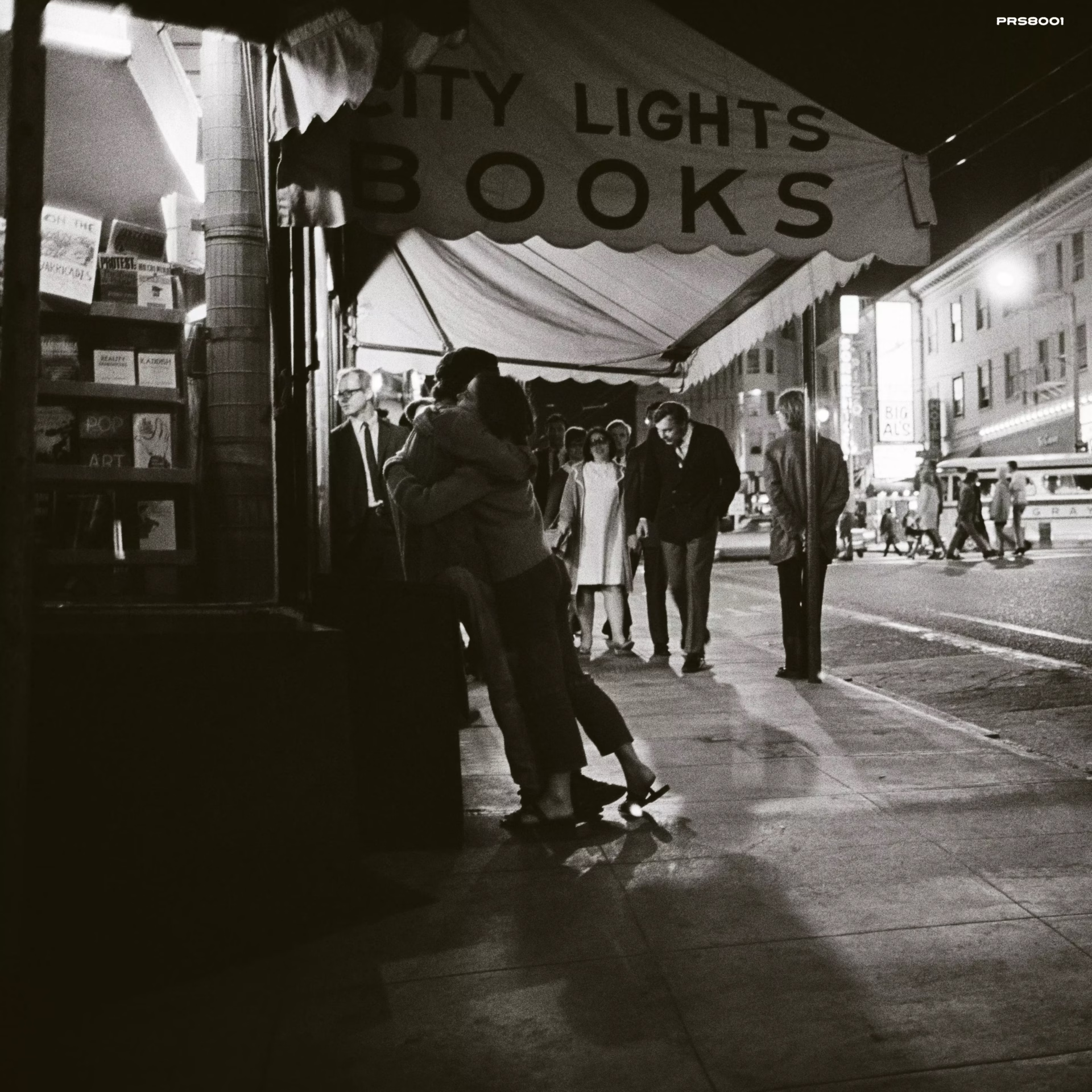
Cover art for *The Fooler* — a couple in front of City Lights Books in North Beach
I and others have previously cast you among the wave of retro soul artists. How has that characterization shaped your music, if at all?
What I'm doing is not aping. I'm expressing myself with the tools and the vocabulary that I have on hand, and a listener has to trust me, that I'm doing what I'm doing in good faith.
I always had much more in common with — and actually lived among and worked among and incubated with — the San Francisco garage scene. Ty Segall is playing drums on my first record. But you know, when you make your first record with horns and gospel-style vocals, and the people who work on your record — including your publicist and your distributor — put out Daptone-related stuff or Mayer Hawthorne or Aloe Blacc related stuff, you're put into the bloodstream as another one of those cells. It also switches how people hear stuff. I struggled with that from the beginning.
Back to The Fooler, is there anybody playing on it that you want to highlight or any interesting production facts that you think are worthwhile to note?
Making it with Mark Neill, at his place, was really revelatory for me. I surrendered to Mark to be the artist. And I also brought in my childhood best friend, Anthony Polizzi, who's playing second guitar or piano, who's a part of my DNA. Almost every record I've put out has a song co-written by us; we haven't lived in the same city together since we were 17.
[Mark] understood the sound was the place and we talked a lot about these records specifically that were influencing us whether they were little Anthony and the Imperials records, or they were loving spoonful records, or they were Bert Berns records. And he was looking into me to find who I was, and for me, it helped push me.
What else is on your plate that is contributing to your new creative impetus?
I'm writing a lot. I have been working on a lot of other projects; I'm working on another record with Jon Batiste to follow up the work that we won a GRAMMY for.
I'm finding that in a lot of my writing, [my breakthrough] helped me comprehend how I want to write and what I'm actually trying to strike at. Every day, I try to get closer or touch it if I can. So it's been good. It's turbulent, but it's productive.
Inside The National Museum Of Gospel Music — A Beacon Of American Music Rising From The Ashes