Remixing singles, albums and catalogs became a standard part of major label marketing plans for pop stars in the ‘90s and 2000s. While the business practice is currently seeing resurgence, remix culture — the celebration of remixing as a true craft — has been continually appreciated on dancefloors worldwide.
Case in point: Michael Jackson’s Blood on the Dance Floor: HIStory in the Mix. The 1997 remix album isn’t regularly referenced as a highlight in the late entertainer’s vast catalog — or even as one of the best examples of the remix format. But, more than 25 years after it was released, Jackson’s platinum-certified collection remains the biggest selling remix album of all time.
"That’s an amazing fact," English producer/remixer Terry Farley tells GRAMMY.com when informed of Jackson’s standing achievement. Under the name Fire Island, Farley remixed Jackson’s "Money" for Blood on the Dance Floor with his frequent collaborator Pete Heller. Although the duo didn’t have any contact with Jackson during the project, they were compensated well enough to be able to hire musicians to record new elements for remixes. That’s something Farley says is now only afforded to the top one percent of remixers.
"Some labels don’t even offer studio time money," Farley says of the current climate for commissioning remixes. "Most labels and DJs seem okay with this situation. It’s sad because back in the day, the better the desk, the better the sound."
Remix albums, like Dua Lipa’s Club Future Nostalgia, made a comeback during the pandemic. Club Future Nostalgia features remixes by a roster of in-demand international touring DJs/producers like The Blessed Madonna, Kaytranada (who won two GRAMMY Awards in 2021), Masters At Work, Dmitri From Paris, Mr. Fingers and Moodymann, plus cameos from the actual Madonna, Missy Elliott and Jamiroquai.
"It was the perfect opportunity to create something like this," Dua Lipa told GRAMMY.com in August 2020. "I had what felt like all the time in the world, and everyone's at home. It doesn't really happen so often that you get the opportunity to collaborate with all these incredible producers and artists. I think it was of-the-moment that I was able to snap everyone up, especially The Blessed Madonna, who would've been on tour by [that] time. This album really came to be because of the current climate."
A Connection To The Past
Remix albums can be a way to introduce younger listeners to unfamiliar genres as well as artists who have passed away, such as with the 2021 release of Nina Simone’s Feeling Good: Her Greatest Hits and Remixes on Verve Records. The collection is an extension of the classic jazz label’s Verve Remixed album series, which features remixes of songs by Billie Holiday, Ella Fitzgerald, Dinah Washington, Dizzy Gillespie, Sarah Vaughn, Count Basie, Louis Armstrong and other dearly departed stars.
Verve Remixed was created by Dahlia Ambach-Caplin, who was Verve’s international publicist at the time, and it remains the longest-running remix album series in America. Now, Ambach-Caplin is the SVP A&R for Verve, Verve Forecast and Impulse.
"We concocted the idea by witnessing the growing group of electronic producers who were using jazz in their music and [feeling that] we could bring songs of the catalog to a brand new audience," she tells GRAMMY.com. "The whole idea was to leave the songs as recognizable as possible so people would be drawn to hear the originals. We always released a companion album of originals in the same order and it sold well too. Everyone at the label was super open to keep revitalizing the catalog and electronic music was an area of growth with producers excited to jump in."
"When this series started the remix was still an ode to a vibrant culture – DJs, electronic and hip-hop," says Todd Roberts, Head of Music Publishing Creative at MNRK and Executive Producer of Verve Remixed with Ambach-Caplin from 2005-2013. "Now, I think 'remix culture' is unfortunately being led by lazy marketing executives looking to capture peripheral new trends in music."
Though there’s a lot of mediocrity to wade through in general, Roberts points to the remix work of artists like Kaytranada, DJ Koze and Moodymann as proof that there are still producers who view remix culture as a craft and a tradition to build on further.
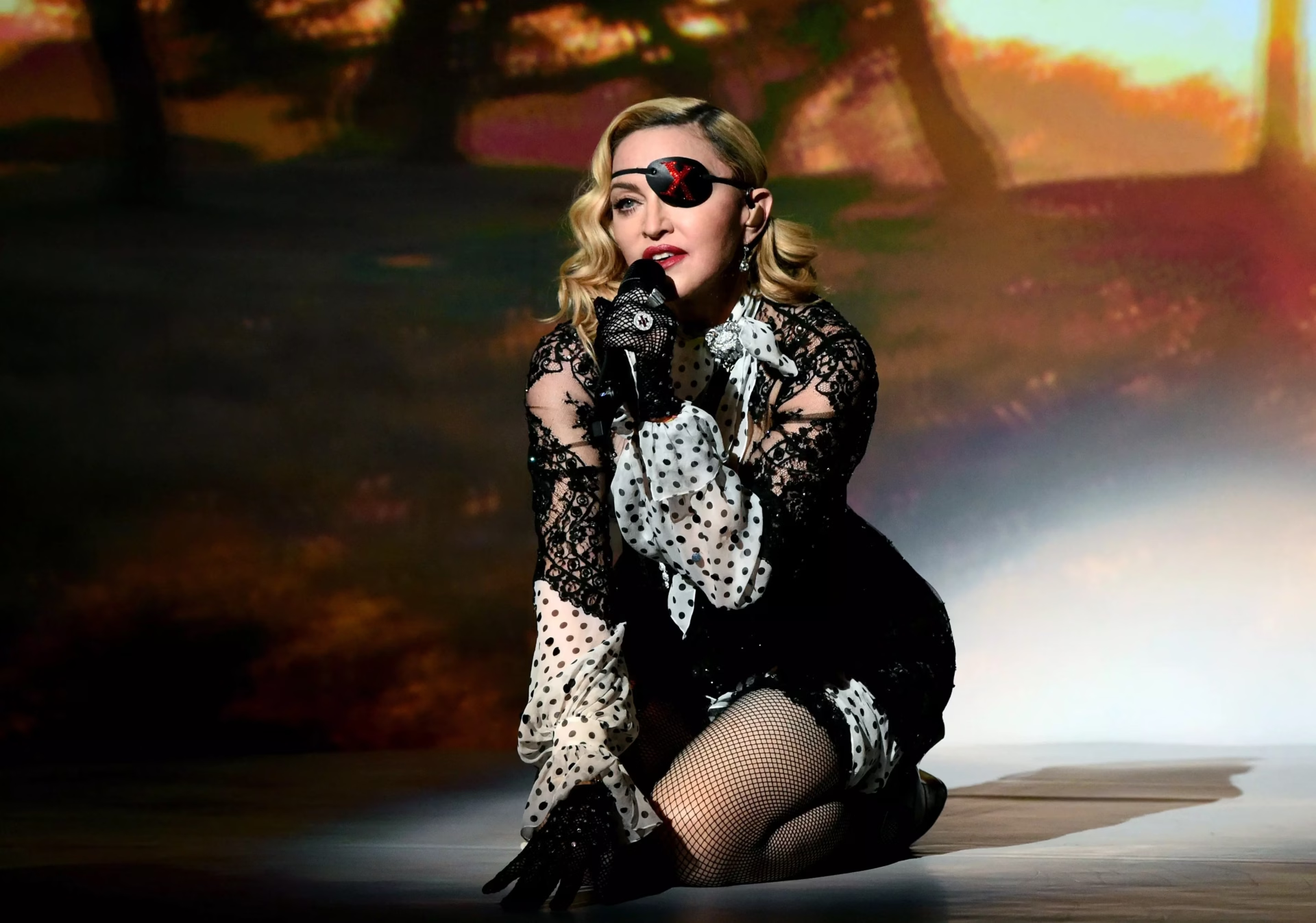
The concept of a big budget remix album will be back in the mainstream music spotlight with the August 19 release of Madonna’s Finally Enough Love: 50 Number Ones. The album contains 50 of her remixes that have topped the Billboard Dance Club Songs chart — a feat that hasn’t been replicated by any other recording artist on any Billboard chart — some of which also appeared on her first remix album, 1987’s You Can Dance.
Finally Enough Love features a generationally and stylistically varied lineup of producers, including early remixers like Shep Pettibone, Junior Vasquez and David Morales, transgender house music producer Honey Dijon and the late Swedish DJ Avicii. Madonna’s last album, 2019’s Madame X, failed to go gold, but the nostalgic and career-spanning selection of Finally Enough Love coupled with the release coinciding with a host of 40th anniversary Madonna reissues might give it a better chance at earning higher sales.
"Classics from Madonna’s catalog of remixes are always going to track better than her new music, I think," says Roberts. "Remarketing is free money for the labels essentially, whereas breaking new songs from an older artist is usually gonna be more work."
The Material Girl may already be on the way to having a summer blockbuster. A representative for Rhino Records told GRAMMY.com that pre-sales of the vinyl version of Finally Enough Love: 50 Number Ones sold out in less than 48 hours.
From Tools To Tracks
From slashing to clicking, the tools of remixing have evolved dramatically alongside technology. Today’s remixes are largely made by using software to manipulate digital audio files — a far cry from the razorblade-to-reel editing of the '70s and '80s, which could draw actual blood alongside the sweat and tears. The Latin Rascals (Albert Cabrera and Tony Moran) exemplified the stuttering, stop-and-go style of razor editing in the mid-80s. Highlights include the extended drum breaks in their reconstructions of songs like Bauhaus lead singer Peter Murphy’s solo song "Final Solution," Aretha Franklin’s "Freeway of Love" and their "Version Latina" of Pet Shop Boys’ "Opportunities."
The '90s level of remixing that Farley recalled often included recording entirely new musical elements and arrangements to lay on top of an existing work. This was exemplified by the first two winners of the GRAMMY Award for Remixer of the Year, Non-Classical (later changed to Best Remixed Recording, Non-Classical): house music pioneers and long time Def Mix business partners Frankie Knuckles and David Morales.
Knuckles, who passed away in 2014, was widely known as the "Godfather of House" and was a prolific remixer in addition to a producer of his own music. Then and now, Frankie Knuckles remixes stand out as elaborate new studio arrangements of songs, often with the addition of live piano and new supporting vocals. In the year leading up to his 1998 GRAMMY Remixer of the Year, Non-Classical win for his "Franktidrama Club Mix" of Toni Braxton’s "Un-Break My Heart," Knuckles crafted elaborate new arrangements of songs by Michael Jackson ("You Are Not Alone," for Blood on the Dance Floor), Janet Jackson, Chaka Khan and Mary J. Blige.
Morales — who won the golden gramophone for Remixer of the Year, Non-Classical in 1999 for his work with Mariah Carey — maintained an equally busy schedule of remixing. Carey was particularly hands-on in the remix process with Morales, who also won Album Of The Year in 1996 as a producer on Carey’s Daydream.
"When it came to remixing Mariah Carey's songs, we usually went in and re-sang the song," Morales told the Recording Academy in 2016.
For Carey’s "Fantasy," for example, Morales disregarded the downtempo instrumentation of the original. Instead, he went into her studio to build a fresh club-ready backing song on her studio’s Sony digital multitrack machines.
"‘Fantasy’ was almost 80 tracks [of new sounds]," he noted. "I programmed my drums on drum machines and Satoshi Tomiie programmed keyboards on Vision software. Terry Burrus played live piano. First, I had to create the music for the remix, which really had nothing to do with the original version. Once that’s done then Mariah comes in and does what Mariah does: she vibes to the track and makes it happen. I did a couple of different versions of the remix so there's something special about all of them."
Back To The Edit
Since the Jamaican practice of making new versions and dubs of songs dates back at least to the '60s, Sean Combs drew international side eyes when he named his 2002 Bad Boy Records remix compilation We Invented The Remix. But the trend-savvy businessman then known as P. Diddy also sold enough copies for the collection to be certified platinum, opening the door to even more hip-hop and R&B remixes to follow.
"Remix culture is Jamaican soundsystem culture," Roberts says. "While I think any genre being remixed can qualify, it is an art and not easy."
Years later, even country music has a place in the current remix conversation. It’s a popular category for BPM Supreme, a Los Angeles company that offers a "record pool" of digital remixes and edits of songs for DJs and employs a network of remixers around the world. Country also serves as a remixing muse for buzzing groups such as England’s Flying Mojito Bros, who fashion old songs by country acts like Ronnie Milsap and Crosby, Stills and Nash into cosmic disco dance floor heaters.
The practice of remixing hasn’t slowed down, but in 2022, a shopper on a DJ-centric music site such as Beatport might find more tracks labeled as edits than remixes — though this refers to edits made on a computer instead of with a razorblade.
That shift in terminology is perhaps fitting for the general effort and relative lack of larger investment that’s currently put into this craft. Though the era of big budget business-minded remixes may be past, remix culture will continue whether it’s within or outside of the gaze of the music business.