Early in 1973, Gladys Knight & the Pips made a series of bold moves. The charismatic soul quartet — Gladys, her brother Merald "Bubba" Knight jr, and cousins William Guest and Edward Patten — severed ties with one of the era’s biggest hitmakers, signed with a fledgling new label short on cash but big on ambition, and handpicked collaborators who understood their potential.
All these decisions were vindicated by the group’s soul-stirring album *Imagination*, released in October 1973. Packed with slow-burning ballads and rousing mid-tempos, the album helped establish Gladys Knight & the Pips as a formidable entity within soul and popular music writ large. Co-produced by the group, *Imagination* peaked at No. 9 on the Billboard 200 and bore several Top 10 hits, including the song that would quickly become the group’s signature: the chart-topping, GRAMMY-winning, and utterly timeless "Midnight Train to Georgia."
Yet just 10 months prior to Imagination’s release, the group’s prospects were unclear. Their seven-year contract with Motown Records was due to expire, presenting them with an opportunity to jump aboard a different train.
Unlike many Motown stars who were plucked from high school and groomed for success, Gladys Knight & the Pips arrived at the label from Atlanta as seasoned performers, having already performed grueling stints on the Chitlin' Circuit and at Harlem’s Apollo Theater. They had even experienced chart success with their cover of the Royals’ "Every Beat of My Heart" (a No. 6 pop hit in 1961). "Gladys could ‘sang,’" wrote Motown founder[ Berry Gordy](https://www.grammy.com/artists/berry-gordy/2727) in his autobiography. "She had warm Southern charm and a hint of Country soul, mixed in with an infectious Gospel feel."
However, the group felt neglected in favor of big-hitters like[ the Temptations](https://www.grammy.com/artists/temptations/8400),[ the Four Tops](https://www.grammy.com/artists/four-tops/7761), and, especially, [Diana Ross](https://www.grammy.com/artists/diana-ross/15248) and the[ Supremes](https://www.grammy.com/artists/supremes/17715). According to Gladys’ autobiography, Gordy once removed the group’s supporting slot on a Supremes tour. Why? Their riotous live performances were deflecting from the main act. "We felt at Motown like we were adopted," Bubba tells GRAMMY.com, also noting accounting practices at the label which the group found "distasteful."
Gladys Knight & the Pips *did* experience chart success at Motown: their spirited recording of "I Heard It Through the Grapevine" was a[ No. 2 pop hit](https://www.billboard.com/charts/hot-100/1967-12-16/) in 1967. But in the twilight of their initial contract, the group flirted with other opportunities. "We wanted to go to a label where we would be a big fish in a small pond, as opposed to a small fish in a big pond," explains Bubba.
The group were soon courted by New York-based label Buddah Records. "They had all the qualities of a hit group," says Buddah Vice President Cecil Holmes, who admits spending a year "romancing" the group, noting also their "clean cut, no drugs" reputation. As a new, smaller label unable to compete financially with the industry’s bigger fish, Buddah sold themselves on passion.
Fellow Buddah executive Ron Weisner, who would later manage Gladys as well as [Madonna](https://www.grammy.com/artists/madonna/5068) and [Michael Jackson](https://www.grammy.com/artists/michael-jackson/13202), remembers Buddah’s pitch to the group: "We don't have this ridiculous amount of money to give you. We give you our word — we’re going to kill for you. Whatever you’re looking to do, we're going to make it successful."
In February 1973, it was announced that Gladys Knight & the Pips had left Motown and signed with Buddah. Their swan song was the GRAMMY-winning "Neither One of Us (Wants to be the First to Say Goodbye)," penned and first recorded by country musician Jim Weatherly – whose songbook the group were keen to revisit.
After meeting with various producers, they enlisted Richie Wise, Kenny Kerner, and Tony Camillo to work on their upcoming album. Their first Buddah single was the gorgeous Weatherly ballad "Where Peaceful Waters Flow." However, their next single would define their careers.
**Gladys Knight & The Pips Reinvent A Country Ballad**
But before Gladys Knight & the Pips boarded the midnight train to Georgia, Weatherly flew the midnight plane to Houston. As explained to Marc Myers for the oral history project *Anatomy of a Song*, Weatherly called his actor friend Lee Majors one evening in 1970. The actress Farrah Fawcett, Majors’ then-girlfriend, answered the call, telling Weatherly she was preparing to take a "midnight plane to Houston" to visit family.
Struck by the accidental poetry of Fawcett’s remark, Weatherly wrote a country ballad about a man accompanying his girlfriend back to Houston after her dreams of stardom in Los Angeles failed to materialize. "The line ‘I’d rather live in her world than live without her in mine’ locked the whole song," said Weatherly, who released "Midnight Plane to Houston" on his 1972 album *Weatherly*.
The song was next recorded by gospel singer[ Cissy Houston](https://www.grammy.com/artists/cissy-houston/13569), whose background work as part of the Sweet Inspirations provided color and richness to the music of[ Aretha Franklin](https://www.grammy.com/artists/aretha-franklin/11503),[ Elvis Presley](https://www.grammy.com/artists/elvis-presley/6033), and[ Jimi Hendrix](https://www.grammy.com/artists/jimi-hendrix/3866). Her gospel-country ballad was released in early 1973 as "Midnight Train to Georgia," a lyric change she requested. "My people are originally from Georgia, and they didn’t take planes to Houston or anywhere else. They took trains," she told Myers.
Yet Cissy’s gender-flipped and lyrically-altered rendition stalled commercially, which she blamed on limited promotion by her label Janus. Weatherly recounted to Myers that his publisher then sent the song to Gladys Knight & the Pips. "I listened to Cissy’s version and loved it," mentioned Gladys in her account to Myers.
However, Gladys has claimed in her autobiography and in various[ interviews](https://www.spokesman.com/stories/2017/jan/16/this-motown-star-knew-midnight-plane-to-houston-wo/) that *she* conceived the central change from "plane" to "train" and "Houston" to "Georgia." Bubba echoes this, adding emphatically that "we voted for Gladys to call Jim Weatherly and find out if we could change the title and some of the lyrical content." He elaborates: "[Ray Charles](https://www.grammy.com/artists/ray-charles/10927) had "Georgia On My Mind" and that was the theme song for Georgia. We wanted something to represent our hometown as well."
There is some scope to reconcile these accounts. In a different[ interview](https://www.youtube.com/watch?v=TNjBZTl6h84&t=3s&ab_channel=Tennessean), Weatherly explained that it was in fact his original song that was sent to Gladys Knight & the Pips, rather than Cissy’s re-titled version. "We had no idea it was going to stay ‘Midnight Train to Georgia,’" he said. "We were pitching ‘Midnight Plane to Houston’ but Gladys wanted to change it."
Engineer Ed Stasium also remembers that the sheet music for his sessions with the group had the original title which was subsequently updated. It is therefore plausible that the Gladys and the Pips organically envisaged the same or similar lyric changes before becoming aware of Cissy’s version (though Bubba tells GRAMMY.com he never knew Cissy’s version existed at the time the group recorded the song).
Stasium engineered three mixes of "Midnight Train to Georgia" in total. He describes the first two mixes as "way slower" than the final product, a "similar vibe" to mellower *Imagination* tracks "Perfect Love" and "Once in a Lifetime Thing." "Totally a whole other record," adds engineer David Domanich. (On one mix, Camillo can be heard singing "midnight train to *Atlanta*" when mapping out guide backing vocals.) The group rejected these mixes for being too sedate.
"I wanted an[ Al Green](https://www.grammy.com/artists/al-green/13386) thing going," Gladys told Myers. "Something moody, with a little ride to it." After burying himself in Al Green records, Camillo hurriedly convened the session musicians at his Venture Sound Studios in New Jersey to blast out a new arrangement which Stasium quickly engineered.
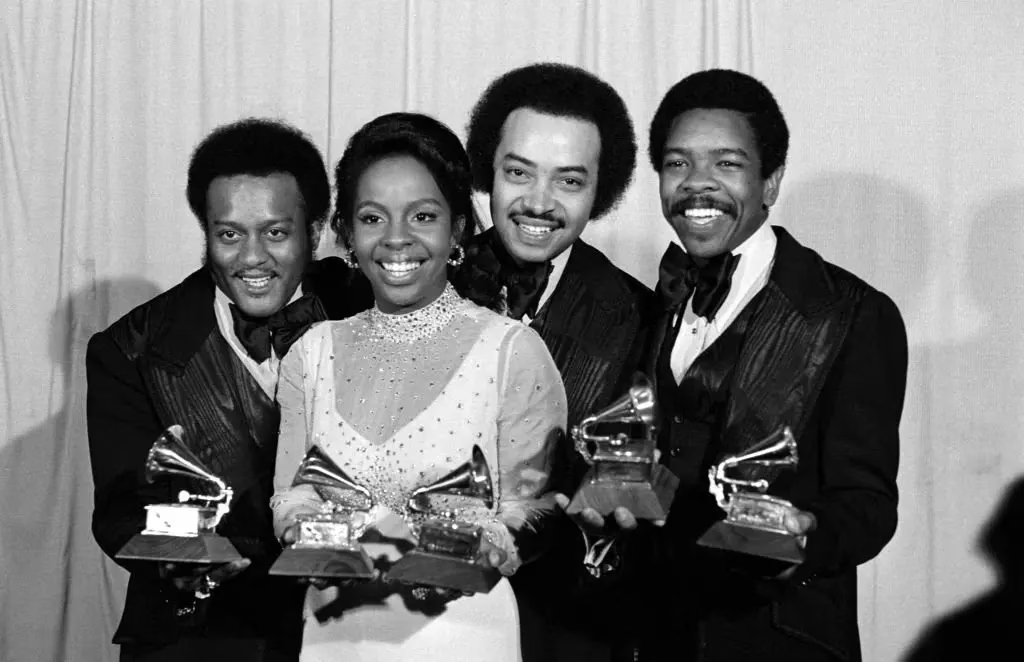
Gladys Knight & the Pips at the 1974 GRAMMYs | CBS via Getty Images
The group were thrilled with this muscular, earthier mix. Recording in Artie Fields Studios in Detroit, Gladys delivered a "scratch" vocal to help the Pips organize their background parts before recording a "serious" take. "She sang the meat of the song beautifully but, at that particular time, my sister had a problem with ad-libbing," remembers Bubba, who proceeded to the engineer’s desk to issue instructions to her. "I told Gladys: ‘When you get to this part go, "*I got to go, I got to go!*" Gladys followed her brother’s lead, resulting in the joyous, life-affirming ad libs we hear on the record.
Organ, horn, strings, and piano (inspired by Floyd Cramer, pianist Barry Miles notes) were later overdubbed. Stasium also "punched in" an additional ad-lib which Gladys recorded in New York. By the end, Weatherly’s docile country ballad was transformed into an undeniable R&B juggernaut, an energetic dialogue between Gladys and her Pips. It reached No.1 in October 1973 and later won a GRAMMY award for Best R&B Vocal Performance by a Duo, Group or Chorus.
***Imagination Y*****ields Further Hits**
The *Imagination* album was also released in October, and was certified "gold" by the end of that year. Five out of nine tracks were written by Weatherly. The other four: the Barry Goldberg/Gerry Goffin tune "I’ve Got to Use My Imagination," covers of Paul Williams’ "Perfect Love" and Johnny Nash’s "I Can See Clearly Now," and the Gladys Knight & the Pips-penned "Window Raisin’ Granny" – inspired by the image of Gladys and Bubba’s mother standing by the window watching her children, nieces, and nephews’ early performance routines.
The propulsive, funky "I’ve Got to Use My Imagination" was the album’s third single. Goldberg tells GRAMMY.com that he wrote the song as a simmering blues number – influenced by[ Marvin Gaye](https://www.grammy.com/artists/marvin-gaye/13346)’s version of "Grapevine" and BB King’s "The Thrill is Gone" – and assumes the romantic anguish of Goffin’s lyric ("Such a sad, sad season / When a good love dies…") was inspired by Goffin’s recent divorce from songwriting partner Carole King. Goldberg was astounded when he first heard Gladys Knight & the Pips’ pacier rendition, conceding that the song "wouldn’t have been a hit" if recorded as originally written (it peaked at No.4 pop). Fourth single "Best Thing That Ever Happened To Me," another Weatherly ballad first released by country singer Ray Price, peaked at No. 3.
Imagination was the triumph the group needed, not only giving them several hits but demonstrating their talents as co-producers and justifying their decision to leave Motown. "[Buddah] promoted us and our music like nobody had before," wrote Gladys in her autobiography, crediting the label for further opportunities for the group such as recording the Curtis Mayfield-scored soundtrack for the film Claudine.
"The success of the *Imagination* album took us to another level," opines Bubba. "Our career just took off. Our level of headlining took off. It took us to European tours." "Midnight Train to Georgia" and "Best Thing that Ever Happened to Me" also became UK Top 10 hits, laying the groundwork for Gladys’ strong touring presence across the pond to this day. These two *Imagination* tracks also sit in the top 5 most streamed Gladys Knight & the Pips songs on Spotify.
Subsequent Buddah releases would not reach *Imagination*’s levels of mainstream popularity. But, particularly from 1974-'75, other well-performing albums would follow for the group, with pop/R&B hits including "On and On," "I Feel a Song (In My Heart),"[ ](https://d.docs.live.net/d6df3910d775fa63/Research%20Projects/Gladys%20Knight's%20Imagination/How%20Gladys%20Knight%20%5e0%20the%20Pips%20'Imagination'%20cemented%20their%20legacy%20in%20soul%20-%20FINAL.docx#_msocom_14)their soulful rendering of[ Barbra Streisand](https://www.grammy.com/artists/barbra-streisand/6847)’s "The Way We Were," and "Part Time Love." They had no reason to hanker for the days of Motown.
Of course, "Midnight Train to Georgia" remains the most enduring of *Imagination*’s tracks and the group’s entire repertoire. Fifty years later, this song about stubborn loyalty remains stubbornly in the popular consciousness as one of (soul) music’s definitive anthems, with a wider cultural impact too. It has been covered by the likes of[ Joss Stone](https://www.youtube.com/watch?v=ipKeSfWgdRE&ab_channel=PortalJossStone),[ Neil Diamond](https://www.youtube.com/watch?v=sffI5ZZlTzc&pp=ygUmbmVpbCBkaWFtb25kIG1pZG5pZ2h0IHRyYWluIHRvIGdlb3JnaWE%3D), and[ Aretha Franklin](https://www.youtube.com/watch?v=mdo_BPQtvC0&pp=ygUpYXJldGhhIGZyYW5rbGluIG1pZG5pZ2h0IHRyYWluIHRvIGdlb3JnaWE%3D), parodied in TV series like "[Modern Family](https://www.youtube.com/watch?v=b3JGcrHbJm4&ab_channel=ArtemB)" and[ "30 Rock](https://www.youtube.com/watch?v=uANsFziGObs&ab_channel=30RockOfficial)" (which featured a Gladys cameo), and has become a staple on talent shows like[ "American Idol](https://www.youtube.com/watch?v=a8EHnqQljc4&ab_channel=linoya7)" and[ "The Voice](https://www.youtube.com/watch?v=EAIx9md0vqc&pp=ygUga2Vpc2hhIG1pZG5pZ2h0IHRyYWluIHRvIGdlb3JnaWE%3D)."
It turns out there were actually[ no midnight trains departing from L.A. to Georgia](https://www.cbc.ca/radio/the180/be-kind-and-don-t-recline-stop-being-so-cynical-about-electoral-reform-and-the-problem-with-this-song-1.3677753/the-problem-with-this-song-midnight-train-to-georgia-1.3678044) in the early ‘70s, but Gladys Knight & the Pips sure make it sound like a journey worth taking.
Living Legends: The Meters' George Porter Jr. Remains A Force Of Funk Six Decades Into The Game