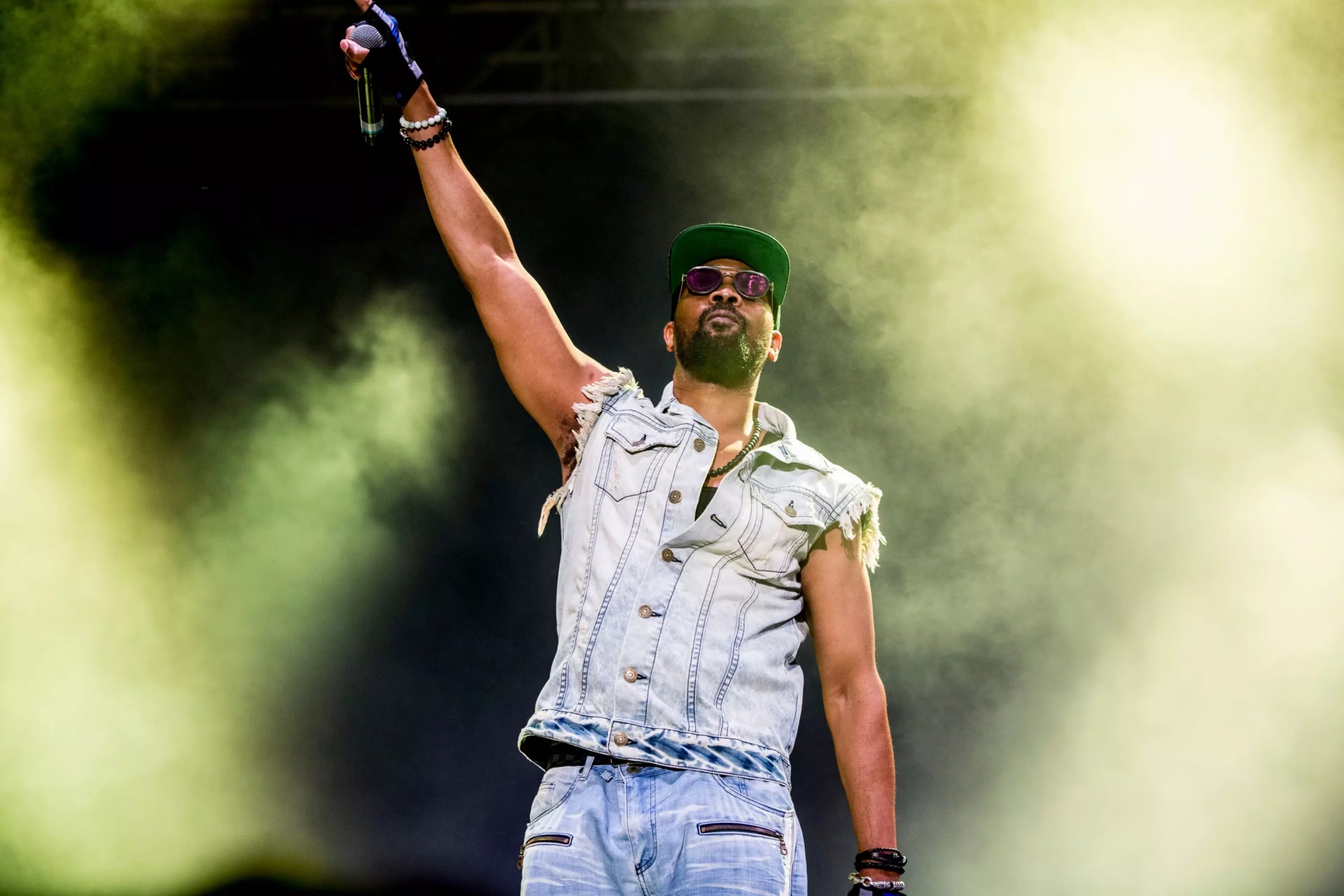
Artists who’ve stretched their careers past the unimaginable often come full circle; at no point do they ever really lose the foundations that moved them to begin with. Robert Diggs — known as the RZA — is having one of those full-circle moments. After founding a record label and clothing brand, creating comic books and soundtracking Hollywood hits, today he admits: “Now, I can get back to my foundational love that started it all, which is and will always be, hip-hop.”
Diggs’ — a.k.a. Zig-Zag-Zig Allah, a.k.a. Prince Rakeem, a.k.a. the RZArector (among his many monikers through the decades) — career began through homespun demos with cousins and neighborhood friends in Staten Island. RZA’s supreme mathematics with the Wu-Tang Clan were well known by 1994, when Enter the Wu-Tang (36 Chambers) forever changed rap with uncanny ballistics not seen before or since. As Wu-Tang’s visionary, RZA famously masterminded their record deals and single-handedly produced all the vaunted material; his group mentality aiding everyone’s collective ascension.
RZA then transcended Shaolin, landing in Hollywood to oohs and ahs in the late ‘90s, where he scored Jim Jarmusch’s meditative film Ghost Dog: Way Of The Samurai. Yet it wasn’t until 2012’s The Man With The Iron Fists — a film produced by Quentin Tarantino starring Russell Crowe which RZA co-wrote and directed — that he felt he’d finally arrived. “My evolution to manhood began with that film,” he tells GRAMMY.com.
“At that point I became a master. It took me many years but I really felt like I evolved into the artist I am today after that project.” His voice now a bit dustier, but RZA’s energy and enunciation rings familiar. “I felt like I could run a small country after that.”
In 1998 he once again emerged solo, this time as Bobby Digital — a character and concept album woven with fantastical tales over fewer sampled beats, creating an atmosphere that was equal parts Blaxploitation and futuristic street narrative. Hearsay tells us that a Bobby Digital film was even in the works, though it never materialized and remained the final word regarding the Digital persona — until recently.
After 20 years, RZA has boomeranged to Bobby Digital with Saturday Afternoon Kung Fu Theater, out March 4. Bobby Digital’s return pays homage to the Shaw Brothers — Hong Kong’s largest film company, operating for an astounding 86 years, with almost every notable kung fu ever made film under their banner — while evolving the album’s namesake character. GRAMMY-nominated producer DJ Scratch nails the sample palette, creating an epic undertone of kung fu dialogue and sound effects.
Reprising the Digital the character gave RZA a sense of liberation. “It was freeing just rapping and spitting verses all over,” he says. “It was fun trying to match my words to the vibe of the beats and just using all kinds of different cadences again.”
From his pre-Wu days, to the making of “C.R.E.A.M.”, to his production epoch, and his celebrated film work, GRAMMY.com demystifies and unpacks the many histories that orbit one Robert Diggs.
This interview has been edited and condensed for clarity.
I want to start at the beginning and move forward: While “Protect Ya Neck” was the first single, “C.R.E.A.M.” likely introduced Wu-Tang to many and still resonates. What comes to mind when you think of it today?
“C.R.E.A.M.” was a song that actually took three four different evolutions before it became final. At one time it was called “I’m On Some S**t.” And later on, there was a version with just me and Ghostface. Then, later there was a version with just Raekwon and [Inspectah] Deck. That one was called “Lifestyles Of The Mega Rich” and it was 12 minutes long. [Laughs]
When we got the deal to make [36 Chambers], I wanted to use it because I knew that the beat was special. I knew that the vibe between Raekwon’s voice and Deck’s voice was the best. But as we was doing it, it just seemed like something else had to happen.
For instance?
We needed a hook. And so at the time, the best person to do hooks was Method Man. He was a melodic member of the crew and was always very witty with his hooks. I was like, “Yo, I need a hook for this” and he was casual about everything and came back with “C.R.E.A.M. get the money. Dolla dolla bill.”
We touched on “C.R.E.A.M.” but does RZA have a favorite Wu-Tang song?
I don't know, my favorite changes. But recently I've just been really impressed with the way I did “Bring Da Ruckus.” I used a CD skipping as my horn. Even to me, that sounds like I really was innovative back then.
I was trying to complete a story…and it made sense to me that I needed a horn. While I was looking for samples, the CD started skipping so I sampled that sound. Then I slowed it down and it became the tata tata tata tata tata that you hear. So the orchestration of this song and how it came together finally means a lot to me. I’m just really impressed to think of my young mind being able to compose that without even knowing what a C chord was.
As the producer of Wu-Tang Clan, what an embarrassment of riches to have those MCs to produce for.
Each member had something unique and I knew them all. They all knew each other but I was the denominator; I did demos with all of them. There’s a demo with just me and Ghostface. There’s a demo of Dirty and GZA and so on. Some of these tapes go back to when I was 12.
When [my debut solo project] Prince Rakeem happened, I had a little record deal and felt like I understood the industry a little bit. Even then I was like, “The best talent my ears have heard are homies that I've been doing demos with my whole f***ing life!” So I went and told execs that we got something different and that we had that Wu-Tang slang. Bong bong.
Do you mind sharing your decision to leave high school? What was your family’s reaction?
To keep myself motivated, I just wanted to record and record. That's why I dropped out of school.
I don't think I ever made this public, but it was my mom that actually signed me out of school. At first I was just absent so much that they’d send people to our house. And my mother said she was gonna do whatever I wanted; I told her I just wanted to do music. So she drove me up to the school and the lady asked us, “You sure you want to do this?” I was 16 years old at the time and my mom signed me out, and I went for it.
Thanks for that. What strikes you now looking back on that transitional stage in life?
I came in as this young man that had his heart and energy focused on writing songs and making music. The problem that I had, though, was nobody believed in me as a producer.
Acclaimed producer Easy Mo Bee produced your first released material during your Prince Rakeem era. Tell us about your early development and how that impacted you as a young producer.
I may have had like a hundred beats at that point. And a hundred ain't enough to be at the master level. I was making these beats with the Roland and a 4-track Yamaha. I didn’t even have a sampler; I would just scratch in samples live. I met Easy Mo Bee with his brother and they had an SP 1200 and were killing it. I was just enamored by that. I saw that machine and didn’t know what it did and Mo Bee would just make a beat right in front of me. Mo was dope. I would to go to his house a lot. I wanted him to produce my whole album, and he gave me a couple tracks. I couldn't afford him at the time. [Laughs]
We’d be remiss to not mention your Gravediggaz project with Prince Paul, 1994’s 6 Feet Deep. Looking back, do you think you guys invented “horrorcore?” And please touch on Paul’s importance for us.
We never wanted to call it “horrorcore.” That was a title that the writers started calling it. But I do think we definitely pioneered it. Nobody else was doing it in front of us. You could give credit to The Geto Boys too, like “Mind Playing Tricks On Me” or “Mind Of A Lunatic.” They were pretty dark, but it wasn't spiritually dark like us.
Prince Paul is a producer who brought skits to the whole album format for hip-hop. His creativity was there before all of us. Paul was definitely a pioneer on interludes and being able to add abstractness. He made Gravediggaz happen. His choices were just different.
You have a new Bobby Digital project out soon, but I want to talk about the first one, Bobby Digital In Stereo. What did this allow you to do that was different from the RZA?
RZA has a certain responsibility, so I had to protect that persona. Bobby Digital offered escapism for me. I was in the studio smoking and drinking and I just had this insight that the whole world's gonna be digital. I felt like I became a digital being around that time. Whatever combination of drugs I had that night, I did more. And did it again. I remember I couldn’t feel my hands! And then I thought of my birth name, which is Robert Diggs, Bobby Digs. So I knew I had to be Bobby Digital.
Production wise, it had less samples, more strings and keys. What are your thoughts when you look back on that era of your production?
I didn’t want to do RZA anymore. Thinking back, I think it helped open up the fact that hip-hop could be electronic music and not only sample based. Maybe more kids got Triton keyboards after that instead of samplers. I still wasn't musically trained like I am now. What I love about the album in particular and its vibe, is that I was bold and tried weird s***. With the new Bobby Digital, I wanted to bring it back and be positive about everything.
On My Beautiful Dark Twisted Fantasy and Watch The Throne, you worked with Kanye, who like yourself both raps and produces. What was that experience like and did you have any takeaways?
Working with him was great because Ye has the ability to bring a lot of energy and people together to create. He was the first artist that I met personally that treated his project like how a boxer prepares for a fight. The regimen of him and his crew and all the dedication to that moment of creativity. I had never seen that before.
When Wu did it, we were all sort of at the studio and we were all dedicated, but it wasn't scheduled. For us, the studio was like a clubhouse, it’s where you’re going. But with Kanye, the scenario was that the team would get up and eat breakfast together. Then do something recreational together and another activity. But at 4 o'clock we’re all going to be at the studio.
I want to move to your film work. There’s Afro Samurai and of course the scores for both Kill Bills. Touch on Tarantino and describe your mind state when scoring a film versus production.
Artists sometimes come together and I think it’s destiny. Our relationships come out of a love for art. With Tarantino, we’re just both big kung fu heads and our friendship started by watching movies. He’d call and say, “I'm in town, come over. I got this film.”
With scoring a movie, you lose your freedom. You’re there to complement the story and as well as have a story to tell through music. It’s more trial and error. Once your brain gets the process, it all makes sense. I had a scene where the music started right when the girl in the scene opened her eyes. It was very subtle. It was magic. You need to communicate to the audience as the composer.
Let’s touch on directing The Man with Iron Fists. You grew up on kung fu films. Was it hard to take all your influences and not make a 5-hour kung fu epic?
The first cut of the film was over three hours! But to be real with you, Dave, and to be real with your readers, I’ll tell you how I put out art. You need three things: inspiration, imagination and aspiration. All of those words, there's an action to it. There's an internal spirit and movement. All these things are important.
I was just so happy that I was able to share this with the world. It was the most difficult artistic expression I had ever done to date. It was the greatest challenge of my life. And when I finished it, I became a full-blown artist and a full-blown man. I truly believe that.
When it comes to films, what inspires you most: scoring, acting or directing? And what do you exactly mean by it helped you “evolve?"
Directing is the greatest because as a director, you have all the control. I wrote, directed, acted and scored it. My signatures were on everything. Moviemaking is the most expensive form of art creation. It is your responsibility to protect everybody's interest and money and time and still tell a story while doing it. And that's why I said I became a full-blown man because after that. To me, it was almost the epitome of artistic creation. But now, I can get back to my foundational love that started it all, which is and will always be hip-hop.