A rainshower of recent press coverage has positioned Terri Lyne Carrington as a conservator, a custodian, a caretaker of the canon — and that's deservedly so.
In Sept. 2022, the three-time GRAMMY-winning drummer released New Standards: 101 Lead Sheets by Women Composers. This sheet music collection rebalances the gender scales and shines a light on women who have been blatantly underrepresented in male-dominated "fake books" — figures like Toshiko Akiyoshi, Geri Allen, Joanne Brackeen, Carla Bley, and Mary Lou Williams.
Accompanying this was new STANDARDS vol. 1 — the first in a series of albums aiming to cover all 101 compositions. Therein, Carrington, pianist Kris Davis, bassist Linda May Han Oh, trumpeter Nicholas Payton, and guitarist Matthew Stevens interpreted compositions by women composers represented in the book — like Brandee Younger's "Respected Destroyer," clarinetist Anet Cohen's "Ima," and Bley's "Two Hearts (Lawns)."
This multimedia project does a lot to contextualize Carrington as something of a gravitational center for gender equity in jazz. As an NEA Jazz Master — one of the highest honors a musician in this field can receive — with decades of experience under her belt, Carrington is a worthy representative for this sea change in classrooms, conservatories, workshops and stages.
But while New Standards is a historic and long-overdue achievement, discussions of exactly why Carrington fits into this nexus can get lost in the sauce. Carrington is an extraordinary musician — full stop.
Both her records and live performances speak volumes about how she brings people from divergent backgrounds together, engenders rapport between them, and encourages them to forge forward on their own terms.
No matter which setting or ensemble she appears in, Carrington conjures an ineffable center of gravity. When she's behind the kit, the music takes on new architecture, fresh integrity and a unique sense of purpose and destination.
This was wholly apparent onstage at New York's Village Vanguard in May, when Carrington appeared as part of Kris Davis' Diatom Ribbons ensemble, alongside guitarist Julian Lage, turntablist Val Jeanty and bassist Trevor Dunn.
"I like ebb and flow, and the other thing is time feel. Kris has amazing time, so we connect," Carrington tells GRAMMY.com over Zoom, with her dry, languid and down-to-earth manner. "Also, this reference you would have in common has to do with phrasing. If she plays a phrase, I'm able to hear where it's going before it goes there, and vice versa." (Adds Davis: "She knows when to light a fire, and when to sit back and let things happen.")
But time and phrasing aside, what accounts for the heft in her playing? The heaving, pendulum-like swing? The sense that even a strike of a ride cymbal is a declaration?
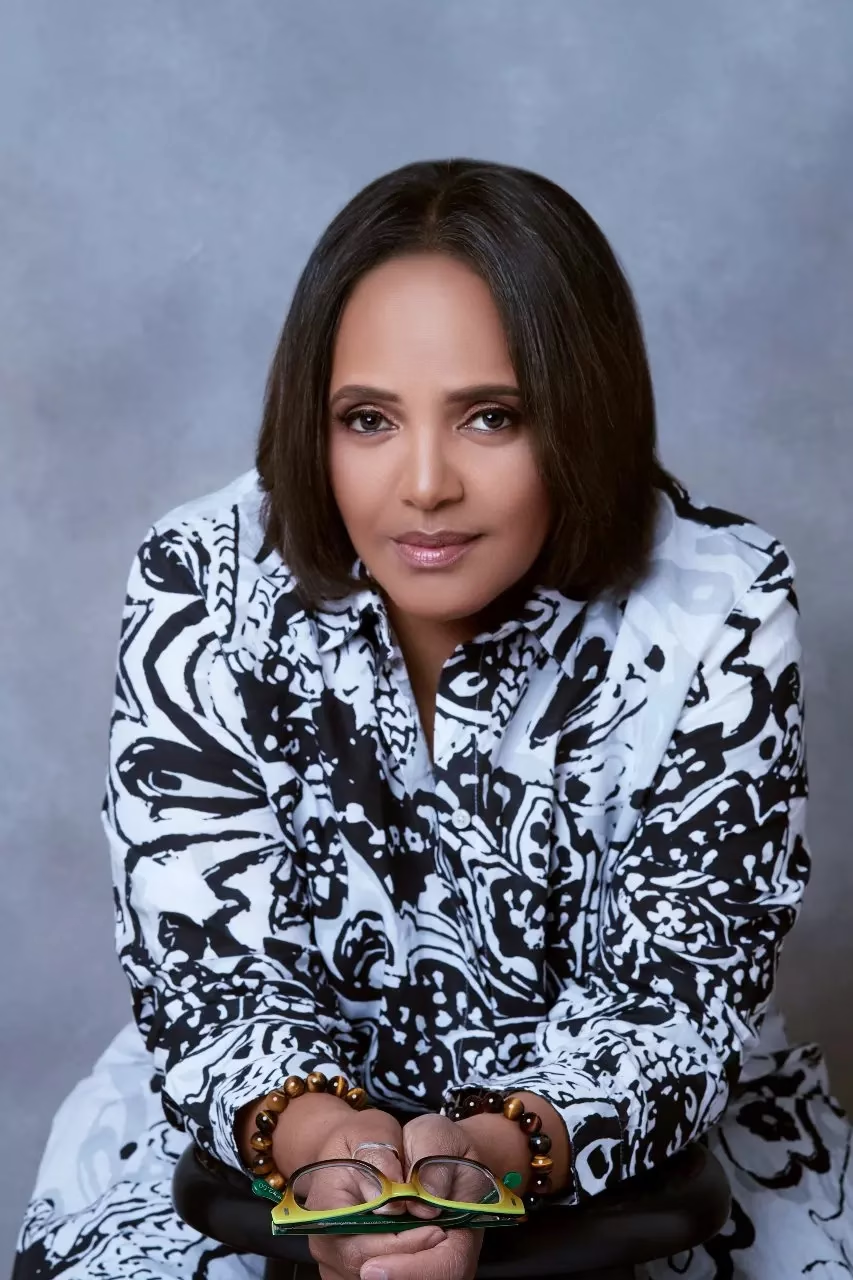
*Terri Lyne Carrington. Photo: Michael Goldman*
The River Of Tradition
Matthew Stevens, who plays in Carrington's ensemble Social Science, sees her work through the lens of the lineage. He names a few stupendous, highly compositional drummers before her: Roy Haynes, Tony Williams, Elvin Jones, and her personal mentor, Jack DeJohnette.
"She has a certain way of playing time that's really rare by today's standards," Stevens tells GRAMMY.com. "And I think it's just by virtue of coming up under and playing with the mentors that she played with."
The path to DeJohnette came by way of Carrington's early life, when her father exposed her to heavy-grooving records, including those by James Brown and organ trios led by Jimmy Smith, "Brother" Jack McDuff, and Richard "Groove" Holmes.
"The velocity of drummers — of pushing a band — that was my foundation," Carrington says. From there, she analyzed the mechanics of timekeeping, and the concept of interweaving drums through the music in a perpetual flow of organized improvisation.
"I don't feel like I even like to solo," she adds, "because I feel like I'm soloing through everybody else's solo." And all of these concepts are in abundance within DeJohnette, a two-time GRAMMY winner and one of the most revered jazz drummers of the 1970s and beyond.
A Mentor In DeJohnette
Among other accomplishments during his long and storied career, DeJohnette has played on electric Miles classics like Bitches Brew, worked with saxophone luminaries like John Coltrane, Jackie McLean and Charles Lloyd, and cut albums in various contexts for ECM Records. And contemporary offerings like 2016's In Movement show that his abilities remain undimmed.
DeJohnette and Carrington met when she was about 16, by the elder drummer's estimation. From early on, her budding mentor encouraged see the big picture in music, and the value of people — and she not only listened to his counsel, but ran with it.
"We wouldn't really talk about the drums, necessarily, but we listened to music," he tells GRAMMY.com. "She's got her own sound and her own approach, and she started expanding… She learned how to be a good leader, and to get the most out of the musicians she worked with. That's what a good drummer does — inspire the players to forge ahead."
"He's just a really well-rounded drummer who's very organic, and I think that's what I related to with his playing," Carrington says. "He was very open, he could play free — he could play straight-ahead, of course, and could play funky stuff. So, I was very much inspired by him."
Watching Carrington do her thing live, you'll see one of DeJohnette's axioms play out: "We're always trying to be free within the boundaries."
"I like to keep stretching and pushing the boundaries as far as I can, so you're remaining open and can figure out organically: What's the next thing I can do to take the music someplace else?" Carrington says. "It's always about a journey and a mystery: How do I find a mystery? What can I do at this moment to bring things together, or mess things up in a good way, or inspire somebody else, or inspire myself to play something I feel really good about?"
Carrington was asking herself these questions when she performed in Detroit with saxophonist Wayne Shorter, bassist and vocalist Esperanza Spalding, and pianist Leo Genovese — which was just released on Sept. 9 as Live At The Detroit Jazz Festival 2017.
Her Connectivity In Action
The titanic (and sadly underheralded) pianist and composer Geri Allen was supposed to be on the gig; on June 27 of that year, she had passed away at only 60. In mourning, the reconstituted quartet decided to perform her "Drummer's Song" and dedicate the evening to her.
In this context, the boundaries were partly dictated by these four specific musicians from differing generations, and their matrix of memories and inspirations related to Allen.
"She was looking forward to that show; I remember we were talking about it," Carrington rues. "But the four of us have a strong history in varying ways. There was a lot of love on this stage, and a lot of trust, and a lot of knowledge about each other musically and personally; we've played together a lot."
What transpired on that stage — as you can hear on the record — is what happens when Carrington's the rhythmic core of any ensemble; it takes on a majestic logic of its own.
After the show, "I remember Esperanza, Leo and I kind of looked at each other without saying anything. We all gave that look of, 'Did you feel it, too? Did you feel what I felt?' … It's kind of a lifetime of preparation that sometimes comes together on a certain evening."
That unshakeable integrtion — not just with her fellow musicians, but those before her — permeates all facets of Carrington's work. As the Founder and Artistic Director of the Berklee Institute of Jazz and Gender Justice since 2005, she, in the words of her online bio, "teaches, mentors, and advocates for musicians seeking to study jazz with racial justice and gender justice as guiding principles."
How did social justice come to be part and parcel with Carrington's career? She says it was incremental — and predated her position at said collegiate institute.
A Swell Of Empathy
"I started having empathy for people who had experiences I didn't experience," she recalls. "If a woman came up to me and said, 'I'm having this trouble,' I would just give her advice based on my life, which I realized was not the right thing: 'Oh, just plow through. Just be the best.' Or, 'You can; just don't pay attention to that!'"
This enhanced consideration of discrepancies felt across the gender and racial spectrum led Carrington on the path to New Standards. "Then, you start thinking about animal justice or environmental justice," she says. "All the other things that you want to be involved with, or concerned about, so you leave the planet better than when you found it, if that's possible."
This value system is harmonious with that of the Recording Academy, which continually fights for the rights of all music people through MusiCares, Advocacy, and many other outlets. And naturally, Carrington was a prime candidate for their Board of Trustees, where she served for two terms.
And given her positive experience, she's thinking of getting involved again.
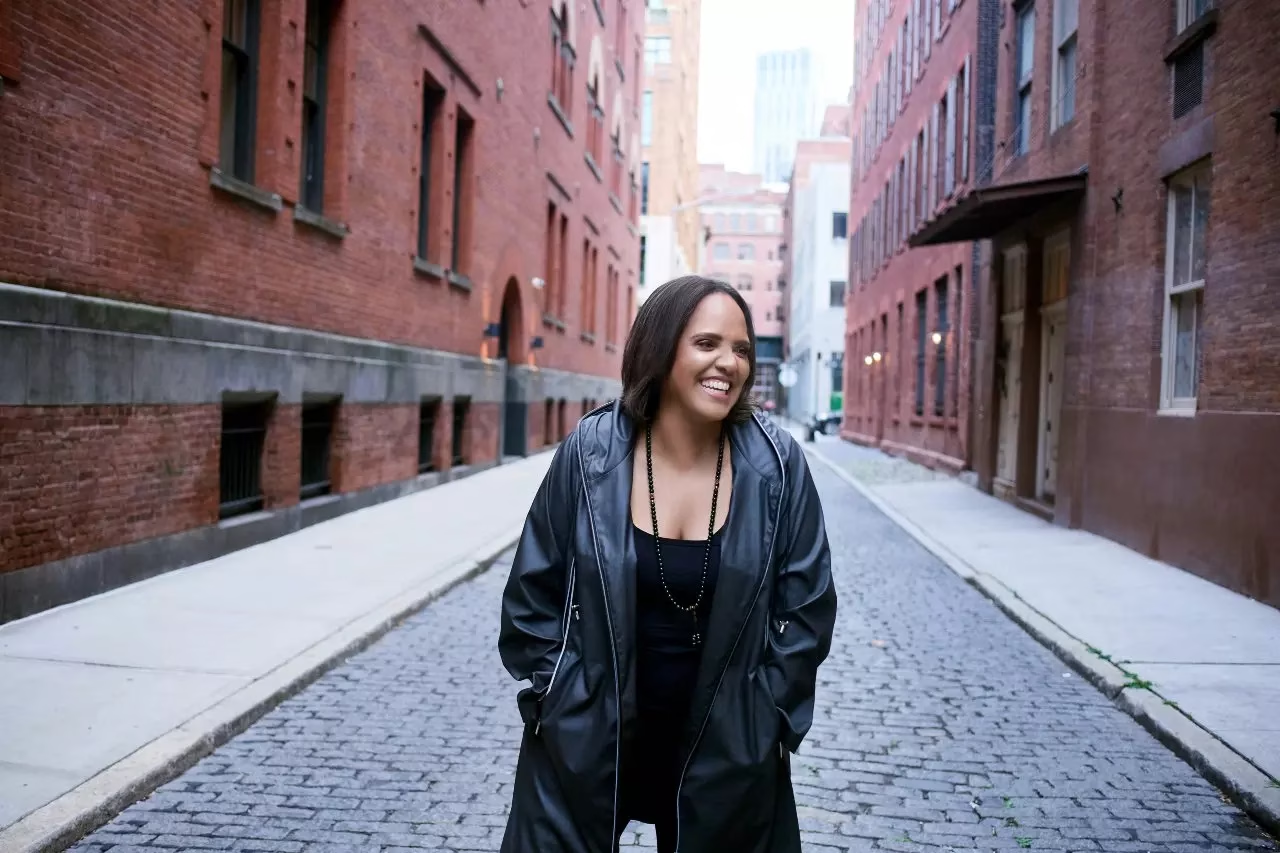
*Terri Lyne Carrington. Photo: Michael Goldman*
"I just termed out as a trustee, but I learned a lot and became a voice for the things that I'm concerned with, which tend to be on the margins," she says. "Just think jazz; that's on the margins when you think about the Academy, because it's such a small percentage of consumed music and the mentorship."
Reflecting on her time with the Academy, Carrington cites a common flaw in public understanding of the organization.
"Everybody wants to win a GRAMMY, but a lot of people either don't join, or don't vote, or don't get involved," she says. "The best way to do that is to get involved and understand the organization — and the biggest thing is to serve."
Translating this advice into action, Carrington has worked under the organization's umbrella to continue pushing for constructive change. Of course, you don't need to play an instrument — much less master one — to do that.
But Carrington has. Which means the heartbeat of her values — and how she relates to and communicates with her fellow musicians — rings out for all who will listen.
"A Bridge Between Worlds"
"She's a visionary, and most likely the hardest-working person I know," bassist Linda May Han Oh, who performed on new STANDARDS vol. 1, tells GRAMMY.com.
Oh calls Carrington "a bridge between worlds" capable of bringing disparate people and communities together for the love of music-making: "She's able to connect like-minded musicians who may not even be from the same genre, from the same style."
Russell Ferrante, the only remaining original member of GRAMMY-winning jazz-fusion greats Yellowjackets, thinks back fondly on Carrington's period of working with the band in the early 2000s.
"She's a beautiful human being, someone you are drawn to and can easily connect with," he tells GRAMMY.com. But this interpersonal amenability never translated to meek or docile playing — far from it.
"She's such an exciting and explosive drummer, never playing it safe," Ferrante adds, remembering working with her quartet in tandem with her Yellowjackets affiliation. "I quickly realized her music demanded a heightened level of focus and listening. So much is implied in her playing, and a momentary lapse of focus and concentration came at your own peril!"
"Her intuition is in alignment with Linda and I," Davis says about making music with Carrington. "That push-and-pull, with drama and creating a storyline in the music."
That word — "storyline" — piques curiosity. Especially when considering Carrington's role in the music community, whether she's shaping the flow of an ensemble, mentoring young talent or changing the game via lead-sheet representation for women.
Because Carrington isn't just telling a story within the bounds of a composition, or a gig, or a record date, or even her catalog in its entirety. Her wider story could involve all of us.
One Night In The Eyes Of Eternity: How In Common III Speaks To Jazz As An Intergenerational Form