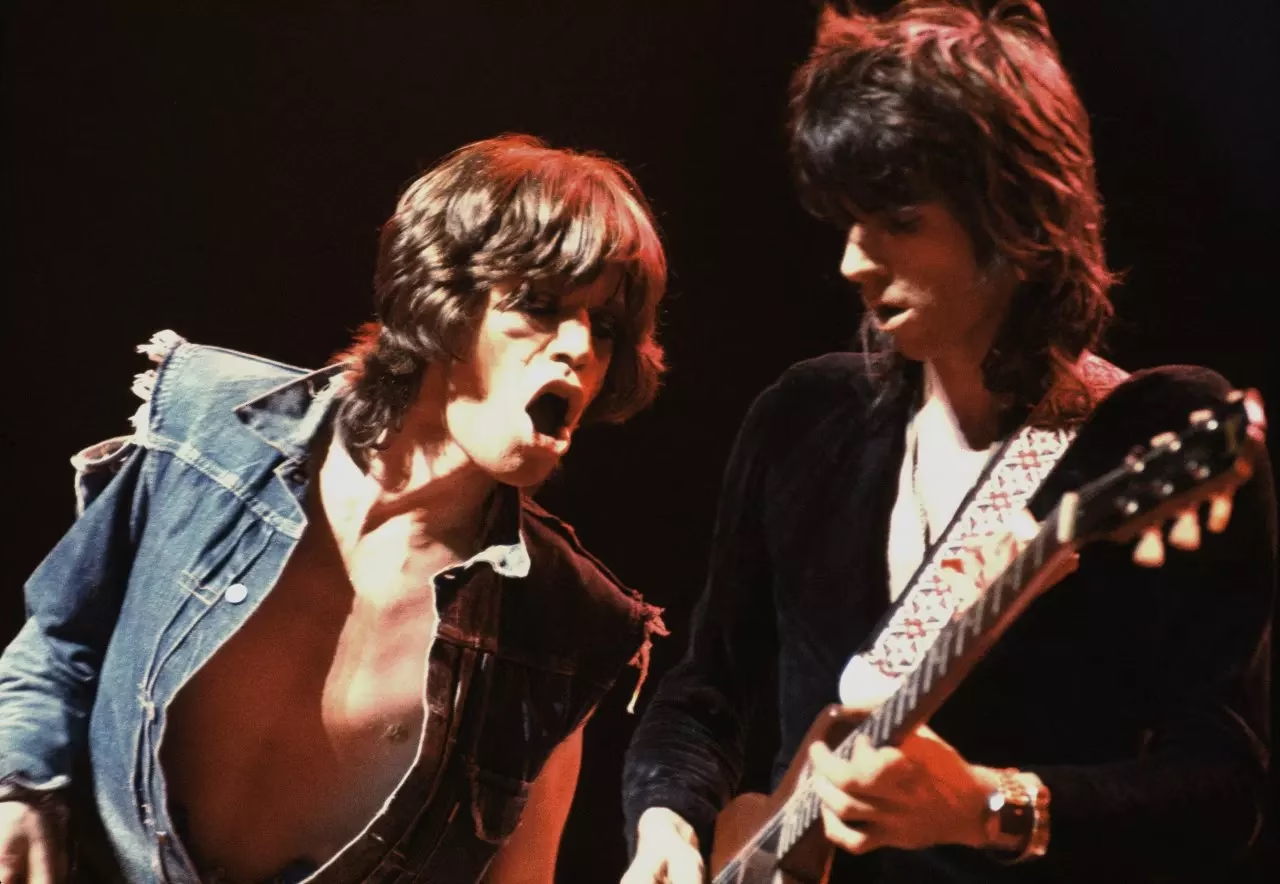
Energetically speaking, the Rolling Stones' 1970s run is something of a reverse parabola — it goes up, and then down.
After 1968's acoustic-focused Beggars Banquet — basically their Led Zeppelin III — and 1969's blues-drenched Let it Bleed, the Stones really started to burn rubber. 1971's gloriously decadent Sticky Fingers was the final ramp-up to their arguable masterpiece: the following year's Exile on Main St.
Across four greasy sides, the Stones went from riotous, disheveled fun to Sunday morning-style ache and longing: it seemingly contains the totality of the Glimmer Twins' art in microcosm.
As Exile on Main St. was such a skyscraping achievement, it's natural to wonder if what followed was a downturn. Enter Goats Head Soup, its 1973 follow-up, which turns 50 today.
Lumpy and undulating, Goats Head Soup is mostly known as the album that gave us their No. 1 ballad "Angie"; "Doo Doo Doo Doo Doo (Heartbreaker)" also broke the Top 20 on the Hot 100. On the main, it's an elliptical, hazy listen — like the strewn detritus from the Exile on Main St. sessions coagulated into a hobbling automaton.
There is no "Street Fighting Man" or "Gimme Shelter" or "Brown Sugar." Instead, we get the crawling "Dancing With Mr. D," the dog-tired "Coming Down Again," and the shaking-apart "Star Star." More than almost any other Stones album, Goats Head Soup is its own universe.
For better or worse, Goats Head Soup is stuck in first gear. But for Stones fans wired a certain way, that's a feature, not a bug.
When the Stones sound exhausted, that's a Stones worth savoring. And despite any number of middling contemporaneous reviews, Goats Head Soup is where this beautiful comedown began. Here are 10 reasons why you should give this sui generis Stones platter a shot.
"Dancing With Mr. D" Is Something Else
From Keith Richards’ deliciously ominous opening riff forward, "Dancing With Mr. D" proves itself to have almost no analog in the Stones’ catalog.
"Yeah, down in the graveyard where we have our tryst/ The air smells sweet, the air smells sick/ He never smiles, his mouth merely twists," Mick Jagger sputters. "The breath in my lungs feels clinging and thick/ The palms of my hands is clammy and wet."
Does Mr. D’s initial stand for death? For devil? Whatever the case, Jagger’s indulging in some macabre fun.
"Coming Down Again" Is A Buzzkill For The Ages
There’s a certain, unforgettable weariness to Keith Richards’ Stones songs, and "Coming Down Again" is something of a downcast masterpiece.
Before you ask, yes, it’s about drugs — these are the Stones in the ‘70s, after all. But take junkie mythology out of the equation, and it’s simply a thing of windswept, head-hung-low beauty.
Dig Billy Preston With The Stones!
In the years following the events of the Beatles’ Get Back documentary, keyboardist Billy Preston was in demand as a session cat: he appeared on solo albums by three of four Beatles, as well as those by Sly and the Family Stone, Joe Cocker, and — yes — the Stones.
Preston had previously appeared on Sticky Fingers and Exile on Main St.; on "100 Years Ago," he plays inspired clavinet, and on "Doo Doo Doo Doo Doo (Heartbreaker)," he doubles the clavinet with piano. Speaking of…
Minor Hit "Doo Doo Doo Doo Doo (Heartbreaker)" Remains Satisfying
Despite its kicked-up tempo, "Doo Doo Doo Doo Doo (Heartbreaker)" doesn’t exactly rock; it simmers and hovers.
Lyrically, it presents mirror examples of urban tragedy: a young man shot by police in a case of mistaken identity, and a 10-year girl who ODs in an alley. But a ripped-from-the-headlines "Hurricane"-style story song it isn’t.
Decades later, Jagger denied any specific, real-world inspiration, chalking it up to "New York as a violent place. America as a heavy-handed police state.
"We can go back 100 years and it's probably even heavier," Jagger continued. "Obviously, all that time ago it was heavy in a lot of places, heavy now and heavy before."
"Angie" Is Immortal For Very Good Reasons
Who is Angie? Is it Angela Bowie? Marianne Faithfull?
This talk can safely be consigned to the rock lore archives, as it’s beside the point: "Angie" is simply a gorgeous song. (Although your mileage may vary with Jagger’s whispering.)
For an expert appraisal of what makes this majestic — and wildly popular — single tick, check out Rick Beato’s analytical YouTube video, for his What Makes This Song Great? series.
Much Of The Bluster Had Worn Off
Yes, we come to the Stones for cocksurity and bravado, but it’s arguably even more interesting when those qualities lose their luster.
Take two of the most horny cuts: "Silver Train" is about a prostitute; "Star Star" is about a groupie. But rather than sound hyped-up, they sound fragile, like machismo is an old costume that didn’t fit them at that moment.
Giles Martin Has Freshened Up Goats Head Soup
As a Beatles remixer, Giles Martin didn’t fall far from the tree; his father, of course, was iconic Fabs producer George Martin.
After making his mark with Sgt. Pepper’s, Abbey Road and the like, Martin has begun working with other camps — the Stones included.
His 2020 remix of Goats Head Soup wipes away the grime and reveals its vulnerable, autumnal heart. Truly, despite its mixed-bag reputation, this stew has never been so savory.