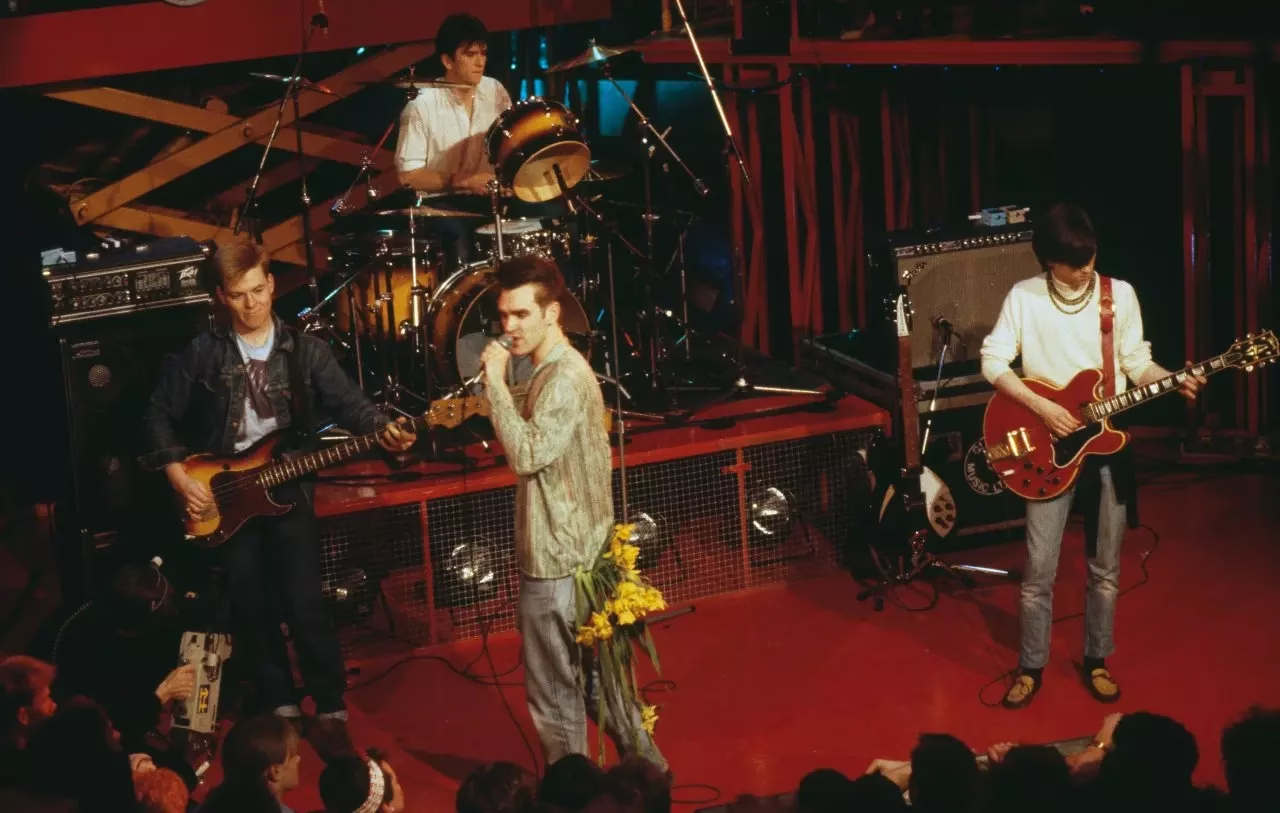
In the annals of rock history, how many artists seem to foreshadow all of indie, in some way? One was Buddy Holly; from the glasses to the Strat to the attitude, his short career was like a split atom that produced nuclear fission. And, arguably, there was one other: the Smiths.
Their fey, idiosyncratic and devastatingly witty frontman, Morrissey — born Steven Patrick Morrissey — was fully himself right out of the box. From his baritone voice to his ambiguous sexuality, Moz set the prototype of unconventional, underdog frontmen for good.
His foil, Johnny Marr, played resplendent jangle guitar, with harmonic shades of light and shadow that played off Morrissey's sweet-and-sour musings. Their perennially underrated bassist, Andy Rourke, was supple and tensile. And rock-solid drummer Mike Joyce provided the tasteful foundation, with anthemic flourishes in his fills that made the tunes pop.
The world was introduced to the Smiths via, well, The Smiths — their debut album, released on Feb. 20, 1984 via Rough Trade Records.
Across their four-album discography — plus some must-have compilations, like Hatful of Hollow and Louder Than Bombs — the Manchester-based group would develop in a very short time — and split apart in short order, in 1987. But if, on Feb. 21, 1984, a double-decker bus crashed into the foursome, their role in rock history would still be ironclad.
From the gorgeous, sprawling "Reel Around the Fountain" to the sexually palpitating "This Charming Man" to the stony-yet-sparkling "What Difference Does It Make?", The Smiths paved the way for the Stone Roses, Radiohead, Oasis, and so many more Brits with a way with melody and a screw loose.
And their literary inspirations, melancholia and navel gazing also inspired a generation of emo and goth groups — including acts on the other side of the pond, like the National, Ryan Adams, Billie Eilish, and Low.
How did they accomplish this? Partly due to their visual aesthetic — simple, striking typography, against grayscale photography of anonymous figures, typically men. (Take a spin through Belle and Sebastian's discography, and you tell us whether they were influenced.)
The cover of The Smiths depicts gay sex symbol Joe Dallesandro; he's topless and a curtain of hair obscuring his face; his extremities are cut off by the camera, Venus de Milo-style. The image speaks to both the play with sex and gender in the lyrics, and the band's quotidian personae.
Despite its subject, the cover of The Smiths doesn't scream starpower; it looks ripped out of a moldering magazine. Which completely jibes with the music — glimmering yet murky, seemingly anti-produced in places. That vibe was the point from the beginning — hence their band name.
"It was the most ordinary name," Morrissey once said, "and I thought it was time that the ordinary folk of the world showed their faces." And throughout The Smiths, Moz sings about those ordinary folk — their traumas, their abuses, their sexual hangups.
The Smiths being the Smiths, well, it got dark. The gently unspooling opener "Reel Around the Fountain" is about a sexual experience with an older partner; tabloids wondered aloud if it was about pedophilia. "The Hand That Rocks the Cradle" connotes child murder. To say nothing of the knife-twisting closer "Suffer Little Children."
But despite their critical reputation as "miserablists," it's not all pitch-black. "Still Ill" addresses the decriminalization of gay sex in the United Kingdom — an early glimmer of political consciousness for the band that would go on to make Meat is Murder. And the gorgeous "Hand in Glove" — with haunting harmonica blowing through it — is about love slipping away, with a queer tint.
What also makes The Smiths resonate? Partly what they didn't do. In the most synth-choked era of pop/rock, at the tail end of the UK's new romantic movement, The Smiths' guitar-bass-drums starkness was like bare brick against gaudy wallpaper.
Unincumbered by overwrought sonic trappings, the Smiths' hilarious, harrowing vignettes stick with you from the first listen. Clearly, that unadorned aural aesthetic stuck for decades, with numberless acts — and to a great degree, you can thank Moz and company.
So many terrific artists take a few records to become themselves, but not the Smiths. No, with their classic debut, you get everything now — including the ocean of indie in its wake.